

A nurse manager once described her typical Monday morning: she spent the first ninety minutes tracking down shift confirmations on WhatsApp, resolving two last-minute swap requests, and manually updating a spreadsheet roster before she could focus on anything clinical. This wasn’t an understaffed hospital, it was a 120-bed private hospital in Pune with a dedicated HR team.
The problem isn’t a people problem. It’s a systems problem. Healthcare workforce management is genuinely different from every other industry. Hospitals run 24 hours a day across three or four rotating shifts. Nurses and technicians have certifications that expire and must be tracked. A single understaffed shift in an ICU isn’t an inconvenience, it’s a patient safety issue. Night shift allowances, mandatory rest periods between shifts, NABH documentation requirements, and compliance across the Factories Act, Clinical Establishments Act, and state Shops Acts all need to work together.
Generic HR software built for 9-to-6 office teams handles maybe half of this well. This guide covers eight tools that are actually relevant for Indian hospitals and clinics in 2026 large hospital chains to single-specialty clinics with honest notes on what each one does well and where it runs out of steam.
What HRMS Looks Different in Healthcare
Before comparing tools, it’s worth naming what specifically makes healthcare HR harder because these are the features that should drive your evaluation, not generic things like ‘easy payroll’ or ‘mobile app’.
- 24/7 rotating shifts. Morning (6–7 AM to 2–3 PM), evening (2–3 PM to 10 PM), and night (10 PM to 6–7 AM) shifts rotate among staff, usually on a monthly cycle. The system needs to enforce minimum rest periods between shifts scheduling a nurse for a night shift followed immediately by a morning shift is both non-compliant and dangerous.
- Department-wise rostering. OPD, IPD, emergency, ICU, OT, lab, pharmacy, and housekeeping each have different staffing requirements, different qualification prerequisites, and different minimum headcounts per shift. A blanket roster doesn’t work you need department-level shift management.
- Credential and license tracking. NMC (Nursing and Midwifery Council) registration, state nursing council certificates, BLS/ACLS certifications for ICU staff, specialist board certifications for doctors all of these expire and must be renewed. Scheduling a nurse with an expired state council registration is a regulatory liability. The HR system should flag this automatically before it becomes an inspection issue.
- Mixed workforce types. A 100-bed hospital typically employs full-time doctors, visiting consultants (who bill per visit), contract nurses from a staffing agency, in-house housekeeping staff, and permanent administrative employees all in the same building, with different payment structures, different PF/ESI applicability, and different leave policies. The HRMS must handle all of them cleanly.
- Night shift allowance and overtime. Night shift workers earn an allowance on top of their base salary. Overtime beyond scheduled hours must be paid at double the ordinary rate under the Factories Act and OSH Code. These need to calculate automatically from attendance data manually calculating them for 80 nurses at month end is where payroll errors consistently happen.
- NABH compliance documentation. NABH (National Accreditation Board for Hospitals) audits include HR documentation: training records, competency assessments, credential files, and staffing ratio compliance. If you want or maintain NABH accreditation, your HRMS needs to support the documentation requirements.
| The question to ask every vendor: Does your shift scheduling enforce minimum rest periods between shifts and does it flag understaffed shifts before they start rather than after? Any vendor who says ‘yes’ should be able to show you this in a live demo with a healthcare scenario, not a generic office example. |
1. Waggex Best for Clinics, Nursing Homes, and Small Hospital Chains
| Quick Overview | |
| Founded | 2022 |
| Best for | Clinics, diagnostic centres, nursing homes, day-care centres, small hospitals (5–100 staff) |
| Healthcare strengths | Shift management with multi-shift support, GPS + FaceLens attendance for mobile staff, attendance-to-payroll direct connection |
| Indian compliance | PF, ESI, TDS, multi-state Professional Tax all automated |
| Free plan | Yes up to 10 employees |
| Pricing | ₹699/mo (10 emp) · ₹1,499/mo (25 emp) · ₹2,499/mo (50 emp) · ₹3,999/mo (100 emp) |
| Website | waggex.com |
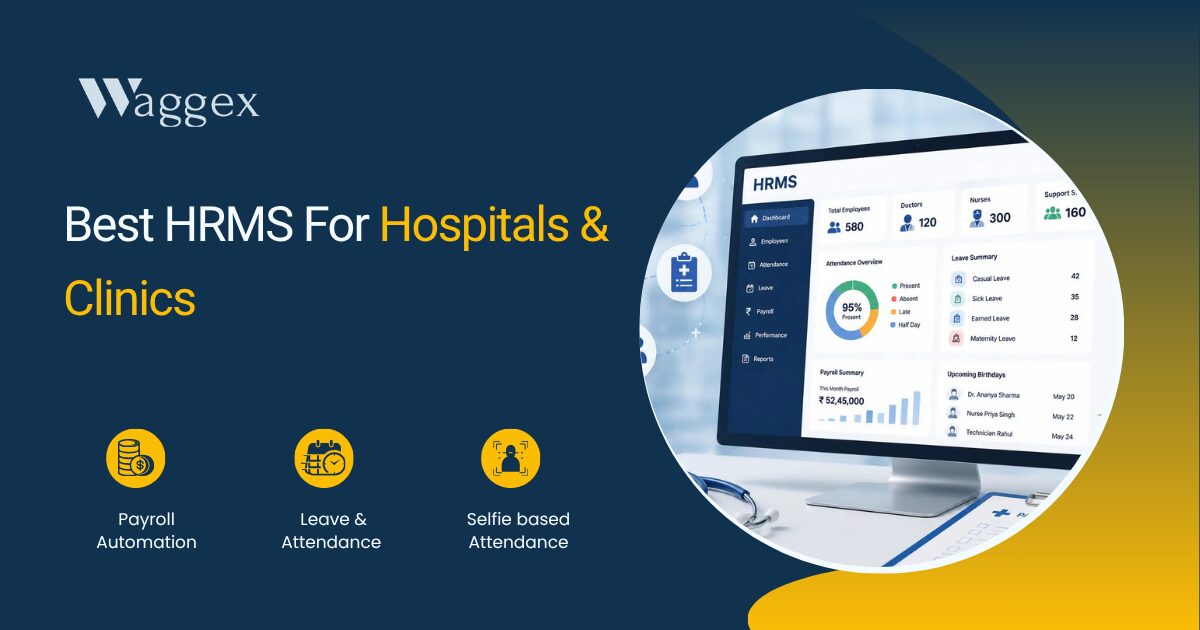
Waggex isn’t a healthcare-specific HRMS and it’s worth being upfront about that. It doesn’t have AI nurse rostering or credential expiry tracking built in. What it does have, and does very well for smaller healthcare facilities, is: shift management that works, attendance that connects directly to payroll without a manual step, and Indian statutory compliance that handles PF, ESI, TDS, and Professional Tax automatically.
For a clinic with 15–40 staff running two or three daily shifts morning OPD team, afternoon team, emergency on-call Waggex’s Shift Management handles rotating schedules, shift allowances, overtime flagging, and comp-off tracking. The FaceLens selfie attendance means no biometric machine to maintain nurses check in on their own phone, face verified on our server. The check-in goes directly into payroll no HR person manually reconciling attendance against a salary sheet before the 1st of every month.
Practical use case: A 35-bed nursing home in Nagpur. Three nursing shifts daily, 28 nurses, 8 administrative staff. Before Waggex, the nursing manager was managing shifts on WhatsApp and the accounts team spent two days before payroll reconciling attendance manually. After switching, shift schedules go out in the app, staff check in via FaceLens, and payroll runs from verified data. Night allowances for the C shift calculate automatically. The two-day reconciliation became a thirty-minute review.
✓ Strengths
| ✗ Watch out for
|
2. HROne Best for Mid-to-Large Hospital Chains with Complex Rosters
| Quick Overview | |
| Founded | 2012 |
| Best for | Multi-specialty hospital chains, 100–5,000 staff |
| Healthcare strengths | AI nurse rostering with skill and certification validation, credential expiry tracking, WhatsApp-based attendance for support staff |
| Indian compliance | Full PF, ESI, TDS, PT, LWF; multi-entity PF/ESI on one instance |
| Free plan | Trial only |
| Pricing | ~₹85/employee/month (custom for hospital chains) |
| Website | hrone.cloud |
HROne is the most healthcare-specific major HRMS in India in 2026. Its AI nurse rostering doesn’t just fill slots it validates that the person being scheduled has the right skill classification and current certification for that shift. Scheduling an ICU shift? The system checks the nurse’s ACLS certification status before confirming. If it’s expired, the shift is blocked and the credential team is alerted, not after the nurse shows up but before the roster is even published.
For hospital chains with multiple units across states, HROne runs all entities on a single instance separate PF/ESI/PT/TDS configurations per unit, unified HR records, consolidated reporting. The WhatsApp-based attendance option is particularly useful for housekeeping and support staff who are less comfortable with a dedicated app.
Practical use case: A 300-bed multi-specialty hospital in Hyderabad with three units across Telangana. HROne manages rotating rosters for 280 nurses across all three locations, validates certifications before shift assignment, tracks mandatory rest periods, and calculates night allowances automatically. The NABH documentation audit trail is maintained in the same system. HR teams from all three units work in the same dashboard with unit-wise access controls.
✓ Strengths
| ✗ Watch out for
|
3. factoHR Best for Shift-Heavy Hospitals with Deep Compliance Needs
| Quick Overview | |
| Founded | 2005 |
| Best for | Manufacturing-adjacent healthcare: hospital laundries, medical device facilities, labs running complex shifts, 100–2,000 staff |
| Healthcare strengths | Deepest rotating shift management and contract labour handling in Indian HRMS market |
| Indian compliance | Deepest in class PF, ESI, PT, LWF, CLRA, Form 16, multi-state |
| Free plan | Trial only |
| Pricing | ₹4,999/mo (Core) · ₹5,999/mo (Premium) · ₹6,999/mo (Ultimate) |
| Website | factohr.com |
factoHR wasn’t designed specifically for healthcare it was built for manufacturing, where complex shift patterns, contract labour compliance, and biometric attendance are the norm. As it turns out, large Indian hospitals share many of these challenges. A 500-bed hospital with housekeeping on agency contracts, nurses on rotating shifts, and resident doctors on a separate schedule operates similarly to a large factory floor from an HR complexity standpoint.
factoHR’s specific strengths for healthcare: it handles contract labour alongside permanent employees in the same payroll run, its rotating shift patterns are among the most configurable in the Indian market, and its compliance depth CLRA (Contract Labour Regulation and Abolition Act), PF, ESI, LWF covers the statutory obligations that hospital chains with agency staff must manage.
Practical use case: A corporate hospital group in Chennai with 400 employees 180 permanent clinical staff, 120 contract nurses from a staffing agency, 100 housekeeping staff on another contractor’s rolls. factoHR manages all three categories, handles joint PF/ESI liability for contract labour correctly, and processes all payroll in one monthly run. Customer support quality consistently rated highly on G2 matters here because payroll errors affecting 400 healthcare workers have operational consequences.
✓ Strengths
| ✗ Watch out for
|
4. SalaryBox Best for Nursing Homes and Diagnostic Centres
| Quick Overview | |
| Founded | 2017 |
| Best for | Nursing homes, diagnostic centres, standalone clinics, 20–200 staff |
| Healthcare strengths | AI face recognition attendance, optional hardware device, GPS for visiting staff, full payroll integration |
| Indian compliance | Full PF, ESI, TDS, PT |
| Free plan | Trial only |
| Pricing | ₹35/employee/month. Hardware device: ₹15,000–22,000 (optional) |
| Website | salarybox.in |
SalaryBox has a feature that directly addresses a common healthcare problem: it offers both a mobile face recognition app and an optional hardware face recognition device both connecting to the same cloud payroll. For a hospital, this translates to a device at the main gate for high-volume shift entries (morning nurse changeover when 30 people arrive within fifteen minutes) and the mobile app for visiting consultants, home nursing staff, and admins who aren’t passing through a fixed point.
The AI face recognition includes anti-spoof detection, which matters in a healthcare context where proxy attendance is a real risk for shift-based support staff. Offline GPS sync means attendance still captures even in basement areas or parts of a building with weak signal.
Practical use case: A 60-bed nursing home in Ludhiana. Gate device handles the nursing and housekeeping staff arriving for shift change. Three home-visiting nurses check in via GPS + FaceLens from patients’ addresses. All attendance flows into a single monthly payroll run. The administrator confirmed that night shift allowances and OT now calculate without manual work.
✓ Strengths
| ✗ Watch out for
|
5. greytHR Best for Compliance-Critical Multi-State Hospital Trusts
| Quick Overview | |
| Founded | 2009 |
| Best for | Hospital trusts, charitable hospitals, multi-state chains where compliance accuracy is non-negotiable |
| Healthcare strengths | Deepest Indian statutory compliance track record; Visage selfie attendance add-on; leaves and compliance built for complex workforces |
| Indian compliance | ✓✓ Deepest 15+ years, 30,000+ companies |
| Free plan | Yes up to 25 employees (Starter plan with real payroll) |
| Pricing | Free (25 emp) · Paid from ~₹3,495/mo flat · Attendance needs Growth plan |
| Website | greythr.com |
greytHR has been processing Indian payroll since 2009. Its compliance depth PF ECR files, ESI challans, Form 130 (updated Form 16), multi-state PT is more tested than any other tool in this list. For a hospital trust operating across Maharashtra, Karnataka, and Tamil Nadu with different PT rates and state-specific Shops Act provisions in each, greytHR’s multi-state compliance handling is genuinely reliable in a way that newer platforms are still proving.
The Visage module adds selfie attendance with geo-tagging and anti-spoof detection. The free Starter plan 25 employees with real payroll is genuinely useful for very small clinics or individual doctor practices that are mostly concerned with compliance accuracy.
Practical use case: A charitable hospital trust running three hospitals in Maharashtra and Tamil Nadu. Different PT rates (Maharashtra ₹2,500/year vs Tamil Nadu ₹1,200/year), different Shops Act provisions, different leave entitlements by state. greytHR manages all three entities with correct state-wise compliance for each, generating unified reports for the trust board while maintaining separate statutory filings per unit.
✓ Strengths
| ✗ Watch out for
|
6. Keka Best for Private Clinics and Admin-Heavy Hospital Departments
| Quick Overview | |
| Founded | 2015 |
| Best for | Private specialty clinics, diagnostic chains, hospital admin departments; 100–500 employees |
| Healthcare strengths | Best UI in the list employee self-service reduces admin queries; GPS geo-fencing and face attendance available; strong leave management |
| Indian compliance | Full PF, ESI, TDS, PT |
| Free plan | Trial only |
| Pricing | ₹6,999/month flat (up to 100 employees) |
| Website | keka.com |
Keka earns its place on this list not for healthcare-specific features but for the problem it solves best in clinical administration: employee self-service that actually gets used. When 120 employees can check their payslip, apply for leave, and see their shift schedule from their phone without calling HR the HR team’s inbox empties considerably. In a hospital, where HR is often managing alongside operational crises, this matters more than the headline feature list suggests.
Keka’s shift management handles rotating schedules, attendance flows into payroll, and leave management connects to LOP deductions automatically. It won’t manage nurse-to-patient ratios or credential expiry but for a private specialty clinic or the administrative wing of a large hospital, it’s the most polished experience in this list.
Practical use case: A 40-doctor private ophthalmology chain with three locations in Bengaluru. Doctors, optometrists, counsellors, and admin staff all on different schedules and salary structures. Keka manages attendance, leave, and payroll across all three locations. The employee app reduced HR-related WhatsApp messages by more than half within the first month of rollout mostly leave balance questions that employees can now check themselves.
✓ Strengths
| ✗ Watch out for
|
7. Darwinbox Best for Corporate Hospital Groups and Large Chains
| Quick Overview | |
| Founded | 2015 |
| Best for | Large corporate hospital groups, 500–10,000+ staff, enterprise-scale operations |
| Healthcare strengths | Advanced workforce analytics, multi-entity HR, AI-driven insights, deep integration capabilities with HIS systems |
| Indian compliance | Full enterprise-scale compliance across all states |
| Free plan | None |
| Pricing | Enterprise custom typically ₹32L–₹55L/year for mid-large deployments |
| Website | darwinbox.com |
Darwinbox is India’s most prominent enterprise HRMS. It’s used by several large hospital groups and healthcare conglomerates. At enterprise scale think a 2,000-bed hospital network with fifteen hospitals across eight states Darwinbox’s workforce analytics, multi-entity architecture, and integration with HIS (Hospital Information Systems) via REST APIs becomes genuinely valuable. You can see revenue-per-bed versus staffing cost per department. You can run attrition prediction for nursing staff. You can consolidate HR data across all entities in one board-level dashboard.
The honest caveat: Darwinbox is enterprise-priced and enterprise-complex. Implementation runs 3–6 months minimum. For a 200-bed hospital, it’s probably over-built but for a Fortis or Apollo-scale operation, it’s worth evaluating.
✓ Strengths
| ✗ Watch out for
|
8. Mewurk HRMS Emerging Option for Small Hospitals and Diagnostics
| Quick Overview | |
| Founded | 2020s |
| Best for | Small hospitals, diagnostic centres, path labs, 15–150 employees |
| Healthcare strengths | Biometric + face recognition attendance; shift management; AI-based performance assessments; healthcare use case focus in design |
| Indian compliance | Full PF, ESI, TDS, PT |
| Free plan | Trial |
| Pricing | Custom SME pricing contact vendor |
| Website | mewurk.com |
Mewurk is a newer entrant that has been specifically noted for healthcare use cases in Indian industry publications. It brings attendance, leave, shift management, payroll, document storage, and AI-based assessments into a single platform. Biometric integration and face recognition attendance are included. Industry observers have flagged it as genuinely well-suited for smaller healthcare environments that need more than a basic payroll tool but can’t justify an HROne or Darwinbox implementation.
We’re including it here with the honest caveat that it’s less established than the others in this list fewer documented case studies, smaller support network. Worth requesting a demo if you’re a 30–100 person diagnostic centre or small hospital, but verify support response times before committing.
✓ Strengths
| ✗ Watch out for
|
All Eight Tools: Quick Comparison
Here’s everything side by side for easy scanning before you shortlist.
| Tool | Best For | Shift Mgmt | Nurse Roster | Indian Compliance | Pricing | Ideal Facility Size |
|---|---|---|---|---|---|---|
| Waggex | Clinics, nursing homes, day-care centres | ✓ Full | Basic | ✓ PF/ESI/TDS/PT | ₹699/mo+ | 5–100 staff |
| HROne | Mid-large hospital chains | ✓ AI rostering | ✓ Skill-validated | ✓ Full | ~₹85/emp/mo | 100–5,000 staff |
| factoHR | Hospitals with complex shifts | ✓ Deep | ✓ Rotating | ✓ Deepest | Custom | 100–2,000 staff |
| SalaryBox | Nursing homes, diagnostic labs | ✓ Good | Basic | ✓ Full | ₹35/emp/mo | 20–200 staff |
| greytHR | Multi-state hospital trusts | Moderate | Moderate | ✓✓ Best compliance | Free–₹3,495/mo | 25–2,000 staff |
| Keka | Private clinics, admin-heavy hospitals | ✓ Native | Moderate | ✓ Full | ₹6,999/mo flat | 100–500 staff |
| Darwinbox | Corporate hospital groups, chains | ✓ Enterprise | ✓ Advanced | ✓ Full | Enterprise custom | 500–10,000+ staff |
| Mewurk | Small hospitals, diagnostics | ✓ Moderate | Basic | ✓ Full | Custom SME | 15–150 staff |
Pricing from vendor websites and third-party sources as of July 2026. Healthcare-specific feature depth varies always request a demo with your actual shift patterns and workforce structure, not a generic demo scenario.
Which HRMS for Which Type of Healthcare Facility
- Single-doctor or two-doctor clinic, <15 staff: greytHR free Starter plan (compliance accuracy, zero cost) or Waggex free plan (if you need shift management for a small team).
- Nursing home or day-care centre, 15–50 staff: Waggex. Shift management, FaceLens attendance, payroll compliance no biometric hardware needed. Free trial, setup in a day.
- Diagnostic centre or path lab, 20–100 staff: SalaryBox (if you want optional hardware at reception) or Waggex (if mobile-first works). Both handle shifts and payroll directly.
- Private specialty clinic or hospital, 50–200 staff: Keka for admin-first facilities with strong employee self-service needs. SalaryBox or Waggex for shift-heavy clinical operations.
- Mid-size hospital, 150–500 staff, compliance is critical: factoHR (complex shifts and contract labour) or greytHR (multi-state compliance accuracy and established track record).
- Multi-unit hospital chain, 300–2,000 staff, nurse rostering matters: HROne. AI roster with credential validation is a healthcare-specific differentiator at this scale.
- Large corporate hospital group, 500+ staff, enterprise analytics needed: Darwinbox. Expensive and complex to implement, but the analytics and HIS integration capabilities justify it at scale.
| One thing before you demo anything: Come with your actual shift pattern. Not ‘we run three shifts’ bring the exact times, the grace periods, the night allowance amount, the OT threshold, and the rotation cycle. Any HRMS vendor worth buying from should be able to show you, in the demo itself, how their system handles your specific configuration. A generic demo that doesn’t touch your actual use case is not a useful evaluation. |
The Bottom Line
The right HRMS for a hospital or clinic isn’t the one with the most features it’s the one that solves the specific problems your workforce actually has. A 35-bed nursing home and a 500-bed hospital chain have almost nothing in common from an HR systems standpoint.
For smaller facilities, the priority is getting attendance connected to payroll without manual work, managing rotating shifts without a WhatsApp thread, and keeping statutory compliance current without a dedicated compliance team. For larger hospital chains, the priority shifts to nurse rostering with credential validation, multi-entity compliance, and analytics that give operations leadership visibility into staffing costs per department.
The one thing every healthcare HR team told us in 2026: the cost of a wrong hire is highest in healthcare, but the cost of a payroll error or a compliance gap is also the most visible because every affected employee is someone whose work directly affects patient care. Get the HR systems right, and the clinical teams can focus on what they came to do.
If you’re running a clinic or nursing home and want to see how Waggex handles shifts, attendance, and payroll for a healthcare team, our free trial gives full access with no credit card. Setup typically takes one working day.