

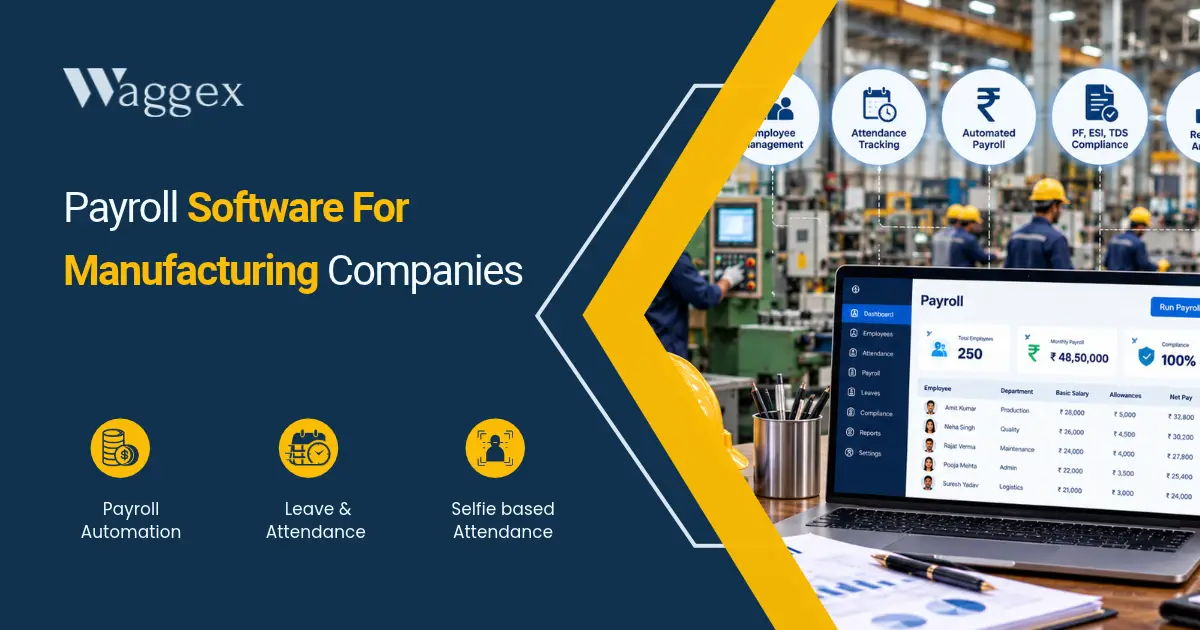
Manufacturing payroll is the most complex category of payroll in India. A typical plant runs three shifts around the clock, employs five different types of workers, operates under the Factories Act and the Contract Labour (Regulation and Abolition) Act, and spans multiple states each with its own minimum wage schedule, Professional Tax rules, and Labour Welfare Fund contribution dates.
A generic payroll tool handles salary components and TDS. That is not enough here. This guide covers what makes manufacturing payroll different, the compliance obligations specific to factories, and what a payroll system needs to handle the whole picture without manual workarounds.
Why Manufacturing Payroll Is Different
Five worker types in the same payroll run. Most manufacturers run a mix of permanent employees on monthly CTC, daily wage workers paid per day attended, fixed-term contract staff, CLRA contract workers supplied by a contractor, and apprentices or trainees on stipend. Each category has different PF applicability, ESI coverage, overtime entitlement, and wage structure. A payroll system that treats everyone as a salaried employee on a fixed monthly pay gets the deductions wrong for four of the five.
Shift-based attendance determines earnings. A late-mark on the A-shift, a double-shift allowance, a night-shift premium (10 PM–6 AM) these aren’t fixed components, they flow from daily attendance data. If the attendance system and payroll system aren’t integrated, someone is keying shift registers into a spreadsheet at month-end, introducing errors at the source.
Overtime rules are stricter under the Factories Act. Under Section 59, overtime in a factory is payable at twice the ordinary rate of wages not 1.5×, not a discretionary amount. The ordinary rate includes basic wages, dearness allowance, and the cash equivalent of food concessions (not just basic pay, as many manufacturers calculate). Section 64 caps overtime at 50 hours per quarter. Factories must maintain an Overtime Register with each worker’s total OT hours before payment is processed. A January 2026 Supreme Court ruling in Union of India v. Heavy Vehicles Factory Employees’ Union confirmed that allowances must be included in the OT base for factory workers any payroll system still calculating OT on basic pay alone is now non-compliant.
| SC ruling January 2026: The Supreme Court held that ‘ordinary rate of wages’ for factory overtime includes all allowances, not just basic + DA. Review your overtime calculation base if you haven’t already. |
Multi-location plants mean multi-state compliance. Plants in Karnataka, Maharashtra, and Rajasthan each bring different PT rules, minimum wage schedules (revised twice yearly in most states), LWF contribution cycles, and factory return deadlines. The compliance calendar becomes the payroll team’s biggest ongoing management task.
The Five Worker Types What Each Needs
| Worker Type | Wage Basis | PF | ESI | Overtime Rule |
| Permanent / on-roll | Monthly CTC | Yes (12%) | Yes if ≤ ₹21K | 2× rate Factories Act Sec. 59 |
| Fixed-term contract | Monthly / daily | Yes | If ≤ ₹21K gross | 2× rate same as permanent |
| Contract labour (CLRA) | Daily wage | Contractor pays (verify) | Contractor pays | Contractor liable; principal employer checks |
| Apprentice / trainee | Stipend | No (apprentice only) | No | Not eligible for OT under Apprentices Act |
| Daily wage / casual | Per day attended | If total ≥ 20 employees | If ≤ ₹21K | 2× rate if Factories Act applies |
| Contract Labour Act (CLRA) liability: When a principal employer engages 20+ contract workers, it must register separately under CLRA. If a contractor defaults on PF or ESI for those workers, the liability falls on the principal employer. Best practice: collect the contractor’s ECR and ESIC challan receipts every month before releasing the contractor’s invoice. |
The Compliance Calendar for Manufacturers
This is the list that causes the most missed deadlines not because teams don’t know the obligations, but because monthly payroll deadlines arrive at the same time as Factories Act return dates, and the two workstreams are usually managed by different people.
| Obligation | Act / Rule | Deadline | Cost of Missing |
| PF (ECR) deposit | Employees’ PF Act | 15th every month | 12% p.a. interest + Section 14B damages up to 25% |
| ESIC deposit | ESI Act | 15th every month | 12% p.a. simple interest |
| TDS deposit | Income Tax Act 2025 | 7th every month | 1.5%/month from deduction date |
| Factory annual return | Factories Act | 31 January | Fine under Section 92, up to ₹2 lakh |
| Factory licence renewal | Factories Act | 31 December | Operating without licence prosecution |
| CLRA registration | Contract Labour Act | Before engagement | Vicarious PF/ESI liability on principal employer |
| F&F settlement | Code on Wages 2025 | Within 2 working days | Interest + compensation under Sec. 17 |
| Minimum wage revision | Code on Wages | State-notified dates | Back pay + penalties per underpaid day |
The Code on Wages (effective November 2025) added the 2-working-day F&F deadline and the 50% basic wage minimum, which raises the PF and gratuity base for any factory that had been running basic at 30–35% of CTC. If your basic wage hasn’t been corrected yet, you are likely underpaying both PF and gratuity contributions.
What the Attendance System Must Do Before Payroll Can Run
In a factory, payroll starts from a muster roll, not a salary structure. Daily wage workers earn by days present; shift allowances apply per slot; overtime comes from time-in/time-out logs. If attendance can’t feed into payroll automatically, the team spends two to three days each month reconciling shift registers before payroll can even begin.
The minimum integration requirement: biometric or facial recognition devices → API or file-based sync → automatic shift, late-mark, and OT rule application → payroll run. Any break in that chain requires manual intervention, and that is where errors enter.
Seasonal hiring adds pressure. A plant that takes on 50 temporary workers before Diwali and offboards them six weeks later needs onboarding, payroll, and F&F in one system UAN generation, ESIC registration, and final settlement all correct for a short tenure.
Registers the Factories Act Requires You to Maintain
Labour inspectors do not audit payroll software, they look at registers. The Factories Act and Contract Labour Act require these to be maintained in prescribed formats, available on demand:
Muster Roll (Form 25): Daily attendance for every worker. Must show name, worker number, shift, in-time, out-time.
Wage Register (Form 19): Monthly wages paid per worker basic, allowances, deductions, net. Signed by worker on payment.
Overtime Register (Form 26): OT hours per worker per day before payment is processed.
Register of Contractors (Form XII): All contractors engaged, their licence numbers, number of workers supplied, PF and ESIC account details.
Leave with Wages Register (Form 16): Leave balance, leaves taken, encashment calculations.
A payroll system that generates these registers automatically, in the prescribed format, eliminates a significant amount of month-end preparation work and removes the risk of a manual register being incomplete on inspection day.
Where Waggex Fits
Waggex is designed for Indian compliance which means it handles the PF, ESI, PT, and TDS calculations that every employer needs, plus the manufacturing-specific layers on top: shift and night allowances as configurable pay components, overtime at the correct statutory rate (2× for factories), attendance device integration for daily wage and shift-based payroll, and multi-location plant configuration with state-specific minimum wages and PT rates.
Factories Act registers muster roll, wage register, overtime register generate automatically from payroll and attendance data. F&F settlement calculates in the system and can be triggered within the 2-working-day window required under the Code on Wages. Contract labour visibility lets you track which contractors have submitted ECR and ESIC challans before you release their invoice.
For a manufacturer managing payroll across two states and 150+ employees in three worker categories, the difference between a generic payroll tool and one built for this use case isn’t a few features, it’s whether the payroll team spends two days or two weeks closing each month. Free for up to 10 employees. Paid plans from ₹699/month.
Compliance obligations cited in this guide are based on central legislation and state notifications current as of FY 2026-27. Factories Act return deadlines and minimum wage revision dates vary by state verify against your state’s official schedule before finalising payroll.