

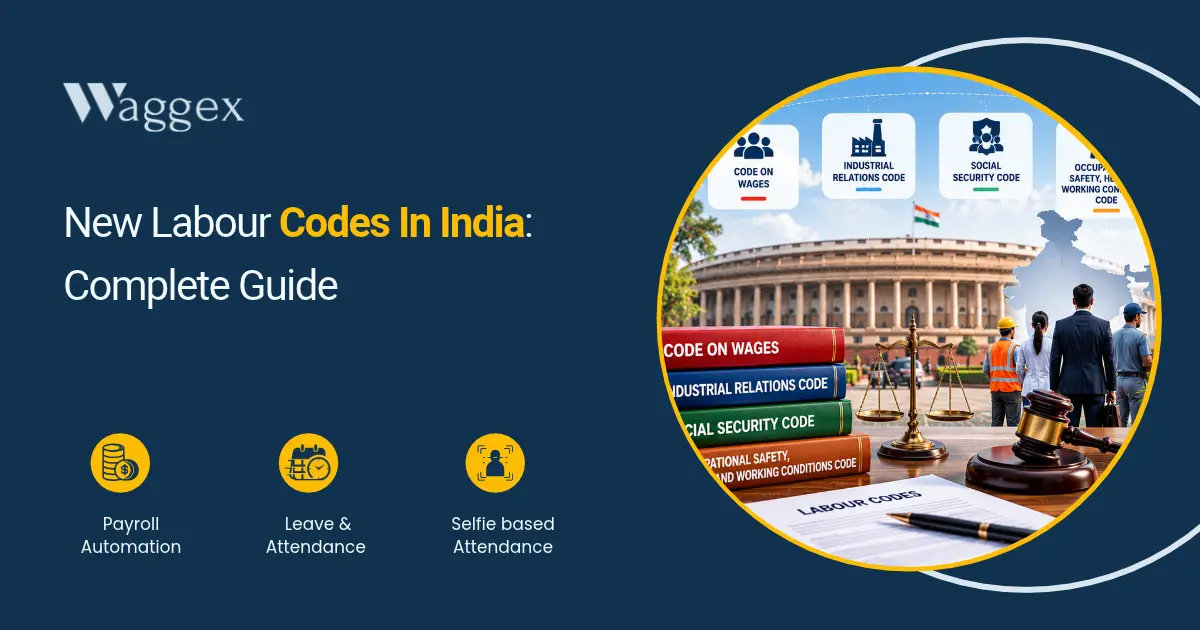
India replaced 29 separate labour laws with four consolidated codes, effective 21 November 2025. The central rules under all four codes were finalised on 8 and 9 May 2026. As of October 2026, 16 states have fully notified their own rules; 23 have published drafts. For companies in states where state rules are pending, the central rules apply in the interim.
The change isn’t just administrative. The 50% wage rule forces a salary structure rethink across most Indian companies. Gratuity eligibility for fixed-term employees dropped from 5 years to 1 year. Full and final settlement that routinely took 30–45 days must now happen in 2 working days. These aren’t technicalities they change payroll costs, HR processes, and compliance timelines in concrete ways.
The Four Labour Codes 29 Laws, Now 4
The four codes and what they replaced:
Code on Wages, 2019 replaces the Payment of Wages Act, Minimum Wages Act, Payment of Bonus Act, and Equal Remuneration Act. Governs wage definition, minimum wages, overtime, bonus, and equal pay.
Industrial Relations Code, 2020 replaces the Trade Unions Act, Industrial Employment (Standing Orders) Act, and Industrial Disputes Act. Governs standing orders, layoffs, retrenchment, and unions.
Code on Social Security, 2020 replaces the EPF Act, ESIC Act, Payment of Gratuity Act, Maternity Benefit Act, and four others. Covers PF, ESI, gratuity, maternity, and gig worker social security.
Occupational Safety, Health & Working Conditions (OSH) Code, 2020 replaces the Factories Act, Contract Labour Act, Inter-State Migrant Workmen Act, and 10 others. Covers working hours, workplace safety, contractor compliance, and migrant workers.
What Actually Changed Key Differences at a Glance
| Area | Old Rule | New Rule (2026) |
|---|---|---|
| Salary structure | Basic pay typically 25–40% of CTC | Basic + DA must be at least 50% of total remuneration |
| PF calculation base | Basic + DA only | Wages (≥50% of CTC); excess allowances also treated as wages |
| Gratuity eligibility | 5 years for all employees | 1 year for fixed-term employees; 5 years for permanent staff |
| F&F settlement | 30–45 days in practice | 2 working days from last working day statutory |
| Appointment letters | No universal requirement | Mandatory for every worker including contract and gig |
| 4-day workweek | Not available | Optional 12 hrs/day, 48 hrs/week; employer discretion |
| Gig/platform workers | Not covered | Social Security Code inclusion; aggregator cess rate pending |
| Standing orders | Required for 100+ employees | Threshold raised to 300+ employees |
| Retrenchment approval | Government approval for 100+ workers | Threshold raised to 300+ workers |
State implementation varies. Haryana, Madhya Pradesh, Karnataka, and Maharashtra finalised state rules by early 2026. In states still at draft stage, central rules apply for central-government-applicable establishments. Check your state labour department’s site for current status.
The 50% Wage Rule The Change That Affects Every Salary
Under the Code on Wages, ‘wages’ are defined as basic pay + DA + retaining allowance, and this figure must be at least 50% of total remuneration. Any allowances beyond the 50% threshold are automatically deemed wages and folded into the PF, gratuity, bonus, and leave encashment calculation base.
Most Indian companies kept basic at 25–40% of CTC to minimise PF liability. A company paying ₹1,00,000 gross with ₹30,000 basic calculated PF on ₹30,000. Under the new rules, basic must be at least ₹50,000. PF is now on ₹50,000. The employer’s PF cost increases by ₹2,400/month on that one employee. For a 60-person company this is a material cost change that needs to be planned before restructuring, not after.
The auto-deeming provision catches companies that don’t restructure. If allowances exceed 50% of remuneration, the excess is automatically treated as wages whether or not the salary structure is updated. Non-restructuring isn’t a workaround it’s non-compliance.
Gratuity After One Year for Fixed-Term Employees
Fixed-term employees are now eligible for pro-rata gratuity after 1 year of service under the Code on Social Security. The five-year rule still applies to permanent employees, but not to anyone on a fixed-term contract.
The formula is unchanged: (15 × last drawn wages × years of service) ÷ 26. A fixed-term employee who completes 18 months earns gratuity for 1.5 years. The practice of renewing employees on 11-month contracts to avoid the 5-year threshold no longer works gratuity accrues from month 12 regardless.
Provision for it from month one of any fixed-term hire. The Waggex gratuity guide covers the formula, the 2026 rule change, and the five employer mistakes that create unexpected liability.
Full and Final Settlement in 2 Working Days
Section 17 of the Code on Wages: all wage components must be settled within 2 working days of an employee’s last working day. The 30–45 day practice is gone.
Two working days requires attendance data to be closed and accurate, leave encashment to be calculable instantly, any advance or loan deductions to be tracked, and payroll to run a partial-month calculation on demand. When attendance, leave, and payroll run in separate systems, meeting this deadline requires someone to manually consolidate data from multiple sources under time pressure. That’s where errors happen.
Waggex keeps all three in one place. F&F can be processed the moment an exit date is confirmed, with no data transfer between systems.
Gig Workers, Appointment Letters, and the 4-Day Week
Gig and platform workers are now formally covered under the Code on Social Security. Aggregators will contribute 1–2% of annual turnover to a central Social Security Fund for gig workers. The contribution rate is pending notification as of October 2026.
Appointment letters are mandatory under the OSH Code for every worker permanent, fixed-term, contract, gig. No exception by company size. The letter must cover wages, hours, leave, and exit terms. Absence of one is a compliance violation.
The 4-day workweek is optional, not mandatory. The OSH Code allows it where total hours don’t exceed 48 per week (12-hour days). It requires employer-employee agreement and remains subject to state rules. For office-based employers it’s operationally feasible. For factories and shift-based operations, state-specific constraints apply.
Penalties for Non-Compliance
Code on Wages: ₹50,000 first offence; ₹1,00,000 repeat violations. Applies to wage structure non-compliance and overtime calculation errors.
Industrial Relations Code: ₹1,00,000–₹10,00,000 for unlawful layoff or closure violations. Criminal liability for certain provisions.
Code on Social Security: up to ₹1,00,000 and/or imprisonment for non-payment of PF, ESI, or gratuity. Late PF deposits attract 12% p.a. interest plus Section 14B damages up to 25% of dues.
OSH Code: ₹2,00,000–₹10,00,000 for safety violations; ₹50,000 for lesser violations including failure to issue appointment letters.
What Employers Must Do Right Now
- Restructure salary. Review every employee’s CTC. If basic + DA is below 50% of total remuneration, restructure before the next payroll run. Recalculate PF and gratuity on the new base and budget for the cost increase.
- Provision gratuity for fixed-term hires past 12 months. From this point, gratuity accrues from month 12 for every fixed-term employee. No exception.
- Fix the F&F process. Connect attendance, leave, and payroll so the settlement calculation can happen in hours. Identify every manual step in the current process and eliminate it.
- Issue appointment letters to every worker without one. This includes contractors and regular gig workers. Cover wages, hours, leave, and exit terms.
- Check your state’s status. Central rules are in force. State-specific rules may differ. In states with final rules Haryana, Karnataka, Maharashtra, Madhya Pradesh state rules take precedence.