

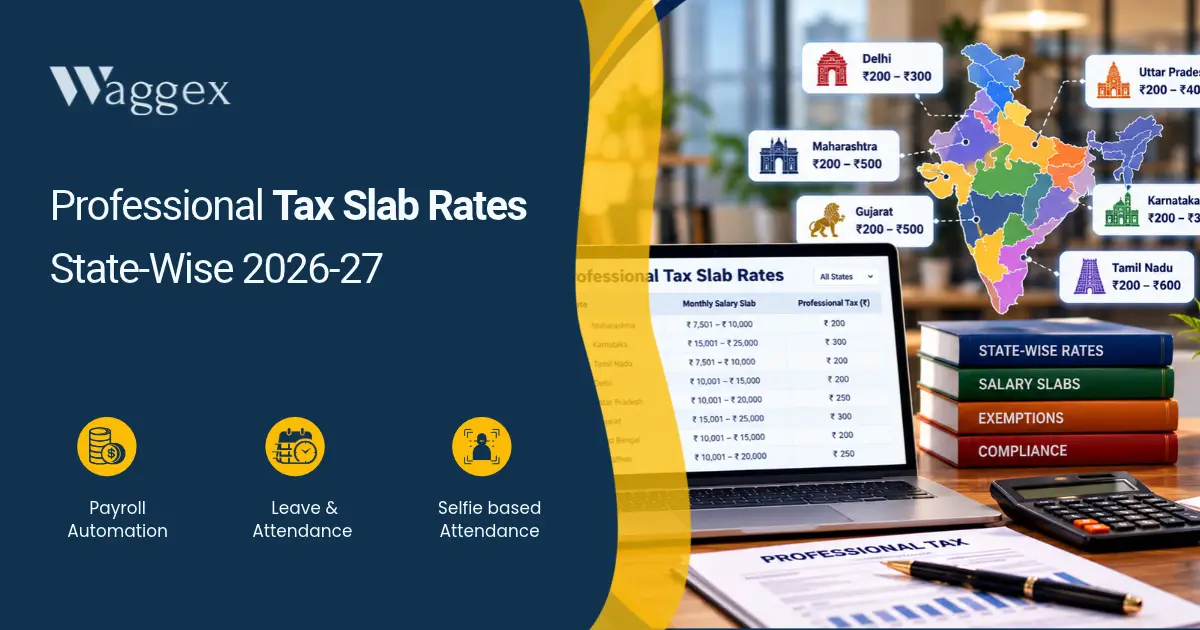
Professional tax (PT) is a state-level levy capped at ₹2,500 per year by Article 276 of the Constitution. Small amount but the compliance work is not small: 19 states and one union territory each have their own slabs, portals, and deadlines. And the liability follows the employee’s work location, not where the company is registered a Delhi-headquartered firm with staff in Bengaluru and Hyderabad owes Karnataka and Telangana PT on those employees.
This guide covers every active PT state for FY 2026-27, the key 2026 change (Odisha abolished PT from 1 April 2026), how to calculate the deduction for common salary levels, and the deadlines that matter.
| ⚠️ 2026 Update: Odisha abolished professional tax effective 1 April 2026. If you have employees working in Odisha, stop deducting PT from their April 2026 salary onwards and deregister with the Odisha PT authority. |
The Constitutional Cap and Why States Stay Under It
Article 276 caps professional tax at ₹2,500 per person per year which is why most states converge on ₹200/month for eleven months and ₹300 in February (total ₹2,500), or ₹208/month across twelve months for the same result. No state can legally go higher.
PT applies to employees and self-employed professionals alike, but payroll teams deal primarily with the employee side: deduct from salary each month and remit to the state government on time.
State-Wise PT Slabs for FY 2026-27
The table below covers all 20 active PT jurisdictions (19 states + Puducherry UT). Odisha is excluded PT was abolished there from 1 April 2026.
| State / UT | Entry Threshold | Monthly PT | Max Annual PT | Filing Frequency |
| Karnataka | ₹25,001/month | ₹200 (nil below ₹25k) | ₹2,400 | Monthly, 20th |
| Maharashtra | ₹7,501/month | ₹200 (₹300 in Feb) | ₹2,500 | Monthly, 31st |
| West Bengal | ₹10,001/month | ₹110 – ₹200 | ₹2,400 | Monthly, 21st |
| Andhra Pradesh | ₹15,001/month | ₹150 – ₹200 | ₹2,400 | Monthly, 10th |
| Telangana | ₹15,001/month | ₹150 – ₹200 | ₹2,400 | Monthly, 10th |
| Tamil Nadu | ₹21,001/half-yr | Up to ₹1,250/half-yr | ₹2,500 | Half-yearly |
| Kerala | ₹12,000/half-yr | Up to ₹1,250/half-yr | ₹2,500 | Half-yearly |
| Gujarat | ₹6,000/month | ₹80 – ₹200 | ₹2,400 | Monthly, 15th |
| Madhya Pradesh | ₹18,751/month | ₹125 – ₹208 | ₹2,500 | Quarterly |
| Assam | ₹10,001/month | Up to ₹208 | ₹2,496 | Monthly |
| Meghalaya | ₹4,167/month | Up to ₹208 | ₹2,500 | Monthly |
| Sikkim | ₹20,001/month | Up to ₹200 | ₹2,400 | Monthly |
| Tripura | ₹7,501/month | Up to ₹208 | ₹2,496 | Monthly |
| Chhattisgarh | ₹12,501/month | Up to ₹208 | ₹2,500 | Monthly |
| Jharkhand | ₹3L/year | Up to ₹300/quarter | ₹2,500 | Quarterly |
| Manipur | Annual slabs | Up to ₹208 | ₹2,500 | Annual |
| Mizoram | ₹5,001/month | Up to ₹208 | ₹2,496 | Monthly |
| Nagaland | ₹4,001/month | Up to ₹208 | ₹2,496 | Monthly |
| Puducherry (UT) | ₹10,834/month | Up to ₹208 | ₹2,496 | Monthly |
| Note: ‘Entry threshold’ is the monthly gross salary at which PT first applies. Employees earning below this amount pay ₹0 PT. Bihar and Punjab have historically had PT on the books but enforcement has been suspended verify locally before deducting. |
Three States in Detail
Karnataka: nil below ₹25,000/month, ₹150 for ₹25,001–₹41,999, ₹200 for ₹42,000+. Annual cap is ₹2,400 (no February surcharge). Returns on the Khajane-2 portal by the 20th of the following month.
Maharashtra: employees earning above ₹10,000/month pay ₹200 for eleven months and ₹300 in February ₹2,500/year. Women earning up to ₹10,000/month are exempt. Employers with 20+ employees file by the 31st monthly; smaller employers file quarterly.
West Bengal: five slabs nil up to ₹10,000, ₹110 (₹10,001–₹15,000), ₹130 (₹15,001–₹25,000), ₹150 (₹25,001–₹40,000), ₹200 above ₹40,000. Returns due the 21st.
States With No Professional Tax
If all your employees work in these states, PT is not a payroll obligation:
Delhi · Rajasthan · Uttar Pradesh · Haryana · Himachal Pradesh · Uttarakhand · Goa · Punjab (suspended) · Bihar (suspended) · Arunachal Pradesh · Jammu & Kashmir
The ‘suspended’ label on Bihar and Punjab means the legislation exists but active collection is paused confirm the current position before you stop deducting if you already have been.
How to Calculate PT: The 30-Second Method
PT is not a formula it is a lookup. Take the employee’s gross monthly salary, find their state’s slab, deduct the amount. The only exception is Tamil Nadu and Kerala, which use half-yearly income: add up six months of gross pay and look up the slab.
Worked examples for five common states:
| Employee | State | Salary | PT Deducted |
| Arjun Sharma | Karnataka | ₹42,000/month | ₹200 every month |
| Priya Mehta | Maharashtra | ₹50,000/month | ₹200 (₹300 in February) |
| Sourav Das | West Bengal | ₹28,000/month | ₹150/month |
| Kavitha Nair | Tamil Nadu | ₹38,000/half-yr | ₹315 each half-year |
| Ravi Teja | Telangana | ₹20,001/month | ₹200/month |
For February in Maharashtra: Priya Mehta’s PT goes from ₹200 to ₹300. This is not a penalty it is the statutory slab and the only way Maharashtra reaches the ₹2,500 annual cap.
| The remote-work rule: PT liability follows where the employee physically works, not where the company is headquartered. An employee who relocated from Mumbai to Bengaluru mid-year pays Maharashtra PT up to the month of relocation and Karnataka PT from the month they start working in Bengaluru. This creates a split-state scenario that is easy to miss in manual payroll. |
Compliance Deadlines That Matter
Monthly: Karnataka (20th), Maharashtra 20+ employees (31st), West Bengal (21st), Andhra Pradesh & Telangana (10th), Gujarat (15th). Deposit and file in the same cycle.
Half-yearly: Tamil Nadu and Kerala April–September due 30 September, October–March due 31 March. Only two filing opportunities a year.
Quarterly: Madhya Pradesh (last day of month following each quarter). Jharkhand follows the same pattern.
Penalties for late filing range from ₹1,000 to ₹5,000 per month per state, plus interest. Since PT amounts are small, penalties can exceed the tax itself after a few missed months.
Registration: When and Where
PT registration is the employer’s responsibility in every state where employees work. Deadlines are tight: Maharashtra requires registration within 30 days of becoming liable; Karnataka requires it before the first deduction. Each state has its own PT portal hiring a remote employee in West Bengal while your business is in Karnataka means separate West Bengal registration before the first deduction.
Multi-State Payroll: Common PT Mistakes
Missing the Odisha deregistration. PT was abolished there from 1 April 2026. Stop deducting and formally deregister with the Odisha PT authority.
Wrong Karnataka threshold. The nil slab is ₹25,000/month, not ₹15,000. An employee earning ₹22,000 in Karnataka pays ₹0 PT.
Missing Maharashtra’s February jump. PT doubles to ₹300 in February. If your payroll software doesn’t handle it automatically, set a manual reminder.
Using registration state, not work location. A Hyderabad company with a Chennai employee owes Tamil Nadu PT, not Telangana. PT follows where the work happens.
Deducting before registering. You need a PT Enrolment Certificate in each state before the first deduction. Deducting without registration leaves the employee charged with nowhere to remit.
Where Waggex Handles This
Manual PT across multiple states means a separate register per state, different due dates to track, and slab updates whenever a state revises its schedule exactly what happened with Odisha this April.
Waggex applies the correct state slab automatically based on each employee’s work location, handles the Maharashtra February rule, and generates PT challans on schedule. When a state revises slabs, the rates update without manual intervention. If you are managing PT across two or three states in a spreadsheet, the compliance overhead quickly exceeds the tax amounts involved.
Free for up to 10 employees. Paid plans from ₹699/month.
Rates and thresholds in this guide are based on state government notifications as understood for FY 2026-27. PT legislation changes frequently at the state level verify current slabs against each state’s official gazette before finalising payroll, particularly for states not covered in detail above. For the broader payroll compliance picture, see our Payroll Compliance in India guide.