

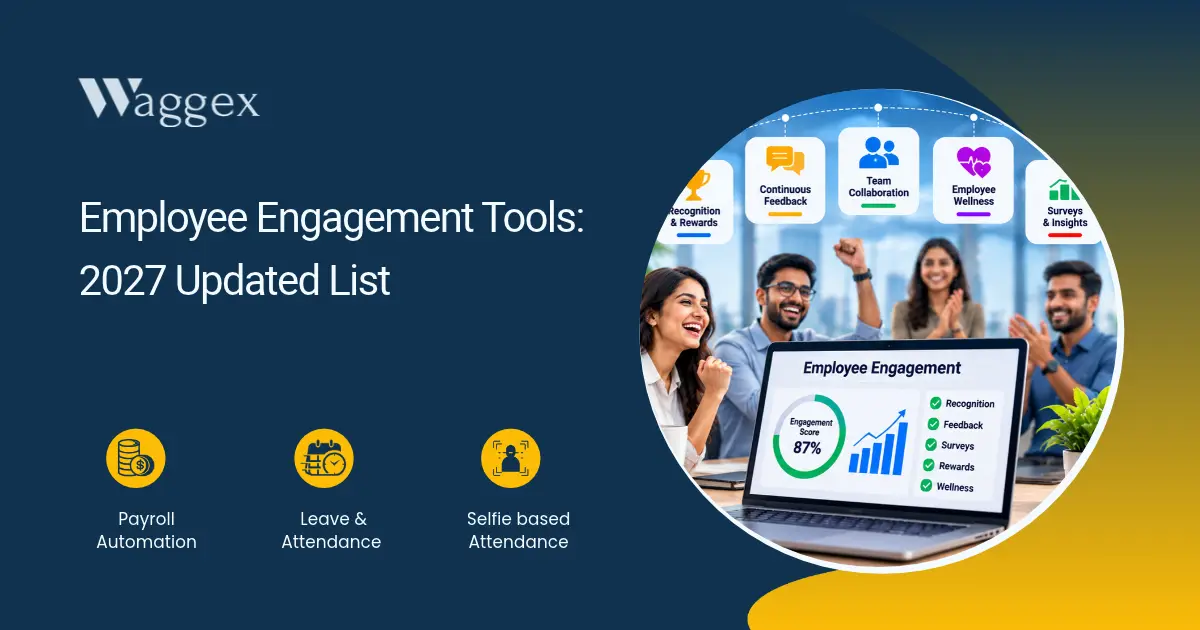
The employee engagement software market has grown significantly over the last three years. As a result, choosing the right tool has become more difficult. There are different types of tools available, including pulse survey tools, employee recognition platforms, manager effectiveness dashboards, and people analytics software. Each tool focuses on improving employee engagement, but they all measure different things.
According to Gallup’s 2025 State of the Global Workplace report, disengaged employees cost the global economy around 9% of global GDP. In India, the report shows that only 32% of employees are actively engaged at work. This means that most companies have a large number of employees who are not fully involved or interested in their work. Employee engagement tools can help companies identify these problems and take action to improve the workplace.
In this article, we’ll look at the main types of employee engagement tools, what each tool measures, and the key things to consider when choosing the right software in 2026.
Why Most Employee Engagement Tools Fail to Produce Action
The most common problem is not choosing the wrong tool. It is using a tool without having a clear plan for what to do with the results. For example, a company may run a pulse survey and find that employees are unhappy with career growth opportunities. However, nothing happens for the next three months because no one is responsible for taking action. Employees notice that their feedback has not led to any changes. As a result, they stop participating in future surveys, and their trust in the company decreases further.
Employee engagement tools collect data, but they do not automatically solve problems. Managers and HR leaders need to take action based on the results. Someone must be responsible for reviewing the feedback, communicating what employees have shared, and explaining what changes will be made. From our experience, companies get better results from engagement tools when they treat survey feedback as a management responsibility rather than just an HR reporting task.
The second common problem is measuring the wrong things. An employee engagement score is not the same as an employee experience score, satisfaction score, or employee retention risk score. Each measures a different aspect of the workplace. When companies confuse these metrics, they often focus more on improving survey results than improving actual employee engagement. This can lead to better survey responses without making any real improvements to employees’ day-to-day work experience.
Employee Engagement Tool Categories: What Each One Actually Does
| Tool Category | What It Does | Best For | Key Limitation |
| Pulse survey platforms | Recurring short surveys (3–8 questions) measuring sentiment, engagement, and morale on a weekly or fortnightly cadence | Companies with 50+ employees wanting real-time sentiment data without annual survey fatigue | Only as good as question design and response rates low trust environments see low completion, skewing results. |
| Annual engagement surveys | Comprehensive questionnaires covering all engagement dimensions management, growth, recognition, workload, culture | Companies wanting a structured baseline for year-on-year comparison and benchmarking against industry data | Annual frequency means problems identified in Q1 may not be acted on until Q4 at the earliest. |
| Recognition and rewards platforms | Peer-to-peer and manager-to-employee recognition; points-based reward systems; milestone and anniversary tracking | Companies with distributed or hybrid teams where informal recognition is harder to deliver consistently | Platforms generate activity data, not engagement data high badge volumes can mask low real engagement. |
| Manager effectiveness tools | 360-degree feedback, upward feedback surveys, skip-level conversation tracking, team engagement by manager | Companies with 200+ employees or rapid management growth where manager quality varies across teams | Upward feedback only works when psychological safety exists without it, scores cluster to the middle and signal nothing. |
| HRMS-embedded engagement | Engagement data integrated with payroll, attendance, leave, and performance data correlates engagement signals with HR metrics | Companies that want to connect engagement trends to actual retention, absenteeism, and productivity data in one system | Requires a mature HRMS with clean HR data engagement signals on top of inaccurate HR records produce misleading correlations. |
The HRMS-embedded engagement row is worth attention for companies that already run HR data through a centralised system. Standalone engagement tools produce engagement data in isolation you know sentiment is declining in one team, but you don’t know whether absenteeism is rising in the same team, or whether that team’s payroll errors are above average. When engagement data sits alongside HR metrics, the correlations become usable.
| What to look for in 2026: the engagement tools that have moved ahead of the market are those that surface leading indicators rather than lagging ones. A platform that tells you engagement dropped last month is reporting history. A platform that flags a team whose leave utilisation has spiked, whose manager feedback scores are declining, and whose salary increments are below market three signals that together predict voluntary exit is actually useful. This kind of signal stacking requires engagement data to be connected to HRMS and payroll data, not sitting in a separate tool. |
Pulse Surveys vs. Annual Engagement Surveys: Which Is Right for Indian Companies
Annual engagement surveys produce comprehensive, benchmarkable data. Most HR teams have used them, most employees have completed them, and the format is understood. The problem is frequency. A company that runs an annual survey in January, gets results in February, discusses them in March, and plans interventions in April is acting on data that’s already six months old before anything changes. In a sector with 20%+ annual attrition, that lag is significant.
Pulse surveys solve the lag problem but introduce a new one: survey fatigue. If employees receive a 5-question check-in every week, they complete it less carefully, or stop completing it at all. The data quality degrades. The optimal frequency for most Indian companies is fortnightly to monthly enough to catch sentiment shifts in near-real-time without creating a burden.
The combination that works best in our experience is an annual engagement survey for baseline measurement and industry benchmarking, plus quarterly pulse checks focused on specific themes manager effectiveness one quarter, workload and recognition the next. This keeps frequency manageable while keeping data fresh.
Recognition Tools and Their Actual Impact on Engagement
Recognition platforms tools that let managers and peers acknowledge good work, often through a points-based reward system have grown popular in India’s mid-market over the last two years. The premise is sound: recognition is consistently one of the top drivers of engagement across surveys, and informal recognition is harder to deliver consistently in hybrid or distributed teams.
The limitation is that recognition platform activity doesn’t equal engagement. High badge volumes can exist in a company with low trust, low growth, and high attrition employees learn to participate in the platform ritual without the underlying experience improving. A recognition tool works when managers are already giving substantive feedback; it doesn’t compensate for managers who aren’t.
Used well as a structured way to make recognition visible and consistent, especially in remote or cross-functional teams recognition tools have a measurable impact on the employees who receive recognition. Used as a substitute for genuine manager engagement, they add noise without changing outcomes.
How Payroll and HR Systems Connect to Employee Engagement
Process-related problems such as payroll errors, slow leave approvals, and difficulty accessing payslips often appear in exit interview feedback as reasons for employee dissatisfaction. These may not be the main reasons employees leave a company, but they create daily frustration. Over time, these small problems can make employees more likely to leave when they get a better job offer.
An HRMS that manages payroll on time and without errors can help reduce these problems. It also gives employees self-service access to their leave balances, payslips, and reimbursements without having to contact HR for every small request. This does not replace other employee engagement activities, such as surveys, recognition programs, and improving manager performance. Instead, it creates a stable foundation for these activities to work better.
Waggex’s employee self-service and compliance module helps manage everyday HR tasks without requiring manual work from the HR team. This allows HR professionals to spend less time handling administrative tasks and more time focusing on employee engagement and improving the overall workplace experience.
Engagement and disengagement cost data from Gallup State of the Global Workplace 2025 report. India engagement rate (32% actively engaged) from the same report. Pulse survey frequency recommendations based on commonly cited HR research benchmarks; optimal frequency varies by company size, culture, and existing survey fatigue levels.