

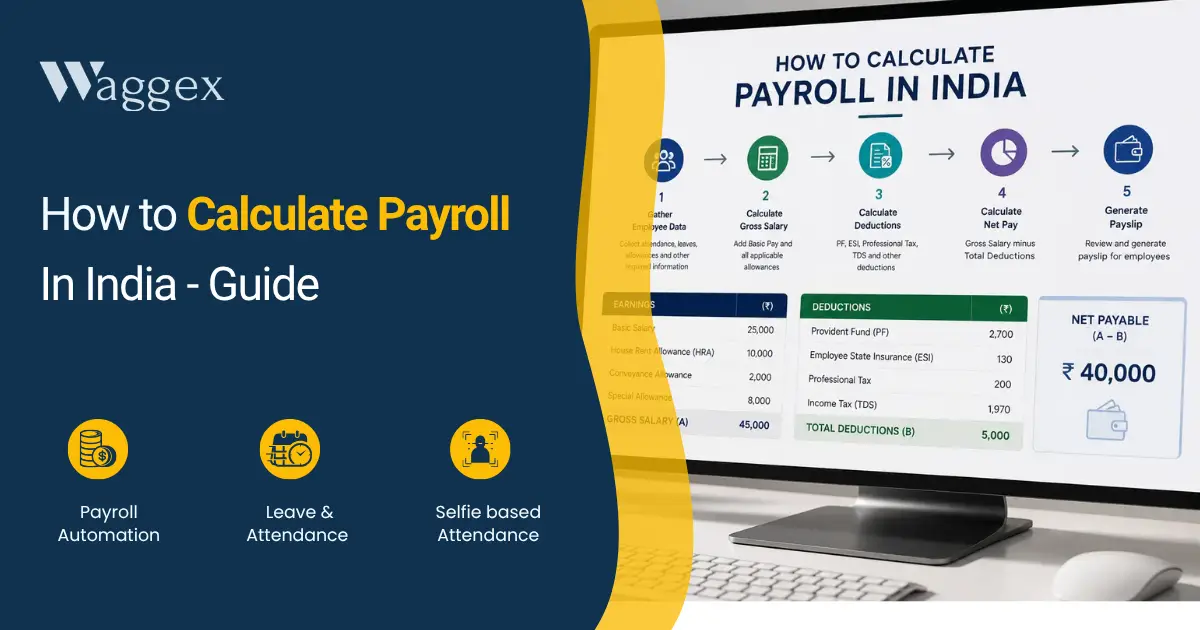
Updated for Tax Year 2026-27. Covers Income Tax Act 2025, new IT regime slabs, Labour Code 2025 changes, and current PF/ESI/PT rates. All figures verified from official sources. Consult a qualified CA for your specific situation. This guide is for information purposes.
Payroll in India is not just a salary calculation. Every month, it involves at least five statutory obligations running in parallel PF, ESI, TDS, Professional Tax, and Labour Welfare Fund (in applicable states) each with its own formula, its own deadline, and its own penalties for errors.
If you’re doing payroll for the first time, or cleaning up a process that’s been done manually for years, this guide is for you and we’ll walks through every step from how to structure a CTC to how to calculate net take-home after all deductions. We’ve used a worked example throughout so the formulas are anchored in real numbers, not just theory.
Two regulatory changes in 2025–2026 affect payroll calculations directly: the Labour Codes that came into force on November 21, 2025 (which changed how basic salary and allowances must be structured) and the Income Tax Act 2025 effective from April 1, 2026 (which changed TDS slabs and filing forms). Both are covered below.
Step 1: Understanding CTC and Salary Components
CTC (Cost to Company) is the total amount a company spends on an employee per year including the employee’s gross salary, the employer’s statutory contributions (PF, ESI, gratuity provision), and any other benefits. CTC is not the employee’s take-home salary.
Typical Salary Components
- Basic Salary. The foundation of the salary structure. Statutory contributions PF, gratuity, ESI base are calculated on it. Under the Labour Codes effective November 2025, basic salary must be at least 50% of the total CTC. Many companies previously kept basic at 30–40% to reduce PF liability. That’s now non-compliant and can trigger EPFO inspection, back contributions, and penalties.
- House Rent Allowance (HRA). Typically 40–50% of basic (40% for non-metro cities, 50% for metro cities). HRA is partially exempt from tax under the old regime but fully taxable under the new regime.
- Special Allowance. The flexible residual component whatever CTC remains after basic, HRA, and employer contributions are allocated. Fully taxable. Under the Labour Codes, total allowances cannot exceed 50% of (basic + DA). Excess is treated as part of basic.
- Leave Travel Allowance (LTA). Tax-exempt under the old regime for actual travel costs twice in four years. Taxable under the new regime.
- Employer PF Contribution. 12% of basic salary, paid by the employer. This is part of CTC but not part of the employee’s gross salary.
- Gratuity Provision. Calculated as 4.81% of basic salary per year (shorthand for Basic × 15/26). Some companies include this in CTC, some don’t. Maximum tax-free gratuity is ₹25 lakh (enhanced in 2024).
| The 50% basic rule the most important CTC change in 2026: If an employee’s CTC is ₹10 lakh, the basic salary must be at least ₹5 lakh annually (₹41,667/month). If basic is currently below 50% of CTC in your payroll, restructuring is needed before EPFO inspection not after. Back-dated PF shortfalls attract 12% interest plus Section 14B damages. |
CTC vs Gross Salary vs Net Take-Home The Difference
- CTC = Gross salary + Employer PF + Employer ESI + Gratuity provision + any other employer costs
- Gross Salary = Basic + HRA + Special Allowance + LTA + any other allowances (what gets paid before deductions)
- Net Take-Home = Gross Salary − Employee PF − Employee ESI − TDS − Professional Tax
Step 2: A Complete Worked Example
Employee: Priya Sharma, Software Developer, BengaluruAnnual CTC: ₹8,00,000 | Tax regime: New (default)
- CTC Breakdown (Annual)
| Component | Annual Amount | Monthly Amount |
|---|---|---|
| Basic Salary (50% of CTC) | ₹4,00,000 | ₹33,333 |
| HRA (40% of basic non-metro) | ₹1,60,000 | ₹13,333 |
| Special Allowance (residual) | ₹1,60,000 | ₹13,333 |
| Employer PF (12% of basic) | ₹48,000 | ₹4,000 |
| Gratuity Provision (4.81% of basic) | ₹19,240 | ₹1,603 |
| Employer ESI (3.25% gross ≤ ₹21K) | Not applicable (gross > ₹21K) | — |
| Total CTC | ₹7,87,240 (+ rounded) | ₹65,603 |
- Gross Salary
| Component | Annual | Monthly |
|---|---|---|
| Basic Salary | ₹4,00,000 | ₹33,333 |
| HRA | ₹1,60,000 | ₹13,333 |
| Special Allowance | ₹1,60,000 | ₹13,333 |
| Gross Salary | ₹7,20,000 | ₹60,000 |
- Statutory Deductions
| Deduction | Annual | Monthly |
|---|---|---|
| Employee PF (12% of basic) | ₹48,000 | ₹4,000 |
| Employee ESI | Not applicable (gross > ₹21,000/mo) | — |
| Professional Tax (Karnataka) | ₹2,400 | ₹200 |
| TDS (calculated below Step 5) | ₹7,500 (approx.) | ₹625 |
| Total Deductions | ₹57,900 | ₹4,825 |
- Net Take-Home
| Annual | Monthly | |
|---|---|---|
| Gross Salary | ₹7,20,000 | ₹60,000 |
| Less: Total Deductions | (₹57,900) | (₹4,825) |
| Net Take-Home Salary | ₹6,62,100 | ₹55,175 |
Step 3: Calculating PF (Provident Fund)
PF is mandatory for establishments with 20 or more employees. The contribution base is Basic Salary + Dearness Allowance (DA). Most private sector companies don’t have a DA component, so PF is calculated on basic salary alone.
Rates
- Employee contribution: 12% of basic salary + DA
- Employer contribution: 12% of basic salary + DA, split as:
- → EPS (Employees’ Pension Scheme): 8.33% of basic, capped at ₹1,250/month (i.e., based on wage ceiling of ₹15,000)
- → EPF: 3.67% (remainder after EPS)
- Employer admin charge: 0.50% of basic salary, paid separately to EPFO
Example (Basic = ₹33,333/month)
- Employee PF = 12% × ₹33,333 = ₹4,000/month
- Employer PF = 12% × ₹33,333 = ₹4,000/month
- → EPS = 8.33% × ₹15,000 (capped) = ₹1,250
- → EPF = ₹4,000 − ₹1,250 = ₹2,750
- Admin charge = 0.5% × ₹33,333 = ₹167
- Total employer PF cost = ₹4,000 + ₹167 = ₹4,167/month
| Deposit deadline: 15th of every month File the ECR (Electronic Challan cum Return) on the EPFO portal. Late deposits attract 12% per annum interest plus Section 14B damages up to 25% of dues for delays beyond 6 months. |
Step 4: Calculating ESI (Employees’ State Insurance)
ESI applies to employees whose gross salary is ₹21,000/month or below (₹25,000 for employees with disabilities). Once an employee is covered in a contribution period, coverage continues for the full benefit period even if salary temporarily crosses ₹21,000.
Rates
- Employee contribution: 0.75% of gross wages
- Employer contribution: 3.25% of gross wages
- Total: 4% of gross wages
Example (Gross salary = ₹18,000/month ESI applicable)
- Employee ESI = 0.75% × ₹18,000 = ₹135/month
- Employer ESI = 3.25% × ₹18,000 = ₹585/month
- Total ESI contribution = ₹720/month
Note: In our main worked example (Priya’s gross = ₹60,000/month), ESI does not apply. It would only apply to employees earning ₹21,000 or below.
| ESI deposit deadline: 15th of every month Half-yearly returns: 11 October (April–September) and 11 April (October–March). Late payment attracts 12% per annum simple interest. |
Step 5: Calculating TDS on Salary
TDS on salary is governed by the Income Tax Act 2025, effective from April 1, 2026. The employer estimates each employee’s annual income at the start of the year, calculates the total tax liability, and deducts an equal monthly amount. If the employee’s income changes mid-year, the monthly TDS is adjusted.
The Two Tax Regimes (Tax Year 2026-27)
New regime (default): Lower tax rates, no deductions for HRA, 80C, 80D, LTA, home loan interest. Standard deduction of ₹75,000 available. This is the default unless the employee specifically opts for the old regime.
Old regime (opt-in): Higher tax rates but allows deductions for HRA, 80C (up to ₹1.5L), LTA, home loan interest, 80D (medical insurance), NPS, etc. Standard deduction ₹50,000. Employees must submit Form 12BB with investment declarations to claim these.
New Regime Tax Slabs (TY 2026-27)
| Annual Taxable Income | New Regime Rate | Old Regime Rate | Notes |
|---|---|---|---|
| Up to ₹4,00,000 | 0% | 0% (up to ₹2.5L) | Basic exemption limit |
| ₹4,00,001–₹8,00,000 | 5% | 5% (2.5–5L) | New regime has higher basic limit |
| ₹8,00,001–₹12,00,000 | 10% | 20% (5–10L) | New regime significantly lower here |
| ₹12,00,001–₹16,00,000 | 15% | 30% (above 10L) | Old regime 30% starts at ₹10L |
| ₹16,00,001–₹20,00,000 | 20% | 30% | — |
| ₹20,00,001–₹24,00,000 | 25% | 30% | — |
| Above ₹24,00,000 | 30% | 30% | Same at very high incomes |
| Standard Deduction | ₹75,000 (salaried) | ₹50,000 | New regime higher standard deduction |
| Section 87A Rebate | ₹60,000 (income ≤₹12L) | ₹12,500 (income ≤₹5L) | Salaried: zero tax up to ₹12.75L gross (new) |
| Cess | 4% on tax payable | 4% on tax payable | Health and Education Cess |
TDS Calculation Priya’s Example (New Regime)
Annual gross salary: ₹7,20,000 | Standard deduction: ₹75,000
- Taxable income = ₹7,20,000 − ₹75,000 = ₹6,45,000
- Tax on ₹6,45,000:
- 0–₹4L = ₹0
- ₹4L–₹6.45L = 5% × ₹2,45,000 = ₹12,250
- Total tax before rebate = ₹12,250
- Section 87A rebate: taxable income ≤ ₹12L → rebate up to ₹60,000. Tax = ₹12,250 < ₹60,000 → zero tax after rebate
- TDS = ₹0/month for this employee
Let’s also calculate for an employee with higher income to show a non-zero TDS.
TDS Example 2 Rahul Mehta, CTC ₹18 lakh, Bengaluru
- Annual Gross Salary (basic + HRA + special allowance) = ₹14,40,000
- Taxable income (after ₹75,000 standard deduction) = ₹13,65,000
- Tax calculation:
- 0–₹4L = ₹0
- ₹4L–₹8L: 5% × ₹4L = ₹20,000
- ₹8L–₹12L: 10% × ₹4L = ₹40,000
- ₹12L–₹13.65L: 15% × ₹1.65L = ₹24,750
- Total tax = ₹84,750
- 4% Cess = ₹84,750 × 4% = ₹3,390
- Total tax payable = ₹88,140
- Monthly TDS = ₹88,140 ÷ 12 = ₹7,345/month
| TDS deposit deadlines: 7th of every month for the previous month’s TDS. Exception: March TDS is due by 30th April. File quarterly TDS returns on Form 138 (replaces Form 24Q from Q1 TY2026-27). Issue Form 130 (replaces Form 16) to all employees by 15th June annually. Late TDS deposit: 1.5% per month interest from the date of deduction. |
Step 6: Professional Tax (PT)
Professional Tax is a state-level deduction not all states levy it, and those that do have different slabs and frequencies. The Constitution caps the maximum at ₹2,500 per year per person. Employers collect it from employee salaries and remit it to the state authority.
- Maharashtra: ₹200/month for 11 months + ₹300 in February = ₹2,500/year (for salary above ₹10,000/month)
- Karnataka: Slab-based: ₹200/month for income above ₹15,000/month
- West Bengal: Slab-based; ₹110/month for income above ₹10,001/month
- Tamil Nadu: ₹600 half-yearly (₹1,200/year) for income above ₹21,000/month
- Delhi: ₹0 Delhi does not levy Professional Tax
- Haryana: Slab-based; ₹200/month above certain thresholds
Always verify current slabs on your state’s official PT portal before configuring payroll rates update periodically.
Step 7: Loss of Pay (LOP) Deduction
LOP applies when an employee takes leave beyond their entitled balance, or is absent without approval. The deduction formula is:
Daily rate = Gross Monthly Salary ÷ Total working days in month
LOP deduction = Daily rate × Number of LOP days
Example
- Priya’s gross monthly salary: ₹60,000
- Working days in the month: 26
- Days of unauthorised absence: 2
- Daily rate = ₹60,000 ÷ 26 = ₹2,307.69
- LOP deduction = ₹2,307.69 × 2 = ₹4,615.38
The denominator 26 or 30 or actual calendar days varies by company policy. Consistency is what matters. Use the same denominator for the same employee throughout the year. Changing it mid-year creates payslip inconsistencies that generate disputes. Most Indian companies use 26 (for a 5-day week) or 30 (calendar month).
Step 8: Overtime Calculation
Under the OSH Code and Factories Act, overtime must be paid at double the ordinary rate for hours worked beyond the daily/weekly limit.
Hourly rate = Monthly Basic Salary ÷ (26 working days × 8 hours)
Overtime rate = Hourly rate × 2
Overtime pay = Overtime rate × Number of overtime hours
Example
- Basic salary: ₹33,333/month
- Hourly rate = ₹33,333 ÷ (26 × 8) = ₹33,333 ÷ 208 = ₹160.25
- Overtime rate = ₹160.25 × 2 = ₹320.50
- 10 hours of overtime = 10 × ₹320.50 = ₹3,205
Step 9: The Complete Net Salary Formula
Putting it all together:
Net Salary = Fixed Earnings + Variable Earnings + Arrears + Reimbursements − LOP Deduction − Employee PF − Employee ESI − TDS − Professional Tax − Other Recoveries
Total Employer Cost = Net Salary + Employer PF + Employer ESI + Gratuity Provision + Admin Charges
| Full payroll run for Priya (₹8L CTC, no LOP, no OT, new tax regime, Bengaluru): Gross salary: ₹60,000 | Employee PF: ₹4,000 | ESI: Not applicable | TDS: ₹0 (below rebate threshold) | PT (Karnataka): ₹200 | Net take-home: ₹55,800/month Employer’s total cost: ₹60,000 gross + ₹4,167 employer PF + ₹1,603 gratuity provision = ₹65,770/month |
Monthly Payroll Compliance Calendar
Here’s every statutory deadline in one place.
| Deadline | Obligation | Action Required | Penalty for Missing |
|---|---|---|---|
| 7th monthly | TDS deposit | Pay TDS deducted in previous month via Challan 281 | 1.5% per month interest from date of deduction |
| 30th April only | March TDS | March’s TDS deposit extended deadline (not 7th April) | Same 1.5%/month if delayed |
| 15th monthly | PF contribution | Pay employer + employee PF share; file ECR on EPFO portal | 12% p.a. + up to 25% damages under Section 14B |
| 15th monthly | ESI contribution | Pay employer (3.25%) + employee (0.75%) to ESIC | 12% p.a. simple interest |
| 31 Jul/31 Oct/31 Jan/31 May | TDS quarterly return | File Form 138 (replaces Form 24Q from Q1 TY2026-27) | ₹200/day under Section 234E |
| 11 April / 11 Oct | ESI half-yearly return | File half-yearly ESIC return for Apr–Sep and Oct–Mar | Penalty for late filing |
| 15 June (annual) | Form 130 / TDS cert. | Issue Form 130 (replaces Form 16) to all employees | ₹500/day + legal exposure |
| Varies by state | Professional Tax | Monthly or half-yearly PT remittance per state rules | State-specific fines |
Sources: EPFO portal, ESIC portal, Income Tax Act 2025, Code on Wages (Central) Rules 2026. Verify current rates on official government portals before filing. Consult a CA for specific situations.
Common Payroll Calculation Errors and How to Avoid Them
- Basic salary below 50% of CTC. The single most common compliance gap after the Labour Codes. Triggers EPFO inspection and back-dated PF liability.
- Calculating ESI on basic salary instead of gross wages. ESI applies to gross wages basic + HRA + all allowances. Using only basic understates ESI and creates a shortfall.
- Not adjusting TDS when salary changes mid-year. A salary revision in October means the annual income estimate changes. TDS must be recalculated and the remaining monthly TDS adjusted not left at the original rate.
- Missing the March TDS extended deadline. March TDS is due April 30, not April 7. This confuses many HR teams and results in late-payment interest every year.
- Using different LOP denominators for the same employee. 26-day basis one month, 30-day basis the next, creates payslip inconsistency and employee disputes.
- PT not configured for actual work location. An employee working from a Bengaluru office of a Delhi-registered company pays Karnataka PT, not Delhi (where PT is zero). PT follows the work location, not the company registration.
- Gratuity not provisioned in CTC. Gratuity is a statutory obligation after 5 years. Businesses that don’t provision for it monthly find a large liability appearing suddenly when employees complete 5 years.
How Waggex Handles Payroll Calculations
We want to be clear about the intent of this section: it’s about how a connected payroll system changes the calculation process, not about selling Waggex. Everything described above can be done manually. The question is whether manual calculations consistently produce accurate results and for most businesses with more than 20 employees, the honest answer is: not reliably.
In Waggex’s payroll module, salary structures are configured once with the correct components basic, HRA, special allowance following the 50% rule. PF is calculated automatically on the correct base. ESI applicability is checked each month against the ₹21,000 threshold and switches off automatically when an employee’s gross exceeds it. PT is configured by work location, not company registration.
The most important connection is between attendance and payroll. When attendance is tracked in the same system through GPS check-in or FaceLens selfie verification LOP deductions calculate automatically from the verified attendance record. Overtime flagged in real time from shift data feeds into overtime pay without manual entry. The attendance record doesn’t need to be manually transferred into payroll before the salary run.
TDS calculates monthly from the annual income estimate per employee, with adjustment when salary revisions happen. Tax and Forms Management generates Form 138 (quarterly TDS returns) and Form 130 (employee TDS certificates) in filing-ready format. Reminder Management sends alerts before the 7th (TDS), 15th (PF/ESI), and quarterly filing deadlines so nothing is missed because someone forgot what month it was.
None of this replaces a CA for complex situations a senior employee with multiple income sources, a mid-year salary revision affecting TDS significantly, or a final settlement calculation. But for the routine monthly payroll calculation for 10–200 employees with standard salary structures, an automated system produces more consistent results than manual calculation, with less time and less risk of the errors listed above. For more on this, our guide to managing payroll in a small business covers the full monthly process in practical terms.
The Bottom Line
Payroll calculation in India involves six or seven distinct calculations running in parallel every month CTC structure, gross salary, PF, ESI, TDS, PT, LOP each with its own rules, its own thresholds, and its own deadlines. The calculation itself isn’t technically complex. What makes it difficult is doing it correctly, consistently, for every employee, every month, without missing a deadline or letting a mid-year change fall through the gap.
The formulas in this guide are verified and current as of July 2026. Two things to do before your next payroll run: check that your basic salary is at least 50% of CTC per the Labour Code, and confirm whether your TDS calculations are using the correct new-regime slabs and the ₹75,000 standard deduction. Those two points catch the most common errors in Indian payroll right now.
If you’d like to see how automated payroll calculation works in practice, Waggex’s free trial gives you full access salary structure, PF/ESI/TDS automation, attendance-to-payroll connection and no credit card required.