

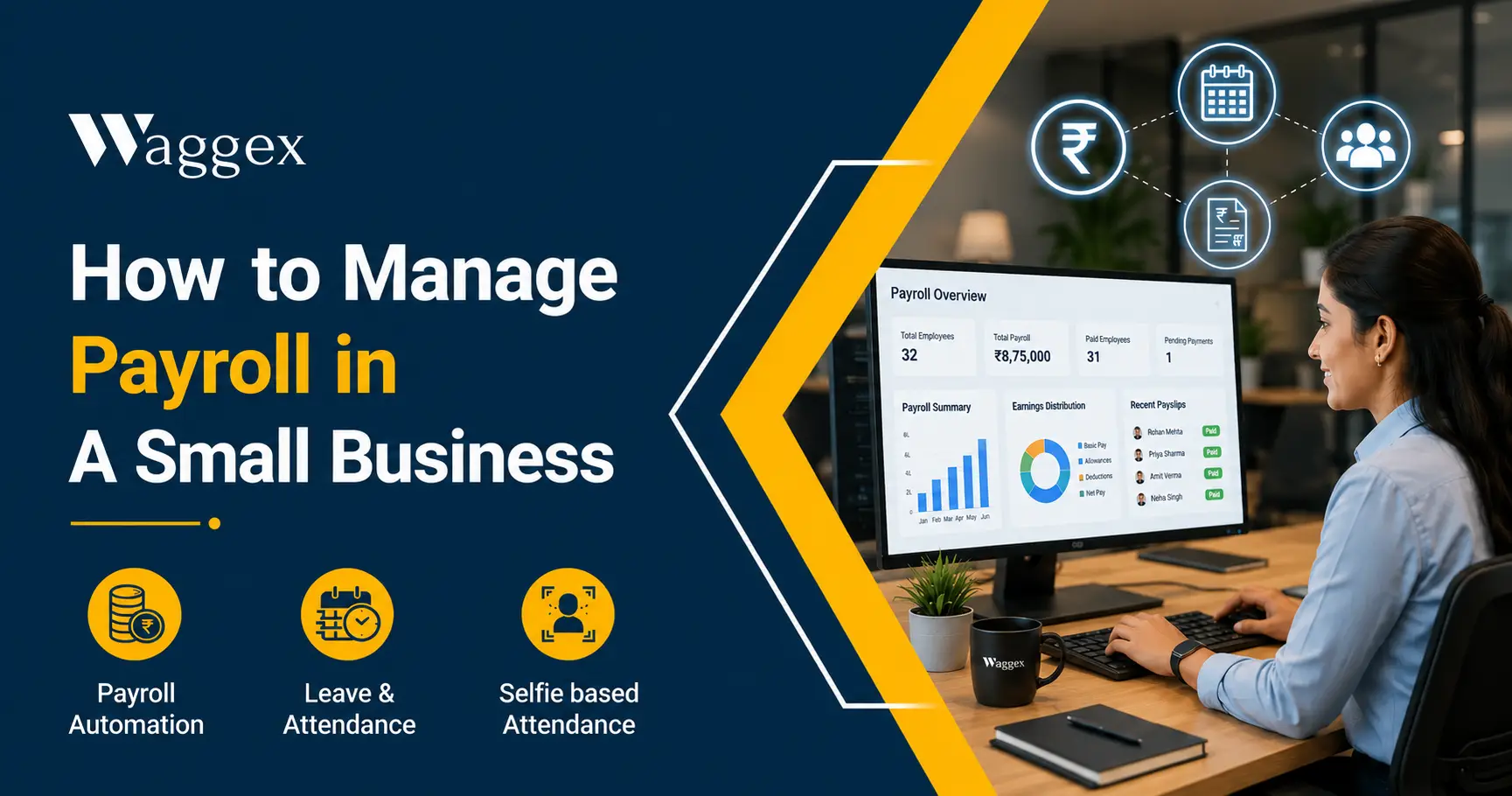
Running payroll for a small business feels like it should be simple. You have 15 employees. You know what everyone is paid. How hard can it be?
Harder than it looks, as it turns out. Indian payroll isn’t just salary calculation. It’s PF contributions that must be deposited by the 15th. TDS that must be deposited by the 7th. ESI for eligible employees. Professional Tax that changes by state. Leave without pay deductions that have to match attendance records. And all of it needs to be done correctly, every month, with documentation that survives a compliance audit.
The good news: once you understand the process and get the right tools in place, payroll for a small team genuinely isn’t difficult. It’s just a series of steps done in the right order. This guide walks through all of it what payroll actually involves for an Indian small business, what compliance you’re responsible for, what mistakes to avoid, and how tools like Waggex can take the repetitive parts off your plate entirely.
What Payroll Actually Involves for an Indian Small Business
Most small business owners think payroll means calculating salary and transferring money. That’s about 40% of the job. The rest is statutory compliance obligations to the government that apply from the moment you have employees.
Salary Calculation
For each employee, you need to calculate their gross salary (basic + HRA + allowances), then apply deductions: PF, ESI (for eligible employees), TDS, Professional Tax, and any loss-of-pay for approved or unapproved absences. The net figure is what gets transferred to their bank account.
This sounds mechanical until you have an employee who took 3 days of casual leave, 1 day of sick leave, and 2 days where they didn’t mark attendance. Which days are paid, which are LOP, and which are disputed? If your attendance management isn’t clean, your salary calculation won’t be either.
Statutory Deductions The Part You Can’t Skip
- Provident Fund (PF): 12% of basic salary from the employee. 12% from the employer. Mandatory once you have 20 or more employees. Deposit by the 15th of every month via the EPFO portal. Miss this date and you’re paying 12% per annum interest plus penalties.
- ESI (Employees’ State Insurance): For employees earning up to ₹21,000/month. Employee pays 0.75%, employer pays 3.25% of gross wages. Mandatory from 10 employees. Deposit by the 15th via the ESIC portal.
- TDS on Salary: You estimate each employee’s annual income, calculate their tax based on old or new regime, and deduct an equal monthly share from their salary. Deposit by the 7th of every month. March TDS has a special extended deadline of 30th April. File quarterly returns (Form 138 from Q1 2026-27). We’ve covered the full compliance picture in Payroll Compliance in India: Complete Guide (2026).
- Professional Tax: State-level deduction not all states charge it. Maharashtra, Karnataka, West Bengal, Tamil Nadu charge it. Delhi does not. Rates and due dates vary by state.
Payslips and Records
Every employee must receive a payslip showing gross salary, all deductions, and net pay. Under the new Labour Codes and the OHS Code that came into effect in 2025, digital record-keeping is mandatory. Paper registers are no longer sufficient. This means your payroll records need to be in a system that can produce them on demand.
The Most Common Payroll Mistakes Small Businesses Make
We see the same problems repeatedly. If you’re currently managing payroll manually or on spreadsheets, at least one of these will sound familiar.
- Attendance errors that carry into payroll. The most common source of salary mistakes. If attendance data is collected manually from registers, from a biometric export someone compiled, from WhatsApp messages there’s always a chance the wrong information reaches payroll. One missed update, and an employee gets the wrong salary.
- Missing PF or ESI deadlines. The 15th comes around every month, and if payroll isn’t done until the 3rd or 4th of the following month, the statutory deposits are already late. Penalties start accumulating immediately with no warning, no grace period.
- Getting TDS wrong because of investment declarations. At the start of the year, employees declare investments under Section 80C, HRA, LTA, and NPS. If those declarations aren’t reflected in TDS calculations, the employee either pays too much tax monthly or faces a large bill when they file their return. Both create complaints.
- Not updating payroll when someone joins or leaves mid-month. A new joiner on the 15th gets half a month’s salary, but their PF and ESI need to be computed correctly on that partial salary. An employee who leaves has a full-and-final settlement that must now happen within 2 working days under the new Labour Codes not at the end of the month as most small businesses currently handle it.
- Treating salary as just a bank transfer. Salary disbursement is one step in a chain. The PF has to be deposited, the TDS has to be deposited, Form 130 (the updated Form 16) has to be issued before June 15 annually. Businesses that treat payroll as only the bank transfer miss all the compliance that surrounds it.
| A real example of how this compounds: A 22-person business in Pune missed PF deposits for three consecutive months because their HR manager was on leave and nobody else knew the process. The penalty by the time it was resolved: ₹18,400 in interest and damages on a PF contribution amount of roughly ₹46,000. That’s a 40% penalty on top of what they already owed, for a three-month oversight. |
The Monthly Payroll Process for a Small Business
Here’s how a well-run payroll cycle should work, step by step. The exact timing depends on when you pay salaries adjust the weeks accordingly.
| Week | What to Do | Why It Matters |
|---|---|---|
| Week 1 | Collect and verify attendance for the previous month | Foundation of every salary calculation errors here flow into every number downstream |
| Week 2 | Approve pending leaves; mark LOP for unapproved absences | Leave without pay must be deducted before salary is calculated |
| Week 2 | Review any salary revisions, new joiners, or exits | Mid-month changes affect this month’s salary and next month’s PF base |
| Week 3 | Calculate gross salary, deductions (PF, ESI, TDS, PT) | PF and ESI must match EPFO/ESIC requirements; TDS follows employee’s chosen regime |
| Week 3 | Generate payslips and have them reviewed | Catch errors before money moves correcting after is slower and more disruptive |
| Week 4 | Disburse salaries to employee bank accounts | Employees expect salary on the same date each month consistency builds trust |
| By 7th | Deposit TDS with Challan 281 | Late deposit: 1.5% per month interest from date of deduction |
| By 15th | Pay PF contributions + file ECR on EPFO portal | Late: 12% p.a. + up to 25% damages under Section 14B |
| By 15th | Pay ESI contributions to ESIC | Late: 12% p.a. simple interest |
How Software Simplifies All of This
If you’re doing all of the above manually, every month, you already know how much time it takes. The attendance collection alone can eat a full day. Statutory calculations take another few hours. And the anxiety of wondering whether something was missed never really goes away.
Good payroll software doesn’t replace the process it automates the repetitive parts of it. Here’s what that actually means in practice:
- Attendance flows into payroll automatically. When attendance is tracked in the same system as payroll, working days, LOP deductions, and overtime all calculate without anyone manually moving data. We’ve explained why this connection matters in detail in Best Payroll with Attendance System in India.
- Statutory calculations run in the background. PF, ESI, TDS, and Professional Tax compute automatically on every salary run. The right amounts are deducted from the right employees. When rules change like they did significantly in 2025–26 with the Labour Codes and the Income Tax Act 2025 an up-to-date platform reflects those changes without you needing to reconfigure your spreadsheets.
- Deadline reminders mean you never miss the 7th or 15th. Statutory deadlines come around the same time every month. A system that sends reminders a few days before each one means the only reason to miss a deposit is if you actively ignore the notification.
- Employees stop asking HR for payslips. A self-service portal where employees can download their own payslips, check their leave balance, and view their attendance history removes a significant chunk of daily HR queries. Small businesses with part-time HR functions or where the founder does HR themselves feel this benefit immediately.
How Waggex Helps Small Businesses Manage Payroll
We designed Waggex specifically for Indian small businesses. Not enterprise companies with dedicated payroll teams but the 15-to-50-person business where one person handles HR alongside several other responsibilities.
The payroll management module connects directly to attendance. If an employee uses GPS check-in from a field location, or marks selfie attendance from the office, or applies for leave through the leave management portal all of it feeds into the payroll run automatically. PF, ESI, TDS, and Professional Tax compute from that verified data. Payslips generate and reach employees through the app.
The Tax and Forms Management module generates ECR files for EPFO, ESI challans, and TDS data in filing-ready formats. The Reminder Management feature sends deadline alerts before the 7th and 15th every month, so compliance deposits happen on time without anyone needing to remember the dates independently.
Pricing is tiered by team size: free for up to 10 employees, ₹699/month for the Small Team plan, ₹1,499/month for up to 25 employees, ₹2,499/month for up to 50 employees. Every plan includes every feature there are no compliance modules that cost extra. If you want to see how it works with your own team before committing, the free trial gives full access with no credit card required.
| What most small business owners tell us after the first month: It’s not that payroll is dramatically different. The steps are the same. But when attendance feeds payroll automatically and statutory calculations run in the background, what used to take two days takes two hours. And the mental load of wondering whether something was missed goes away almost entirely. |
The Bottom Line
Managing payroll in a small Indian business isn’t complicated once you understand what it actually involves. It’s attendance, salary calculation, statutory deductions, timely deposits, and documentation in the right order, every month.
Where small businesses struggle isn’t usually the understanding. It’s the execution under time pressure, with manual processes that create errors, and deadlines that carry real penalties when missed. The businesses that manage payroll well aren’t doing anything different. They’ve just automated the parts that don’t need a human and kept their attention on the parts that do.
If you’re currently managing payroll on spreadsheets or disconnected tools, our piece on How to Choose the Best Payroll Software in India covers what to look for. And if you want to understand the full compliance picture for 2026, Payroll Compliance in India: Complete Guide (2026) has all the statutory details in one place.