

Last updated: July 2026. Figures sourced from state labour department notifications, Husys, Employsome, SalaryBox, and PunchKaro (all July 2026 editions). Minimum wages change twice a year to verify each state’s latest notification before processing payroll. Official source: Ministry of Labour & Employment · Labour Bureau.
A factory owner in Rajasthan paying his unskilled workers ₹7,410 per month thinks he’s compliant. A shopkeeper in Delhi paying ₹15,000 per month to a similar worker is violating the law Delhi’s minimum wage for unskilled labour is ₹18,066/month. Both business owners believe they’re paying a reasonable wage. One is in serious legal trouble.
This is the lived reality of minimum wage compliance in India. There is no single national minimum wage. Each of India’s 28 states and 8 Union Territories sets its own rates by industry, by skill level, and by geographic zone and revises them approximately twice a year. The gap between the lowest state (Rajasthan at ~₹10,050/month for unskilled) and the highest (Delhi at ₹18,066/month) is over 80%. The same worker doing the same job in two different states has a different legal minimum salary.
This guide covers the complete state-wise table for 2026, how the system works, what changed with the Labour Codes in November 2025, and what compliance actually requires beyond just knowing the number.
How India’s Minimum Wage System Works
The system operates on three levels that interact with each other:
Level 1: National Floor Level Minimum Wage (₹178/day)
Set by the Central Government, currently ₹178 per day (approximately ₹4,628/month based on 26 working days). This is an advisory floor no state can legally go below it, but paying this amount is not the same as being compliant with state-level minimum wages, which are almost always higher.
Level 2: Central Sphere Rates
The Central Government also sets separate, higher minimum wage rates for employees working under central jurisdiction railway construction, mines, ports, central government establishments, and certain other scheduled sectors. After the April 2026 VDA revision, central Area A (metro) rates run from ₹21,346/month (unskilled) to ₹28,444/month (highly skilled). These are substantially higher than most state rates.
Level 3: State Minimum Wages (What Most Employers Pay)
For the vast majority of private sector employers, the relevant figure is the state-notified minimum wage for your scheduled employment, skill category, and zone. States revise these approximately twice a year usually in April and October by updating the VDA (Variable Dearness Allowance) component. The basic rate stays fixed; the VDA adjusts for inflation.
| The three questions that determine YOUR minimum wage: 1. Which state does the employee actually work in? (Not where the company is registered.) 2. Which ‘scheduled employment’ does your establishment fall under? (Shops & Commercial Establishments, Factory, Construction, IT, etc.) 3. What is the employee’s skill classification? (Unskilled / Semi-Skilled / Skilled / Highly Skilled) The correct minimum wage is at the intersection of all three. Any one of them wrong = non-compliance. |
The Four Skill Categories Who Falls Where
India classifies all workers into four skill bands for minimum wage purposes. Getting this classification right is as important as knowing the rate.
- Unskilled. Work requiring simple, repetitive physical tasks. No prior experience or training needed beyond basic familiarity with the environment. Examples: loading/unloading, cleaning, basic material handling, agricultural labour.
- Semi-Skilled. Work requiring some training, defined methods, and limited independent judgment. Examples: basic machine operation under supervision, cashiering, data entry, basic assembly line work.
- Skilled. Work requiring specific training, technical knowledge, or vocational qualification. Employee can work independently. Examples: electrician, welder, driver, computer operator, accounting staff, sales executive.
- Highly Skilled. Work requiring advanced technical expertise, supervisory responsibility, or professional qualifications. Examples: senior technicians, supervisors, engineers, accountants, IT professionals at production level.
Important: classify at the highest skill level required for the role, not the lowest. If a role requires skilled tasks 20% of the time and unskilled tasks 80% of the time, it should be classified as skilled. Under-classifying to pay a lower minimum wage is a compliance risk.
What Changed in 2025–2026
- Code on Wages effective November 21, 2025. The Code on Wages 2019 came into force, replacing the Minimum Wages Act 1948, Payment of Wages Act 1936, Equal Remuneration Act 1976, and Payment of Bonus Act 1965. Minimum wage compliance is now governed by the new Code, not the old Act. The substantive rates don’t change instantly, but the compliance framework, penalties, and coverage do.
- Universal coverage. Previously, minimum wages applied only to specific ‘scheduled employments’ listed by each state. Under the Code on Wages, minimum wage protection applies to all employees in all establishments not just those in scheduled sectors. This significantly expands the number of workers with enforceable minimum wage rights.
- Binding national floor wage. The Code provides for a binding statutory national floor wage that states cannot go below. The implementation rules are still being finalised as of July 2026 the current ₹178/day advisory floor remains the reference, but a higher binding floor is expected to be notified.
- 50% wage rule. Under the Code, ‘wages’ must constitute at least 50% of total remuneration. This is the same rule affecting CTC structure and PF calculations. For minimum wage purposes, it means the basic component of the wage must be at least 50% of the total allowances cannot dominate the pay structure.
- Penalties substantially increased. Under the old Minimum Wages Act, penalties were minimal and rarely enforced. Under the Code on Wages, paying below minimum wage carries a fine of ₹50,000 for the first offence. Repeat offences within five years: up to ₹1 lakh and three months’ imprisonment.
State-Wise Minimum Wage Table 2026
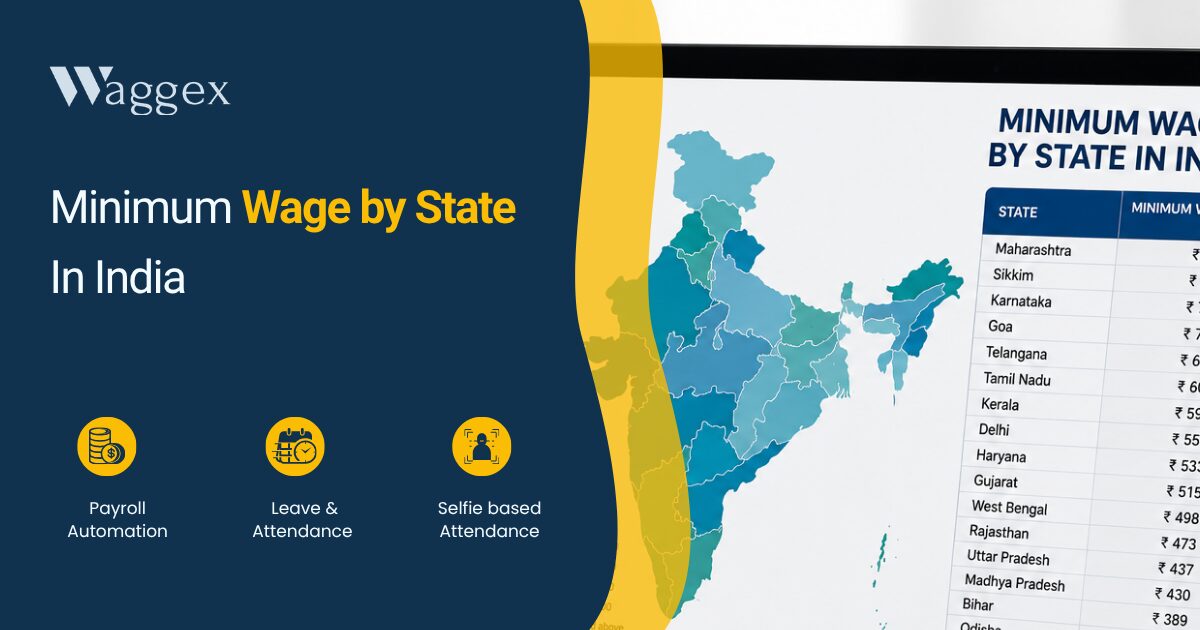
The table below shows monthly minimum wages (₹) for Shops & Commercial Establishments the most commonly applicable scheduled employment for private sector employers. All figures are monthly rates calculated at 26 working days (daily rate × 26). Rates for other scheduled employments (factories, construction, IT, domestic workers, etc.) may differ download your state’s specific gazette notification for your sector.
Sources: State labour department notifications (verified via Husys, Employsome, SalaryBox, TMServices, PunchKaro all July 2026). Figures for NE states and some smaller states reflect 2024–2025 notifications where 2026 revisions were not yet publicly available at time of writing. Effective dates shown are the most recent revision date, not necessarily the current notification period.
| State / UT | Zone / Area | Unskilled (₹/mo) | Semi-Skilled (₹/mo) | Skilled (₹/mo) | Highly Skilled (₹/mo) | Effective / Last Revised |
|---|---|---|---|---|---|---|
| Delhi | Uniform | 18,066 | 19,473 | 22,411 | 24,356 | Apr 2026 |
| Karnataka | Zone I (BLR) | 15,489 | 17,699 | 19,537 | 31,114 | May 2026 |
| Karnataka | Zone II | 13,500 | 15,200 | 17,000 | 25,000 | May 2026 |
| Karnataka | Zone III | 11,000 | 12,500 | 14,000 | 20,000 | May 2026 |
| Haryana | Uniform | 15,220 | 16,500 | 18,000 | 19,500 | Apr 2026 |
| Telangana | Zone I (Hyd) | 15,000 | 16,500 | 18,000 | 20,000 | Oct 2025 |
| Telangana | Zone II | 13,000 | 14,000 | 15,500 | 17,500 | Oct 2025 |
| Maharashtra | Zone I (Mumbai/Pune/Thane) | 14,842 | 16,327 | 17,812 | 19,297 | Oct 2025 |
| Maharashtra | Zone II | 12,500 | 14,000 | 15,500 | 17,000 | Oct 2025 |
| Maharashtra | Zone III | 10,500 | 12,000 | 13,500 | 15,000 | Oct 2025 |
| Uttar Pradesh | Uniform | 13,690 | 14,790 | 16,390 | 18,090 | Apr 2026 |
| Andhra Pradesh | Zone I | 14,000 | 15,500 | 17,500 | 19,500 | Oct 2025 |
| Andhra Pradesh | Zone II | 12,000 | 13,500 | 15,000 | 17,000 | Oct 2025 |
| Kerala | Uniform | 13,500 | 15,000 | 17,500 | 20,000 | Jan 2026 |
| Tamil Nadu | Zone I (Chennai) | 13,823 | 14,200 | 14,743 | 16,500 | Apr 2026 |
| Tamil Nadu | Zone II | 12,500 | 13,000 | 13,823 | 15,000 | Apr 2026 |
| Goa | Uniform | 13,000 | 14,500 | 16,000 | 18,000 | Oct 2025 |
| Gujarat | Zone I | 13,013 | 13,143 | 13,273 | 14,000 | Oct 2025 |
| Gujarat | Zone II | 11,000 | 11,500 | 12,000 | 13,000 | Oct 2025 |
| West Bengal | Zone A | 12,000 | 13,500 | 15,000 | 17,000 | Apr 2026 |
| West Bengal | Zone B | 10,500 | 12,000 | 13,500 | 15,000 | Apr 2026 |
| Rajasthan | Uniform | 10,050 | 10,562 | 11,167 | 11,836 | Oct 2025 |
| Madhya Pradesh | Uniform | 12,150 | 13,048 | 14,012 | 15,048 | Apr 2026 |
| Chhattisgarh | Uniform | 12,000 | 12,500 | 13,200 | 14,000 | Oct 2025 |
| Odisha | Uniform | 11,000 | 12,000 | 13,500 | 15,000 | Oct 2025 |
| Jharkhand | Uniform | 11,000 | 12,000 | 13,500 | 15,000 | Oct 2025 |
| Punjab | Uniform | 11,389 | 12,489 | 13,589 | 14,789 | Oct 2025 |
| Himachal Pradesh | Uniform | 11,000 | 12,000 | 13,500 | 15,000 | Apr 2025 |
| Uttarakhand | Uniform | 11,500 | 12,500 | 13,500 | 15,000 | Oct 2025 |
| Bihar | Uniform | 10,800 | 11,200 | 11,800 | 12,600 | Apr 2026 |
| Assam | Uniform | 6,240 | 7,280 | 9,100 | 11,700 | Apr 2026 |
| Tripura | Uniform | 9,500 | 10,500 | 11,500 | 13,000 | Oct 2025 |
| Manipur | Uniform | 8,000 | 9,000 | 10,500 | 12,000 | 2024–2025 |
| Meghalaya | Uniform | 7,500 | 8,500 | 9,500 | 11,000 | 2024–2025 |
| Nagaland | Uniform | 7,000 | 8,000 | 9,000 | 10,500 | 2024–2025 |
| Mizoram | Uniform | 7,000 | 8,000 | 9,500 | 11,000 | 2024–2025 |
| Sikkim | Uniform | 9,000 | 10,000 | 11,500 | 13,000 | 2024–2025 |
| Arunachal Pradesh | Uniform | 7,000 | 8,000 | 9,500 | 11,000 | 2024–2025 |
| Chandigarh (UT) | Uniform | 13,500 | 15,000 | 17,000 | 19,000 | Apr 2026 |
| Puducherry (UT) | Uniform | 13,000 | 14,500 | 16,000 | 18,000 | Oct 2025 |
| Central Govt. (Area A) | Metro | 21,346 | 23,868 | 26,208 | 28,444 | Apr 2026 |
| Central Govt. (Area B) | Urban | 19,000 | 21,000 | 23,000 | 25,000 | Apr 2026 |
| Central Govt. (Area C) | Rural | 16,500 | 18,500 | 20,500 | 22,500 | Apr 2026 |
⚠ These figures are reference rates for Shops & Commercial Establishments. Factories, construction, IT/ITeS, domestic workers, and other sectors have separate notification schedules. For Central sphere establishments (railways, ports, mines, ONGC), use the Central Government rates in the last three rows above. Always cross-check with the official gazette notification for your state and scheduled employment.
What These Numbers Actually Mean for Your Payroll
Looking at a minimum wage table is the starting point, not the endpoint. Here are the things that actually determine compliance:
- These are statutory floors, not market salaries
A minimum wage of ₹14,000/month for an unskilled worker in Maharashtra doesn’t mean that’s what most employers pay. Market salaries for even entry-level roles in urban Maharashtra typically run significantly higher. The minimum wage is the
absolute legal floor you can always pay more. You cannot pay less.
- Your specific industry’s rate may differ from the table above
Maharashtra alone has over 80 scheduled employments, each with its own minimum wage notification. A garment factory, a software company, and a restaurant in the same Mumbai neighbourhood may all have different applicable minimum wages. The Shops & Commercial Establishments rate shown in the table is the most broadly applicable, but your specific industry category may have a different notification.
- Zone misclassification is the most common error
States like Karnataka, Maharashtra, Andhra Pradesh, and Gujarat have three or more geographic zones with different rates. Using Zone II rates for an employee working in Bengaluru (Zone I) is non-compliance even if your registered office is in a smaller city. The rate follows the employee’s physical work location, not the company’s address.
- VDA revisions mean your compliance status changes twice a year
Even if your wages are compliant today, they may fall below the revised minimum wage after the next VDA notification. Most states revise in April and October. Set a calendar reminder for both months to check your state’s gazette notification and update wages before the effective date not after.
- CTC above minimum wage ≠ compliance
An employee with a CTC of ₹5 lakh/year (₹41,667/month gross) sounds well above any state’s minimum wage. But if their basic salary is ₹15,000/month and the applicable minimum wage for their skill category in that state is ₹16,000/month, you’re non-compliant on the basic component even though total CTC is much higher. Under the Labour Code, the basic wage must individually meet the minimum wage threshold. Allowances padding the total don’t substitute for a shortfall in basic.
| The quick compliance check: Take each employee’s basic salary (monthly). Compare it against the minimum wage for their skill category in their work state and zone. It must be equal to or higher. If basic is below the minimum even if total gross isn’t you need to restructure. |
Employer Compliance Checklist
✓ What Employers Must Do
| ✗ Most Common Compliance Mistakes
|
Penalties for Non-Compliance
Under the Code on Wages 2019 (effective November 2025):
- First offence: Fine up to ₹50,000 per violation
- Repeat offence (within 5 years): Fine up to ₹1,00,000 AND/OR imprisonment up to 3 months
- Back payment: All wages shortfall from the date of non-compliance must be paid with interest
- Prosecution: Under the old Act, prosecution was rare. Under the Code, the enforcement infrastructure is significantly better digital inspection systems and AI-flagged compliance gaps are being rolled out
Note: State-specific penalties under state Shops & Establishments Acts may also apply alongside Code on Wages penalties, and in some cases these are in addition to, not instead of, the above.
Official Sources to Verify Your State’s Current Rate
Always verify minimum wages from official state government portals before processing payroll. Third-party compilations (including this one) should be treated as a starting point, not the final reference.
- Ministry of Labour & Employment: labour.gov.in
- Labour Bureau (central rates and statistics): labourbureaunew.gov.in
- Delhi Labour Department: Delhi minimum wages notifications
- Maharashtra Labour Dept: maharashtra.gov.in
- Karnataka Labour Dept: kalikarnataka.kar.nic.in
- WageIndicator India (aggregator): wageindicator.org/en-in/minimum-wage
Where Waggex Fits In
Keeping up with twice-yearly minimum wage revisions across multiple states, multiple zones, and multiple employee categories is one of the most time-consuming compliance tasks in Indian HR. Waggex’s payroll module is configured per employee including their work state and zone so when minimum wages are revised, salary structures can be reviewed and updated in one place rather than employee by employee in separate spreadsheets.
The Reminder Management feature can be set to flag the April and October revision periods so wages are reviewed before the effective date not after a compliance notice. And because attendance connects directly to payroll, daily-wage or LOP calculations use verified working-days data, not estimates.
For more context on how wages, PF, ESI, and TDS all interact in the same payroll run, our How to Calculate Payroll in India guide has the complete step-by-step with worked examples. And our Payroll Compliance Complete Guide (2026) covers all the statutory deadlines alongside the minimum wage framework.
The Bottom Line
India’s minimum wage system is not a single number it’s a matrix of rates that changes twice a year, varies by state, zone, industry, and skill level, and now carries significantly higher penalties for non-compliance under the Code on Wages. The table in this article gives you the reference figures; your specific compliance position depends on your state, your sector, your zones, and the effective dates of the current notifications.
The two things to do immediately: First, verify that every employee’s basic salary meets the minimum wage for their skill category and zone under the current state notification. Second, set a reminder for October 2026 when the next VDA revision cycle will likely bring fresh notifications across most states.
Always verify from official state government portals or consult a labour law advisor for your specific establishment before making payroll decisions.