

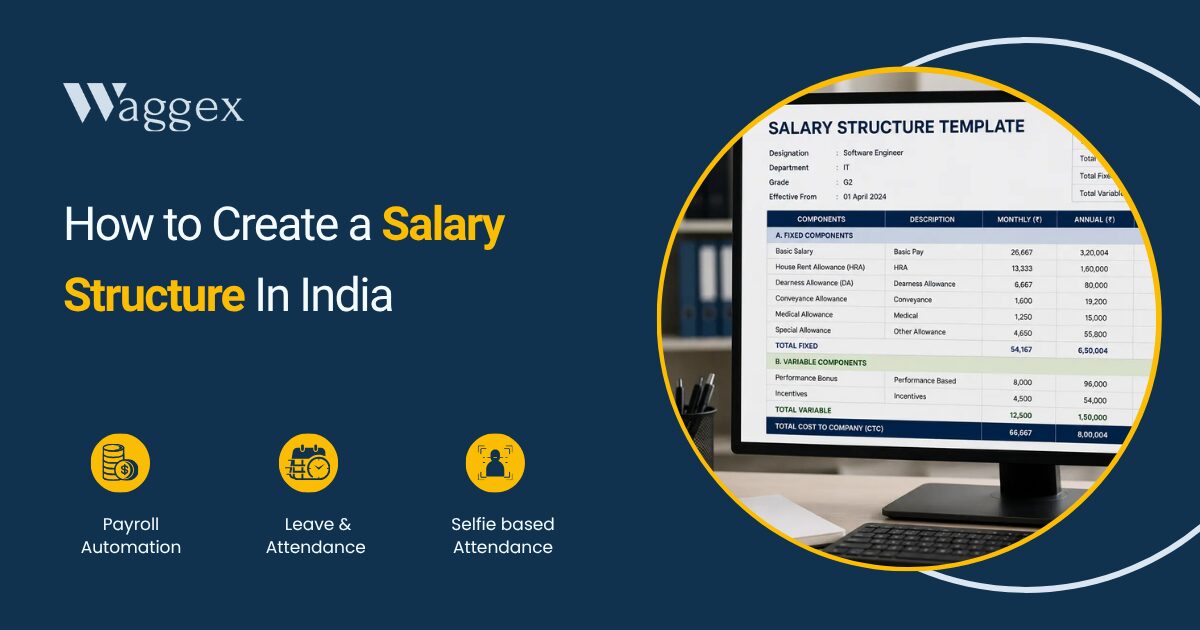
Updated for Labour Code 2025 (effective November 21, 2025) and Income Tax Act 2025 (effective April 1, 2026). Download the free Excel template above all formulas are pre-built and update automatically when you enter the CTC.
When you make someone a job offer, the CTC number is the one that gets written in the letter. But that number is made up of several components basic salary, HRA, allowances, employer PF, gratuity provision and how you split the CTC among them affects the employee’s tax liability, your statutory contributions, and what ends up as their actual monthly take-home.
A well-structured salary isn’t just about making the numbers add up. Under Indian labour law in 2026, there are specific rules about what proportion must go to basic salary, how allowances are capped, and which components attract PF, ESI, and tax. Get this wrong, and you’re either overpaying in statutory costs or building a structure that doesn’t pass an EPFO audit.
This article explains how salary structuring works in India, walks through a complete example, and covers what changed in 2026 that affects every existing salary structure.
What CTC Actually Means and What It Doesn’t
CTC (Cost to Company) is the total annual cost an employer bears for one employee. This includes:
- Gross salary what the employee earns before deductions (basic + HRA + allowances)
- Employer PF contribution 12% of basic salary, paid by the employer to EPFO
- Employer ESI contribution 3.25% of gross wages, only for employees earning ≤ ₹21,000/month gross
- Gratuity provision 4.81% of basic salary set aside for future gratuity payment (payable after 5 years of service)
- Any other employer-paid benefits insurance, meal vouchers, telephone reimbursement, etc.
CTC is not the employee’s take-home. A person earning ₹10 lakh CTC does not receive ₹10 lakh in their bank account. After the employer’s contributions are excluded from the gross, and after employee-side deductions (PF, ESI, TDS, Professional Tax), the actual monthly in-hand figure is significantly lower. This gap is one of the most common sources of confusion and disappointment for new hires and a well-designed salary structure, explained clearly at the offer stage, prevents that.
The Most Important Rule in 2026: Basic Salary Must Be 50% of CTC
The Code on Wages (effective November 2025) mandates that basic salary including Dearness Allowance (DA) must be at least 50% of the total CTC. Allowances cannot exceed 50% of the wage (basic + DA).
This is a direct reversal of what many Indian companies were doing for years. Keeping basic salary low at 30–40% of CTC was a common way to reduce PF liability and gratuity accrual. That practice is now non-compliant. Companies that haven’t restructured their salary framework face back-dated PF shortfalls and potential EPFO audit liability.
| Practical implication of the 50% rule: On a ₹10 lakh CTC: Basic = ₹5 lakh/year (₹41,667/month). PF base = ₹41,667/month. Employee PF = ₹5,000/month. Employer PF = ₹5,000/month. If your company was previously computing PF on ₹25,000/month basic (25% of CTC), you’ve been underpaying PF and the shortfall is back-dated. |
Breaking Down Each Salary Component
- Basic Salary
The foundation of the salary structure. Everything statutory is calculated on it: PF (12%), gratuity (4.81%), and ESI base. Keep it at exactly 50% of CTC not less, as that’s non-compliant, and not significantly more, as that unnecessarily increases PF and gratuity costs.
- House Rent Allowance (HRA)
Typically 40% of basic for employees in non-metro cities, 50% for metro cities (Delhi, Mumbai, Kolkata, Chennai). Under the old tax regime, HRA is partially tax-exempt the exempt amount is the minimum of: actual HRA received, 50% of basic (metro) or 40% (non-metro), and actual rent paid minus 10% of basic. Under the new tax regime (default from FY2026-27), HRA is fully taxable. Employees on the new regime get no benefit from HRA structuring.
- Special Allowance
The residual component whatever CTC remains after basic, HRA, LTA, and employer contributions are allocated. Fully taxable under both regimes. Under the Labour Code, total allowances cannot exceed 50% of basic salary. If they do, the excess is reclassified as part of basic salary which increases PF and gratuity liability.
- Leave Travel Allowance (LTA)
Under the old tax regime: exempt for actual travel costs twice in a block of four years. Under the new tax regime: fully taxable. Most companies still include LTA in the salary structure even for employees on the new regime it remains part of gross salary, just without the tax benefit.
- Employer PF (Part of CTC, Not Gross)
12% of basic salary paid by the employer on top of gross. This forms part of the CTC but is not paid to the employee it goes to the EPFO. It splits as 8.33% to EPS (Employees’ Pension Scheme, capped at ₹1,250/month) and 3.67% to EPF. Deposit deadline: 15th of every month.
- Gratuity Provision
4.81% of basic salary (shorthand for Basic × 15 ÷ 26 ÷ 12 × 12). Payable to the employee after 5 continuous years of service. Maximum gratuity amount: ₹25 lakh (enhanced in 2024, tax-free). Many companies include gratuity in the CTC figure if yours does, be clear about this with employees, as they won’t see this amount in their salary until they leave.
Complete CTC Breakup Example ₹6 Lakh Annual CTC
Employee: Arjun Singh, Operations Executive, non-metro city. Annual CTC: ₹6,00,000. Tax regime: New (default).
| Component | Annual (₹) | Monthly (₹) | Key Rule / Note |
|---|---|---|---|
| A. EARNINGS | |||
| Basic Salary (50% of CTC) | 3,00,000 | 25,000 | Min 50% of CTC mandatory Labour Code 2025 |
| HRA (40% of Basic non-metro) | 1,20,000 | 10,000 | Old regime: partially tax-exempt. New regime: taxable. |
| Special Allowance (residual) | 1,22,000 | 10,167 | Taxable. Total allowances ≤ 50% of basic Labour Code. |
| LTA (8% of Basic) | 24,000 | 2,000 | Old regime: exempt for actual travel. New regime: taxable. |
| GROSS SALARY (A) | 5,66,000 | 47,167 | CTC minus employer contributions |
| B. EMPLOYER CONTRIBUTIONS | Part of CTC, not part of gross salary | ||
| Employer PF (12% of Basic) | 36,000 | 3,000 | Deposit by 15th monthly. EPS capped at ₹1,250/mo. |
| Gratuity Provision (4.81% of Basic) | 14,430 | 1,203 | Payable after 5 years. Max ₹25 lakh tax-free. |
| Employer ESI | N/A | N/A | Gross > ₹21,000/mo ESI not applicable here |
| TOTAL CTC | 6,16,430 | 51,369 | Should match offer letter CTC |
| C. EMPLOYEE DEDUCTIONS | Deducted from employee gross salary | ||
| Employee PF (12% of Basic) | 36,000 | 3,000 | Employee and employer both pay 12% of basic |
| Employee ESI | N/A | N/A | Not applicable (gross > ₹21,000/mo) |
| Professional Tax (Karnataka) | 2,400 | 200 | Varies by state. Delhi = ₹0. See PT reference tab. |
| TDS (New Regime see note) | 0 | 0 | Taxable income ≤ ₹12L → zero tax under 87A rebate |
| TOTAL DEDUCTIONS (C) | 38,400 | 3,200 | |
| D. NET TAKE-HOME | 5,27,600 | 43,967 | Gross minus all deductions |
Note: TDS is zero here because taxable income (₹5,66,000 gross − ₹75,000 standard deduction = ₹4,91,000) falls below ₹12 lakh and the Section 87A rebate fully covers the tax liability. The template’s TDS formula calculates this automatically for you.
Free CTC Breakup Template What’s in the Excel File
The Excel template attached to this article has four tabs, all with formulas pre-built:
- CTC Breakup Calculator. Enter the annual CTC in one yellow cell all components (basic, HRA, LTA, special allowance, PF, gratuity, ESI, TDS, PT, net take-home) calculate automatically. Adjust Professional Tax for the employee’s state.
- TDS Reference. Side-by-side comparison of New Regime and Old Regime tax slabs, standard deductions, and key exemptions for FY 2026-27. Use this to explain to employees why switching to the old regime might or might not benefit them.
- Professional Tax by State. PT rates and payment frequencies for 12 major Indian states. Karnataka, Maharashtra, West Bengal, Tamil Nadu, and others. Delhi (₹0) and Rajasthan (₹0) also noted. Includes the Maharashtra February ₹300 quirk the most commonly missed PT adjustment in India.
- Monthly Salary Register. Process up to 15 employees in one sheet. Enter gross salary, basic, and LOP days PF, ESI, PT, and deductions calculate automatically. Totals row at the bottom sums up employer costs including PF and ESI.
| How to use the template: Open the CTC Breakup Calculator tab. Enter the annual CTC in cell B13 (yellow cell). All components update immediately. Adjust cell D32 for the employee’s state Professional Tax. If the employee is on Old Regime, flag that on the employee details and use the TDS Reference tab to manually verify TDS. |
Common Salary Structuring Mistakes and How to Avoid Them
- Basic below 50% of CTC. The most important compliance gap post-November 2025. If you have existing employees with basic at 30–40% of CTC, restructure before the next EPFO cycle.
- Including TDS in CTC without calculating correctly. TDS is an employee’s tax not an employer cost. It should not be included in CTC calculations. Showing ‘TDS: ₹15,000’ as a component in a CTC breakup document confuses employees and doesn’t represent the employer’s actual cost.
- Using the wrong PT for the employee’s work location. PT follows where the employee physically works not where the company is registered. A Delhi-headquartered company with an employee working from Bengaluru owes Karnataka PT (₹200/month), not Delhi PT (₹0). This is frequently missed for remote employees.
- Not adjusting TDS mid-year after salary revision. When salary changes in October, the annual income estimate changes. TDS for the remaining months must be recalculated, not left at the original rate. A salary revision that isn’t reflected in TDS creates a year-end shortfall the employee pays out of pocket.
- Forgetting the employer PF admin charge. Employer PF cost is not just 12% it includes a 0.5% admin charge on basic salary. For budgeting total employer cost, include this: 12.5% of basic, not 12%.
- Making gratuity disappear from CTC. Gratuity must be provisioned even if not shown in monthly payslips. Employees who complete 5 years have a legal right to it. Companies that haven’t provisioned it monthly find a surprise liability when a long-tenured employee exits.
Old Regime vs New Regime Which Should You Recommend to Employees?
This is one of the most common questions HR teams get asked. The honest answer depends on the employee’s specific deductions, and you shouldn’t push either option both are legitimate choices.
New regime is better for employees who: don’t have significant Section 80C investments (LIC, PPF, ELSS), don’t pay rent in a metro city, don’t have a home loan, and have relatively simple income. For someone earning ₹8–15 lakh with no major deductions, the new regime’s lower rates usually result in lower tax.
Old regime is better for employees who: pay significant rent in Mumbai, Delhi, Bengaluru, or Chennai (large HRA exemption), have maximum 80C investments (₹1.5L), pay home loan interest (Section 24, up to ₹2L), and contribute to NPS (additional ₹50,000 under 80CCD). For someone with these deductions, the old regime’s higher standard deductions can still result in less tax.
The employer’s role is to deduct TDS based on whichever regime the employee declares at the start of the year. If an employee doesn’t declare anything, the new regime applies by default. They can switch at the time of filing their own ITR. For a full breakdown of how TDS is calculated under both regimes, see our Payroll Compliance in India: Complete Guide (2026).
How Waggex Handles Salary Structure and Payroll
The template does the calculation well for one employee at a time. Where it gets difficult is doing this for 30 or 50 employees every month especially when salary revisions happen mid-year, new joiners have different PT states, and some employees are on old regime while others are on new.
In Waggex’s payroll module, salary structures are configured per employee basic percentage, allowance components, which regime applies, which state’s PT to use. Once configured, each payroll run calculates PF, ESI, TDS, PT, and LOP deductions automatically from the current month’s attendance data. There’s no separate export step the attendance record (from GPS check-in or FaceLens selfie attendance) feeds directly into LOP calculation, which feeds directly into net salary.
The Tax and Forms Management module generates Form 138 (quarterly TDS returns) and Form 130 (employee TDS certificates, replacing Form 16) in filing-ready format. Deadline reminders come via the Reminder Management feature so the 7th (TDS), 15th (PF/ESI), and quarterly filing dates are flagged in advance.
If you want to run this process for your own team, Waggex’s free trial gives you full access no credit card, setup in under a day. For background on how Indian payroll calculations work step by step, our How to Calculate Payroll in India guide covers all the formulas with worked examples.
The Bottom Line
A salary structure isn’t just a way to display compensation; it directly determines your PF liability, your gratuity obligation, your employees’ tax burden, and whether you’ll pass an EPFO audit. The 2025 Labour Code’s 50% basic rule has made this more consequential than before for companies that were keeping basic low.
The Excel template above handles the calculations, enters the CTC, choose the state, and the breakup generates automatically. It’s calibrated for the New Tax Regime default of FY2026-27, with the correct standard deduction (₹75,000), the right ESI threshold (₹21,000/month gross), and the gratuity provision at 4.81% of basic. Use it as a starting point, review the outputs with your CA for complex situations, and make sure your existing structures are compliant with the 50% basic rule before the next payroll cycle.