

Take a company with 60 employees, clean hiring process, proper paperwork, a functioning leave system. Attrition is still at 28%. The entry and exit stages are managed. Everything in the middle development, retention, the quiet months between onboarding and the next appraisal runs on autopilot. That’s where people leave from.
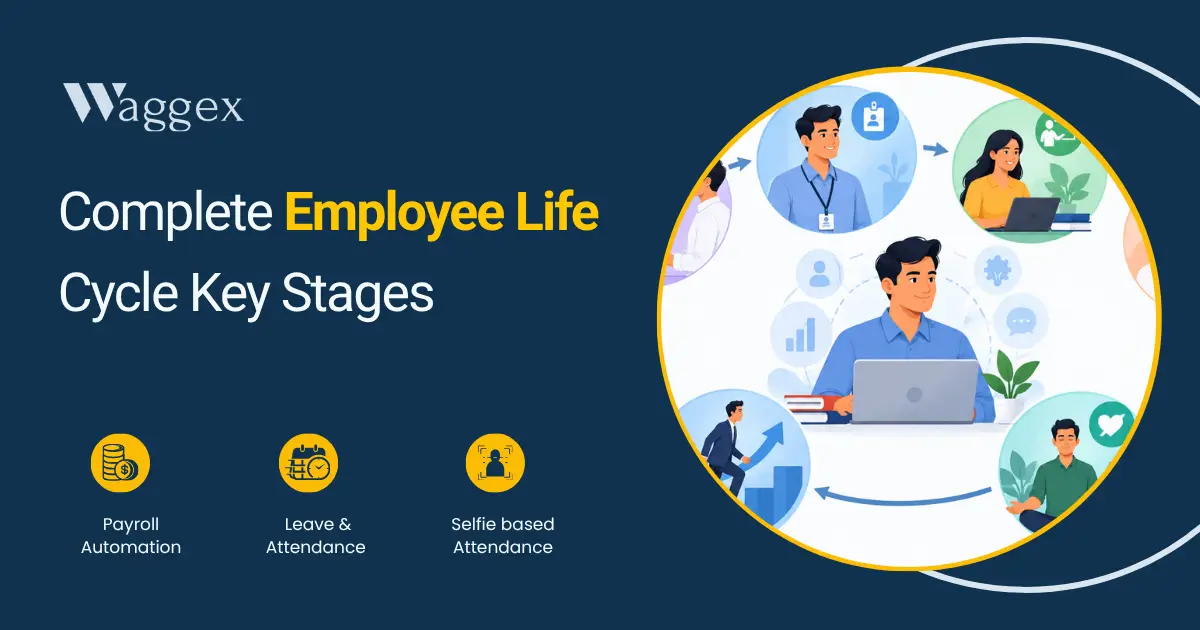
The employee life cycle is the full arc from the moment someone hears about your company to the day they walk out. Most HR teams treat it like a checklist they complete at both ends. This guide covers all seven stages and where each one typically breaks down.
Stage 1 Attraction
Before someone applies, they’ve already formed an opinion about your company. They’ve read Glassdoor reviews, seen how your job descriptions are written, maybe checked your LinkedIn page. A 200-word job posting that reads like a legal document and lists 14 mandatory requirements for a junior role tells candidates something about how the company operates and not something good.
What HR can actually control here: write job descriptions that describe the real job, not the fantasy version. Respond to Glassdoor reviews, even the critical ones. Build an employee referral programme that works because your employees genuinely want to refer people, not because there’s a ₹5,000 bonus attached.
Stage 2 Recruitment
This is the stage most HR teams invest the most time in. The mistake isn’t effort it’s that the process is designed around the company’s convenience rather than the candidate’s experience.
A candidate who goes through five interview rounds for a junior role and then waits 12 days for an offer letter is talking to other companies the entire time. The speed of your hiring process is itself a signal about how the company works. Slow, bureaucratic hiring tends to correlate with slow, bureaucratic management and mid-level candidates know this.
Quick check: How many days between your first interview and offer letter? If it’s more than 10, you’re losing people.
Stage 3 Pre-Boarding
The gap between offer acceptance and day one is when you lose the most people nobody talks about. The candidate accepted your offer. They’re still getting calls from other companies. If they hear nothing from you for two weeks, the silence starts to feel like an answer.
Pre-boarding takes almost no effort: send the appointment letter within 48 hours, share what to bring on day one, introduce them to their manager over email. Make sure their laptop is set up before they arrive. These aren’t complicated. They just require someone to own the checklist. For what documents to collect at this stage, the HR document checklist before hiring covers the full list.
Stage 4 Onboarding
First 90 days. This is the stage that decides whether someone stays for three years or leaves after six months. Not the salary. Not the perks. The onboarding.
Good onboarding isn’t an orientation presentation and a building tour. It’s the structured process of helping someone understand their role, their team, how decisions get made, and what success looks like for them specifically. Companies that do this well see significantly lower early attrition. Companies that don’t tend to blame the hire.
The most common onboarding failure: it stops at week two. The first week is structured. Then the new employee is handed off to the manager and HR considers the job done. A 30-day check-in, a 60-day check-in, a 90-day review these take 30 minutes each and catch problems before they become exit conversations.
Stage 5 Development
Most HR teams go quiet here until appraisal season. That’s a year of silence and for someone who joined wanting to grow, a year of no signal about whether they’re on track is the same as a signal that they’re not going anywhere.
Development doesn’t mean sending everyone to a training programme. It means managers having regular 1-on-1s, goals being set and actually checked during the year, and promotion criteria being communicated before someone is passed over for a promotion they didn’t know they were being considered for. That last one is how you lose your best people to companies that are willing to have the conversation you weren’t.
For a practical framework: 7 proven ways to track employee performance covers the methods that actually work in Indian companies, without requiring a dedicated performance management software.
Stage 6 Retention
Retention isn’t a benefit you add. It’s the outcome of getting the earlier stages right. But there are specific things HR can do when the earlier stages didn’t go perfectly: stay interviews, compensation benchmarking, manager effectiveness reviews.
Stay interviews are underused. Most companies do exit interviews they ask departing employees what went wrong. Stay interviews ask current employees what would make them leave, before they decide to leave. The information is more useful and you still have time to act on it. Ask someone who’s been with you 18 months why they stay and what would change that. You’ll learn things no engagement survey will tell you.
One specific pattern: high attrition at the 12–18 month mark usually means onboarding went well but development didn’t follow. High attrition at 6 months usually means onboarding failed. The timing tells you where to look.
Stage 7 Exit
Someone gives notice. This stage is handled badly by almost everyone.
The exit interview is a form that goes in a folder nobody reads. The knowledge transfer is a rushed two-week scramble where the departing person is half mentally out the door. The full and final settlement takes three weeks when the new Labour Code requires it within two working days of the last working day. The experience letter takes another month. The person leaves feeling like a burden the company was relieved to be rid of.
This matters more than most HR teams realise. The person who just left talks to their network. They mention how the exit was handled. Former employees come back as clients, partners, referral sources, and sometimes as boomerang hires. A clean, respectful exit is not a courtesy it’s a business decision. The full list of documents an employee should collect before leaving is worth sharing proactively so the exit process is smooth on both sides.
The Through-Line
Every stage of the life cycle produces data documents, records, attendance history, leave patterns, performance notes, payroll history. When that data lives in disconnected places (some in email, some in a spreadsheet, some only in someone’s memory), the life cycle has gaps. When it’s in one system, each stage informs the next.
F&F takes two days when everything is already in the system. Onboarding is faster when the joining documents are collected properly. The exit interview is more useful when you can see the person’s review history alongside their resignation reason. Waggex connects attendance, leave, shifts, and payroll in one place for companies of 5–100 employees so when an employee reaches stage 7, HR isn’t assembling their history from five different tabs.