Updated July 2026. Reflects the January 19, 2026 Supreme Court ruling on overtime wage base, Factories Act 1948, state Shops & Establishments Acts, and the OSH Code 2020. Verified sources: Informist Media, TeamLease RegTech, EZHRM, SalaryBox (all 2026). Always verify against official state notifications and consult a labour law advisor for your specific situation.
Overtime calculation in India sounds simple, someone works extra hours, you pay them more. But the actual calculation depends on which law applies to your establishment, which state you’re in, what salary components go into the calculation base, and how many overtime hours the employee has already worked this quarter. Get any one of these wrong and you’re potentially looking at a labour audit.
2026 also brought a significant change to how overtime must be calculated for factory workers. On January 19, 2026, the Supreme Court of India ruled in Union of India v. Heavy Vehicles Factory Employees’ Union that the ordinary rate of wages which is what overtime is calculated on includes all allowances, not just basic salary and DA. HRA, transport allowance, special allowance all of it counts. Most payroll teams have been calculating overtime on basic+DA alone for years. That’s now definitively non-compliant for factory establishments.
This guide covers the full overtime framework for 2026 factories, IT and services, hospitals, shift workers, remote employees, and contract staff with worked examples for each type so the formulas are grounded in real numbers.
The Legal Framework Which Law Applies to Your Business
The first question isn’t ‘how do I calculate overtime’ it’s ‘which law governs my establishment’. The answer determines the rate, the trigger, and the cap.
- Factories Act 1948 Applies to manufacturing units employing 10 or more workers using power, or 20 or more without power. If you run a factory, this is your primary OT law. Section 59 mandates 2× the ordinary rate for hours beyond 9/day or 48/week.
- State Shops and Establishments Acts Applies to commercial establishments: offices, shops, hotels, hospitals, IT companies, service businesses. Each state has its own act with its own rate and hours limit. Delhi mandates 2×. Maharashtra mandates 2×. Karnataka mandates 1.5×. Always check your specific state’s current notification.
- OSH Code 2020 Passed by Parliament but not yet notified in most states as of July 2026. When notified, it will standardise the quarterly OT cap to 125 hours across all covered establishments and require written employee consent before assigning overtime. The Factories Act continues to apply where OSH Code hasn’t been notified yet.
| The two-step check before calculating any overtime: Step 1 Is my establishment a factory (Factories Act) or a commercial/services establishment (Shops Act)? Step 2 If Shops Act, which state’s act applies? The rate and hours threshold differ by state. Getting Step 1 wrong is the most common error. An IT company with a UPS room and generators is NOT a factory under the Act. A packaging plant with 12 workers using power-operated equipment IS. |
The January 2026 Supreme Court Ruling What Changed
This is the most important overtime development of 2026 and directly affects every factory employer in India. The Supreme Court, in its judgment dated January 19–20, 2026 in Union of India & Others v. Heavy Vehicles Factory Employees’ Union & Another (Civil Appeal Nos. 5185–5192 of 2016, 2026 INSC 74), held:
“The ordinary rate of wages under Section 59(2) of the Factories Act includes basic wages plus all allowances to which the worker is entitled. The only exclusions are bonus and wages for overtime work themselves.”
In plain language: HRA, transport allowance, clothing allowance, small family allowance, special allowance all of these must now be included in the overtime calculation base for factory workers. The Central Government had previously issued office memoranda trying to exclude these allowances. The Supreme Court explicitly ruled that ministries have no power to add exclusions that Parliament didn’t put in the statute.
| What this means for your payroll right now: If you run a factory and your overtime has been calculated on Basic + DA only, audit your OT calculations from January 2026 onward. Employees may be owed back payments. The corrected base is Basic + DA + HRA + all other regular allowances. Only bonus and OT wages themselves are excluded. For office and services establishments under Shops Acts, the ruling doesn’t directly bind but it has triggered similar scrutiny, and several states are reviewing their own definitions. |
The Core Formula
Step 1 Calculate the hourly rate:
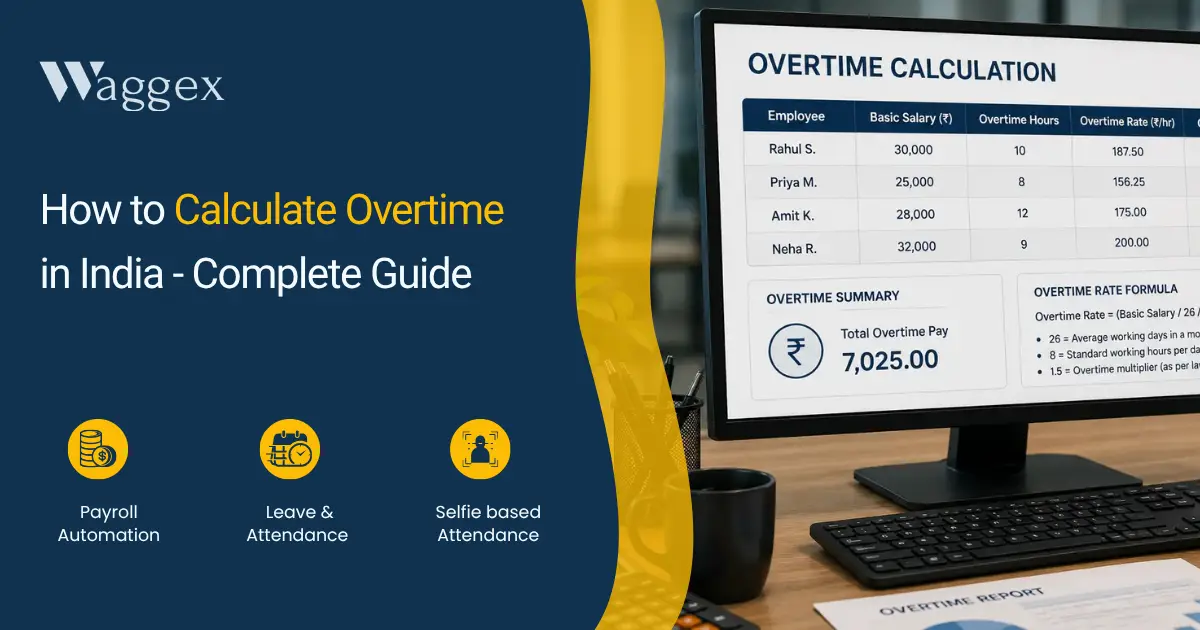
Hourly Rate = Monthly Salary ÷ (Working days per month × Daily hours)
Standard divisor: 26 working days × 8 hours = 208 hours
Some companies use 30 × 8 = 240 hours (calendar month basis). Be consistent use the same divisor for all employees and all months.
Step 2 Apply the OT multiplier:
OT Pay = Hourly Rate × Multiplier × OT Hours
- Factories Act: Multiplier = 2 (double the ordinary rate)
- Shops Act most states: Multiplier = 1.5 or 2 (check your state)
What ‘Monthly Salary’ means in this formula:
- Factories Act (post Jan 2026 SC ruling): Basic + DA + HRA + all regular allowances excluding only bonus and OT wages
- Shops Acts: Typically Basic + DA verify your state’s definition
1. Factories and Shift Workers
This is where overtime calculation is most regulated and after the January 2026 ruling, where most payroll teams have the biggest correction to make. Shift workers in manufacturing, processing, packaging, pharmaceuticals, and similar industries all fall under the Factories Act.
Triggers
- Daily: More than 9 hours of actual work in a day (not including meal breaks)
- Weekly: More than 48 hours of work in a week
- Maximum per day including OT: 12 hours no exceptions
- Minimum rest between shifts: 11 consecutive hours (an employee finishing a night shift at 6 AM cannot start the morning shift at 6 AM)
Rate
2× the ordinary rate. Post January 2026 ruling: ordinary rate = Basic + DA + HRA + all regular allowances.
Quarterly cap
- 50 hours per quarter under Section 64 of the Factories Act
- 75 hours with state government exemption
- Up to 144 hours in states like Maharashtra and Telangana where amendments allow higher caps for specific industries with written worker consent
- 125 hours when OSH Code 2020 is notified nationally still pending in most states as of July 2026
Important: Cash payment is mandatory
Comp-off cannot substitute for overtime under the Factories Act. If an employee works 12 hours instead of 8, you owe them 4 hours at 2× in cash, in that month’s salary. Giving them a day off instead is not compliant. If your factory is currently running comp-off instead of cash OT, this is a compliance gap.
Worked Example Factory Shift Worker
Rajan Kumar Machine Operator, pharmaceutical factory, Gujarat
Monthly salary: Basic ₹18,000 · HRA ₹7,200 · Transport Allowance ₹2,000 · Special Allowance ₹3,000
OT hours this month: 14 hours (worked late on 7 evenings, 2 hours each)
| Component | Amount |
|---|---|
| Monthly calculation base (post Jan 2026 ruling) | |
| Basic Salary | ₹18,000 |
| HRA | ₹7,200 |
| Transport Allowance | ₹2,000 |
| Special Allowance | ₹3,000 |
| Total OT base (all allowances, excl. bonus/OT) | ₹30,200 |
| Hourly rate calculation | |
| Divisor (26 days × 8 hours) | 208 hours |
| Hourly Rate = ₹30,200 ÷ 208 | ₹145.19 |
| OT Rate (2×) | ₹290.38/hour |
| OT Hours worked | 14 hours |
| OT Pay = ₹290.38 × 14 | ₹4,065.30 |
| What it would have been on old Base+DA only | |
| Old base (Basic + DA only no DA here) | ₹18,000 |
| Old hourly rate = ₹18,000 ÷ 208 | ₹86.54 |
| Old OT rate (2×) | ₹173.08 |
| Old OT Pay | ₹2,423.07 |
| Underpayment per month | ₹1,642.23 |
The difference is ₹1,642 per month, per worker. Across 40 factory workers, that’s ₹65,680/month of potential underpayment and a back-dated liability from January 2026 onward.
2. IT and ITeS Companies
IT companies in India don’t fall under the Factories Act they’re covered by state Shops and Commercial Establishments Acts. This means the overtime rate, trigger, and cap vary by state. It also means there’s a long-standing exemption question around managerial and supervisory employees which many IT companies have interpreted very broadly.
The ‘manager exemption’ where IT companies get it wrong
Most state Shops Acts exempt employees in ‘managerial or supervisory capacities’ from overtime provisions. In IT, this has been used to exclude almost everyone above a junior level calling every Team Lead, Senior Developer, and Project Manager a ‘supervisor’ to avoid OT obligations.
This doesn’t hold up on scrutiny. If an employee’s actual job involves writing code, testing software, or handling support tickets even if their title says ‘Senior’ or ‘Lead’ they’re not exercising genuine managerial authority. Labour courts look at actual duties, not job titles. If your classification doesn’t reflect what the person actually does, you’re exposed.
State-by-state OT rates for IT/ITeS (major states)
- Karnataka (most IT companies): Shops Act 1.5× ordinary rate for hours beyond 10/day or 50/week. Bengaluru tech companies should verify with the Karnataka Shops and Commercial Establishments Act 1961.
- Maharashtra (Mumbai, Pune): Maharashtra Shops & Establishments Act 2× for hours beyond 48/week.
- Telangana (Hyderabad): Telangana Shops and Establishments Act 1.5× beyond 48 hours/week.
- Tamil Nadu (Chennai): Tamil Nadu Shops and Establishments Act 2× beyond 48 hours/week.
- Delhi (NCR IT): Delhi Shops and Establishments Act 2× beyond 8 hours/day or 48/week.
Worked Example IT Company, Bengaluru
Priya Nair Software Engineer, mid-size IT company, Bengaluru
Monthly: Basic ₹45,000 · HRA ₹18,000 · Special Allowance ₹12,000 · Total gross ₹75,000
Karnataka Shops Act applies. Rate: 1.5×. Base: Basic + DA (Karnataka S&E Act definition)
OT hours this month: 8 hours (worked late for a product release over 4 days)
| Component | Amount |
|---|---|
| Calculation base (Karnataka S&E Act Basic+DA) | ₹45,000 |
| Hourly Rate = ₹45,000 ÷ 208 | ₹216.35 |
| OT Rate (1.5× Karnataka) | ₹324.52/hour |
| OT Hours | 8 hours |
| OT Pay = ₹324.52 × 8 | ₹2,596.15 |
| OT is taxable as salary income | Include in monthly TDS calculation |
Practical issue in IT: Most IT companies don’t track actual hours beyond a 9–10 hour workday for salaried employees. The concept of a ‘fixed monthly salary covers extra hours’ exists culturally but it has no legal backing in the Shops Act. If an employee can show they regularly worked beyond the weekly limit, the company may owe OT irrespective of the compensation structure.
The ‘all-inclusive salary’ argument does it hold?
Some IT companies pay a higher-than-market fixed monthly salary and argue this implicitly covers overtime. This is not a valid defence under the Shops Act. An employee who works beyond the statutory weekly limit is entitled to OT pay on top of their regular salary the salary amount doesn’t substitute for the statutory obligation. The only compliant approach is either to ensure employees don’t exceed the weekly limit, or to pay overtime when they do.
3. Shift Workers Outside Factories Hospitals, Hotels, BPOs
Not all shift workers are in factories. Hospitals, hotels, call centres, security companies, and retail chains all run 24-hour or extended-hour operations with rotating staff and most of them fall under state Shops Acts, not the Factories Act.
The key difference from factories
- Rate: Under Shops Acts, typically 1.5× to 2× (state-specific, not uniformly 2×)
- Trigger: Usually 8–9 hours/day or 48 hours/week under Shops Acts
- Comp-off: Unlike factories, some Shops Acts do allow compensatory off instead of cash payment but this must be given within a specified period (usually 30 days) and must be agreed in writing
- Night shift allowance: This is separate from OT. Night shift allowance applies when someone works the night shift regardless of whether they exceeded their hours. Overtime pay applies when they exceeded their scheduled hours, regardless of which shift.
Night shift + overtime when both apply
Night shift allowance and overtime pay are not mutually exclusive. If a nurse is on a 10-PM-to-6-AM shift and stays until 8 AM due to a patient emergency, they’ve worked 2 hours of overtime on top of their night shift. They’re entitled to: (a) their regular night shift salary including night allowance, plus (b) 2 hours of overtime pay at the applicable rate. Both.
Worked Example Hospital Nurse, Night Shift OT
Meena Pillai Staff Nurse, 60-bed private hospital, Hyderabad (Telangana Shops Act)
Monthly: Basic ₹22,000 · DA ₹3,000 · Night Shift Allowance ₹150/night worked
This month: worked 22 night shifts (standard) + 3 emergency overtime nights where she worked 12 hours instead of 10
OT hours: 3 shifts × 2 hours each = 6 OT hours
| Component | Calculation | Amount |
|---|---|---|
| Regular Monthly Gross | Basic + DA + Night Allowance (22 nights) | ₹28,300 |
| Night Allowance | ₹150 × 22 nights | ₹3,300 |
| OT Base (Telangana S&E Basic+DA) | ₹22,000 + ₹3,000 | ₹25,000 |
| Hourly OT Rate (1.5×) | ₹25,000 ÷ 208 × 1.5 | ₹180.29/hr |
| OT for 6 hours | 6 × ₹180.29 | ₹1,081.73 |
| Night allowance for OT nights (3 nights) | ₹150 × 3 | ₹450 |
| Total Month Payable | Regular + OT + Night OT allowance | ₹29,831.73 |
4. Remote and Work-From-Home Employees
Remote work has grown significantly in India since 2020 and is now a permanent fixture in IT, consulting, content, customer support, and many other sectors. The labour law treatment of remote workers for overtime purposes is the same as office workers in the same state remote work doesn’t create a separate category or exemption.
Which law applies to a remote employee
The applicable Shops Act is determined by where the employee is physically located and works not where the company is registered. A developer in Hyderabad working for a Bengaluru-registered company is covered by the Telangana Shops and Establishments Act, not the Karnataka Act. The company’s compliance obligations follow the employee’s state.
The practical problem: tracking hours
The biggest overtime challenge for remote teams isn’t the calculation it’s knowing when overtime has occurred. A shift worker clocks in and out through a biometric device or GPS app. A remote employee working from a home office has no equivalent automatic tracking unless the company has set one up.
Without reliable time logs, if an employee later claims they worked beyond 48 hours per week for three months, there’s no data to either confirm or deny it. The burden of proof in most labour courts falls on the employer to show working hours were within statutory limits and ‘we don’t track their hours’ is not a defence.
What actually works for remote OT compliance
- Time-logging in the project management system. Jira, Asana, or Notion time entries create a de facto work-hours record. Train managers to review if a team member’s logged hours consistently exceed 48/week.
- Check-in and check-out via a digital attendance system. An app-based check-in at the start and end of each workday even from home creates the attendance record that protects both the employee and the employer.
- Define working hours in the employment contract. ‘Standard working hours are 9 AM to 6 PM with a 1-hour break, Monday to Friday, totalling 40 hours per week’ gives a clear baseline from which overtime can be calculated and managed.
- Weekly hours review by manager. For teams on results-based work patterns, a weekly review of logged hours catches consistent overtime before it becomes a legal liability.
Worked Example Remote Employee, IT Support
Arjun Mehta Technical Support Analyst, remote, works from Pune for a Delhi-registered company
His state: Maharashtra. Applicable law: Maharashtra Shops and Establishments Act. OT rate: 2×.
Monthly: Basic ₹28,000 · Special Allowance ₹10,000 · HRA ₹11,200 · Total gross ₹49,200
Time logs show he worked 56 hours in Week 2 of the month 8 hours of overtime that week
| Component | Amount |
|---|---|
| Applicable law | Maharashtra Shops Act 2× rate |
| OT base (Maharashtra definition Basic+DA) | ₹28,000 |
| Hourly Rate = ₹28,000 ÷ 208 | ₹134.62 |
| OT Rate (2× Maharashtra) | ₹269.23/hour |
| OT Hours (Week 2 only 56-48=8 hrs) | 8 hours |
| OT Pay = ₹269.23 × 8 | ₹2,153.85 |
| Note on state | His company is in Delhi but his OT rate follows Maharashtra where he physically works |
The FaceLens and GPS attendance features in Waggex work equally well for remote employees they check in from home, location is verified, and the hours are recorded. This creates the attendance record that protects both the employer and the employee in any dispute.
5. Contract and Gig Workers
Contract workers whether through a staffing agency or directly engaged as fixed-term employees are entitled to overtime at the same rate as permanent employees performing the same work. This was made explicit under the Code on Wages 2019 and the Industrial Relations Code 2020. Contractual arrangements cannot reduce statutory entitlements.
Principal employer liability
If your contractor doesn’t pay overtime correctly to the workers they’ve supplied, you as the principal employer can be held jointly liable. This is one of the most significant compliance risks in India’s contract labour landscape. If an EPFO or labour inspector audit finds OT non-compliance by a contractor at your facility, you cannot simply point to the contractor and walk away.
Gig workers the evolving question
Gig and platform workers (delivery, ride-hailing, freelance services) are in a legal grey area. The Code on Social Security 2020 recognises them as a category but doesn’t yet give them the same overtime entitlements as employees. The position is expected to evolve as state-level gig worker policies develop. For the time being, if your business engages gig workers for extended shifts that resemble employment, get legal advice on classification before an audit forces the question.
Overtime, Payroll, and What Gets Connected
Overtime is only correctly calculated if attendance data is accurate. A shift worker who stayed 2 hours late on a Tuesday and the system doesn’t capture that check-out time correctly the OT simply doesn’t appear in payroll. Multiply that by 30 shift workers over 26 working days and you have a significant exposure.
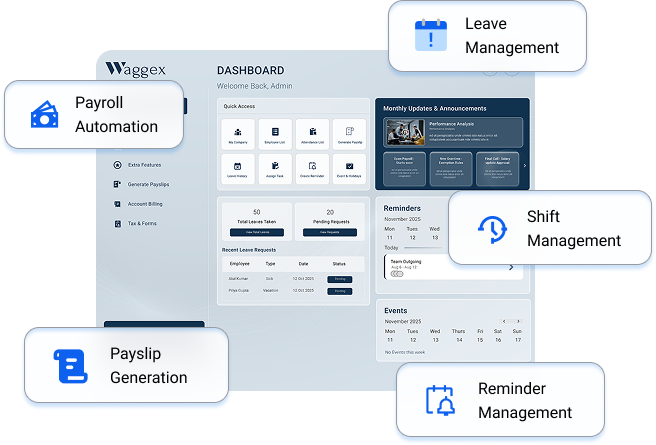
This is why attendance tracking and payroll need to be in the same system for OT to work correctly. In Waggex, when an employee’s check-out goes past their shift’s overtime threshold (configured per shift type), the system flags it in real time. That OT data flows directly into the payroll run no HR person manually checking who stayed late and entering hours before salary day.
For shift-based teams, the Shift Management module lets you define each shift’s start time, end time, and the OT threshold (how many minutes past shift end before OT starts). Night shift allowances also configure per shift so the right allowance applies to the right shift automatically, separate from OT pay.
We’ve covered the complete payroll calculation picture in our How to Calculate Payroll in India guide, and the full compliance calendar in our Payroll Compliance in India: Complete Guide (2026).
Quick Reference OT Rules by Sector
Here’s everything in one place to help identify which framework applies to your team.
| Sector / Type | Governing Law | OT Trigger | OT Rate | Quarterly Cap | Special Points |
|---|---|---|---|---|---|
| Factory / Mfg | Factories Act s.59 | 9 hrs/day or 48 hrs/week | 2× ordinary rate (all allowances SC Jan 2026) | 50 hrs (75 with exemption; some states 144 hrs) | Cash only. Comp-off cannot substitute. |
| IT / ITeS | State S&E Act | Varies by state (mostly 48 hrs/week) | 1.5× to 2× (state-specific) | Varies | Many states exempt ‘managers’ check designation carefully. |
| Shops & Offices | State S&E Act | 8–9 hrs/day or 48 hrs/week | 1.5× to 2× (state-specific) | State-specific | Delhi: 2×. Maharashtra: 2×. Karnataka: 1.5×. |
| Hospitals / Healthcare | Factories Act or S&E Act (varies) | 9 hrs/day or 48 hrs/week | 2× (Factories Act) / State rate (S&E) | 50–75 hrs / state cap | Night shift OT applies on top of night allowance. |
| Construction | OSH Code / BOCW Act | 8 hrs/day | 2× | 125 hrs/qtr (when OSH notified) | Site-based attendance essential for OT tracking. |
| Remote / WFH | State S&E Act (employee’s state) | 48 hrs/week | Same as applicable S&E rate | State-specific | Challenge: tracking actual hours worked. Time logs essential. |
| Contract Workers | Same as principal employer’s Act | Same trigger as permanent workers | Same rate contract workers entitled equally | Same cap | Principal employer jointly liable if contractor defaults. |
OT rates and caps are as of July 2026. State Shops Act rates vary always verify from the official state notification for your establishment. OSH Code pending national notification in most states as of July 2026.
Common Overtime Mistakes and How to Fix Them
- Calculating OT on Basic+DA only for factory workers (post Jan 2026). The January 2026 SC ruling changed this. Your OT base for factory workers must now include all regular allowances. Audit your calculations from January 2026 onward and correct any underpayments.
- Giving comp-off instead of cash OT in factories. Not compliant under the Factories Act. Factory workers must be paid OT in cash. Comp-off is only a valid substitute under some Shops Acts and even then, only within a defined period.
- Blanket ‘manager exemption’ in IT companies. Job title doesn’t determine exemption. Actual duties do. A ‘senior software engineer’ writing code full-time is not a manager.
- Not tracking remote employees’ hours. Without time logs, you can’t prove employees weren’t working overtime. This is the employer’s problem if a dispute arises.
- Applying the wrong state’s Shops Act. The applicable law follows the employee’s physical work location, not the company’s registered state.
- Missing the quarterly OT cap. Under the Factories Act, an employee cannot work more than 50 hours of OT per quarter (or the state-specific limit). Tracking this across shift workers requires a system not a spreadsheet.
- Not getting written consent before assigning OT. Under the OSH Code (and as best practice now), overtime must be voluntary. Maintain a record of consent, especially for recurring OT assignments.
- Treating OT as non-taxable. Overtime pay is fully taxable as salary income. Include it in TDS calculation for the month it’s paid.
The Bottom Line
Overtime in India isn’t a single calculation it’s a framework that varies by industry, state, and employee type. Factory workers are covered by the Factories Act at 2× (now including all allowances). IT and services employees are covered by state Shops Acts at 1.5× or 2× depending on which state. Remote employees follow the rules of wherever they physically work. Contract workers are entitled to the same OT as permanent staff.
The January 2026 Supreme Court ruling on the OT calculation base is the most significant change for 2026 if you run a factory and haven’t updated your payroll calculations since January, that’s the first thing to fix. For every other establishment type, the priority is making sure attendance data accurately captures actual hours so that overtime is detected when it happens, not discovered retroactively before a payroll audit.
If your team’s overtime is currently calculated manually from supervisor notes or a spreadsheet export and especially if you have shift workers whose check-out times determine OT that process is where the errors are. A connected system that captures check-in and check-out against assigned shifts, and feeds that data directly into payroll, is the practical solution. Waggex’s free trial lets you test this with your own team no credit card required.
Note : For informational purposes only. Verify against current state notifications and consult a labour law advisor for your specific situation.