

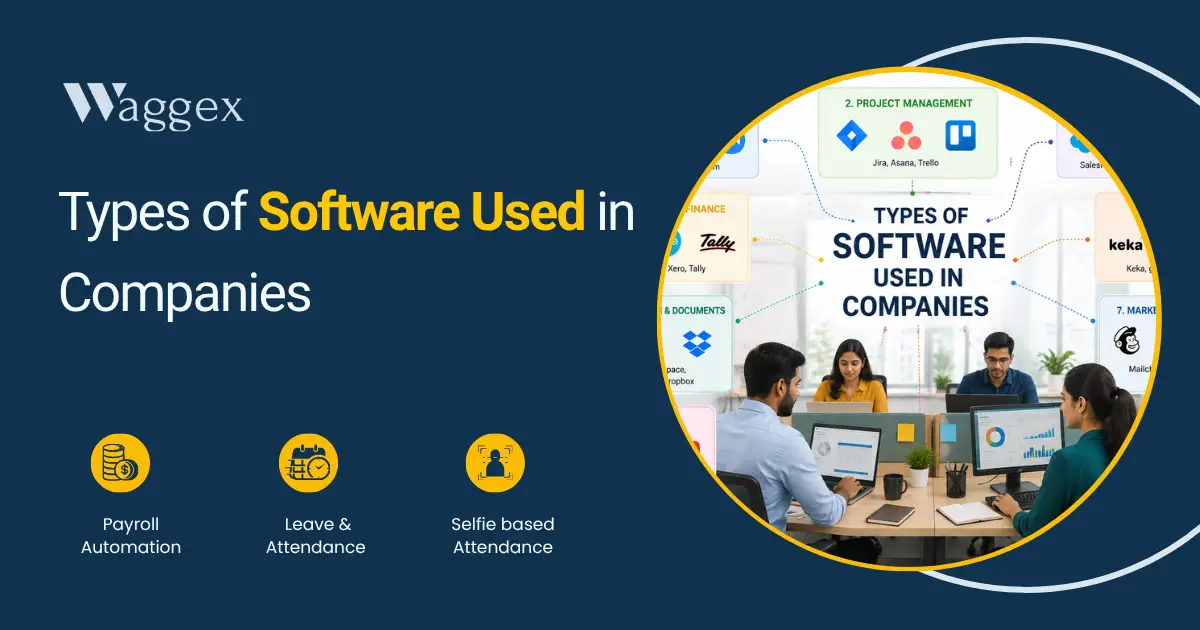
Every company eventually needs a set of software tools to run their business. But most companies choose these tools without much planning or when something goes wrong, a new problem comes up, someone recommends a tool, and they buy it.
Over time, this can lead to too many subscriptions, overlapping tools, and confusion about which one to use.
This guide breaks down the main software categories companies need, explains who needs each one and who can wait, and highlights the leading tools in each category in India.
All 11 Categories Quick Reference
| Software Type | Who Needs It | Skip If… | Tools (India-relevant) |
|---|---|---|---|
| HRMS | 10+ employees | Under 8 people, everything fits in a spreadsheet | Keka, greytHR, Darwinbox, Waggex |
| Payroll Software | Every company with employees | No employees no exception otherwise | greytHR (free/25), Zoho Payroll, Waggex, RazorpayX Payroll |
| Attendance Management | Field, shift, or remote teams | 5-person office where everyone’s visible | Waggex (GPS+face), SalaryBox, ESSL (biometric), factoHR |
| Accounting / Finance | Every company, from day one | Never even 1-person businesses need this | Tally, Zoho Books, QuickBooks, Busy Accounting |
| CRM | Sales-driven companies, 2+ salespeople | High-volume B2C with no real sales cycle | Zoho CRM, Salesforce, HubSpot, LeadSquared, Freshsales |
| Project Management | Teams with deliverables, 5+ people | 1 person owning all tasks end-to-end | Jira, Asana, Trello, ClickUp, Notion |
| ERP | Manufacturing, trading, 50+ employees | Pure service companies with no inventory | SAP, Oracle NetSuite, Tally Prime, Odoo |
| Communication / Collaboration | Any team, especially remote or hybrid | Team of 3–4 in one room WhatsApp works | Slack, Microsoft Teams, Zoom, Google Chat |
| Customer Support / Helpdesk | Companies with 20+ queries/week | Founder personally handles all support | Freshdesk (free tier), Zendesk, Zoho Desk |
| Cybersecurity | Every company no exceptions | Never ransomware hits small companies too | Microsoft Defender, Sophos, 1Password, Veeam |
| Analytics / BI | Companies where reports take hours to build | No defined metrics to measure yet | Power BI, Google Looker Studio, Zoho Analytics |
List Of Most Important Tools For Companies
- HRMS (Human Resource Management System) The system where employee records live: salary structures, leave balances, joining dates, documents, appraisal history. The better ones connect attendance, payroll, and compliance in one place so HR isn’t reconciling three spreadsheets before salary day.
Need it from 10 employees. Below that, a spreadsheet is genuinely fine.
- Payroll Software Calculates salaries, deducts PF (12% of basic), ESI (0.75% of gross where applicable), TDS, and Professional Tax. Generates payslips. Produces the statutory files PF ECR, ESI challan, Form 138 so they can be filed on time. Without this, payroll is manual, slow, and error-prone from around 15 employees.
Needed by every company with employees. The question is only whether they use dedicated software or a spreadsheet that will eventually fail them.
- Attendance Management Tracks when people start and finish work, manages shifts, flags overtime, and feeds data into payroll. Can be biometric hardware (for fixed offices), GPS app (field teams), face recognition (office or remote), or web check-in (desk-based staff). The key is that it connects to payroll attendance data that sits separately and gets manually transferred before salary day introduces errors.
Skip it if everyone is in one room and the manager can see who’s present. Otherwise, get it early.
- Accounting and Finance Software Records revenue and expenses, handles GST filing, generates P&L and balance sheets, manages cash flow. The financial backbone of the business. Tally dominates India especially for GST compliance and manufacturing. Zoho Books works better for cloud-first companies already in the Zoho ecosystem.
No exceptions. Every company from day one.
- CRM (Customer Relationship Management) Tracks every prospect, lead, and customer interaction. Records what was discussed, what’s pending, who follows up and when. When 2+ salespeople are managing 30+ active prospects, spreadsheets stop being reliable. Zoho CRM has the strongest presence in Indian SMEs. LeadSquared is popular in education and financial services specifically.
Can skip if: B2C with high transaction volume and no real sales cycle, or the founder manages all customer relationships personally at low volume.
- Project Management Software Assigns tasks, sets deadlines, tracks completion, shows what’s done and what’s pending. Replaces the ‘what’s the status?’ meeting. Jira works for software teams. Asana and ClickUp for cross-functional teams. Notion doubles as documentation + lightweight project tracking for smaller teams.
Worth getting once a team has 5+ people working on overlapping deliverables.
- ERP (Enterprise Resource Planning) Connects finance, inventory, manufacturing, sales, and procurement so data flows between departments automatically. When a sale is made, inventory updates. When stock is low, procurement is triggered. Essential for manufacturing and trading companies where disconnected departments cause revenue leakage. Tally Prime handles most Indian SME manufacturing and trading needs at a fraction of SAP’s cost.
Pure service companies IT, consulting, agencies rarely need ERP. No inventory, no production.
- Communication and Collaboration Messaging, video calls, file sharing, team channels. Slack for tech companies. Microsoft Teams for companies on Microsoft 365. Zoom where video is the primary need. For remote or hybrid teams, this isn’t optional the office corridor conversations that give managers signal don’t exist on email.
A team of 3–4 people in one room can use WhatsApp. Everyone else should move off it for work communication.
- Customer Support / Helpdesk Manages inbound customer queries as tickets. Tracks response time, records resolution history, assigns ownership. Prevents the same customer from explaining their problem to three different people. Freshdesk has a strong free tier for under 10 agents handling basic queries, it costs nothing.
Hold off if the founder handles all support personally and volume is low. The trigger is usually 20+ inbound queries per week.
- Cybersecurity Endpoint protection, password management, backup, and VPN at minimum. Under the DPDP Act 2023, companies holding customer or employee personal data have specific obligations around data security. A breach for a 10-person company is as damaging as one for a large company recovery capacity is much lower.
No exceptions. Scale the tools to your size a 10-person company doesn’t need enterprise SIEM, but it does need antivirus, a password manager (1Password or Bitwarden), and offsite backups.
- Analytics and Business Intelligence Dashboards and reports built from data across the business. Replaces the two-hour report-building exercise before every leadership meeting. Google Looker Studio is free and connects to Google Sheets and Analytics. Power BI is widely used in companies already on Microsoft. Worth investing in once decisions are being made from gut because the data is too hard to pull.
Hold off if you haven’t defined what you want to measure. Analytics needs clear questions to provide useful answers.
By Company Size What to Prioritise
Under 10 employees: Accounting software, payroll, basic cybersecurity. Everything else can wait.
10–50 employees: Add HRMS with attendance connected to payroll. CRM if sales-driven. Helpdesk if support volume is real. Communication tool if anyone works remotely.
50–200 employees: ERP if manufacturing or complex inventory. BI dashboard for leadership. Review whether your current tools are actually talking to each other disconnected systems compound in cost at this scale.
For HR, attendance, and payroll specifically Waggex covers all three in one connected platform for companies of 5–100 employees. Attendance (GPS + face recognition) feeds directly into payroll. PF, ESI, TDS, and PT calculate automatically. Statutory filings generate from the same payroll run. Free for up to 10 employees, paid plans from ₹699/month. A dedicated account manager manages your first month’s setup and payroll run. Start free here.