

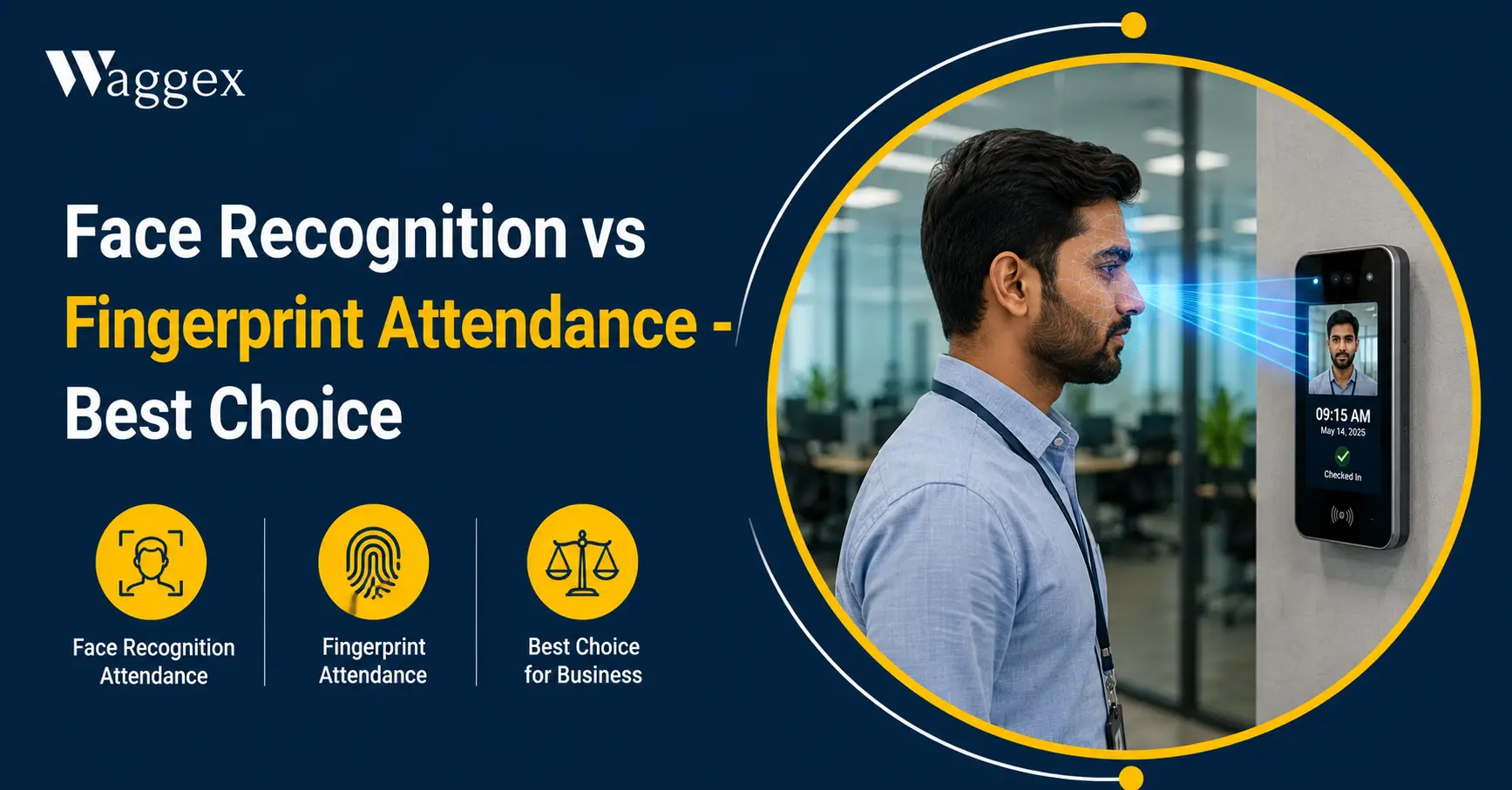
We get this question a lot. And the honest answer is: it depends on your workforce, not on which technology sounds more impressive.
Fingerprint attendance has been around Indian offices and factories for 15+ years. It works. Millions of businesses use it, it’s affordable, and for certain setups it’s still the right choice. Face recognition is newer, growing fast, and clearly better in some situations but not all of them. Both have real limitations that product brochures tend to gloss over.
We’re going to give you the actual comparison including where the fingerprint still makes sense and where it doesn’t. By the end, you’ll know which one fits your team, not just which one sounds more modern.
Fingerprint Attendance: Where It Works, Where It Doesn’t
Fingerprint machines became the default attendance system in India for good reasons. They’re affordable; a basic device runs ₹4,500 to ₹8,000. They’re reliable in straightforward conditions. And for a fixed office where everyone walks through the same door, they do the job without fuss.
The problems start when conditions stop being straightforward. And in most Indian workplaces, that happens more often than people expect.
Dry, wet, dirty, or calloused hands don’t scan reliably. This is the biggest real-world problem with fingerprint machines, and it’s specific to Indian industrial and field environments. A construction worker’s hands. A factory worker’s skin after hours on the floor. A sales rep who’s been in the sun all day. The sensor regularly rejects valid fingerprints which means a real employee standing in front of a machine can’t mark attendance. They end up waiting, trying multiple times, or someone manually overrides it. None of those are good outcomes.
It only works where the machine is. This sounds obvious but it’s worth saying plainly. A fingerprint device at your Delhi office helps nobody in your Pune branch or your field team visiting clients across the city. If any part of your workforce isn’t at the one location where the machine is installed, fingerprint doesn’t solve their attendance problem.
It’s a shared touch surface, every single day. Post-2020, many businesses became genuinely uncomfortable with this. In healthcare, food production, and densely staffed environments, it’s not just comfort it’s a legitimate hygiene concern to have 80 people touching the same surface every morning.
Where fingerprint still makes sense: a stable, office-based team with clean hands working from one fixed location. Accountants, admin staff, customer service teams in a single office. The technology is proven and the price is right for this use case.
Face Recognition Attendance: The Real Advantages and Honest Limitations
Face recognition has moved quickly. The accuracy on modern systems both hardware devices and mobile apps, is genuinely better than it was even three years ago. But the reason we recommend it for most growing Indian businesses isn’t accuracy. It’s flexible.
It works from anywhere. This is the thing that changes the game for distributed teams. A face recognition app on a smartphone means a field sales rep can check in from a client’s office in Faridabad, a delivery executive from a warehouse in Bhiwandi, a remote employee from home. The system confirms who they are and where they are simultaneously, through the same check-in. A fingerprint machine can never do this.
It can’t be shared. You can hand someone your access card. You can lend your phone and ask them to swipe your fingerprint with a silicone duplicate (it’s rare but it happens). You can’t hand over your face. With proper liveness detection which checks that a real face is in front of the camera, not a printed photo it’s the most reliable way to confirm that the person marking attendance is actually the person who should be marking it.
No queue, no contact. A good face recognition device confirms identity in under two seconds. For a factory with 200 workers starting at the same time, that’s the difference between a smooth entry and a 20-minute queue at the fingerprint machine.
The honest limitations. Lighting matters more than fingerprint machines care. Very dark environments or poor camera quality can affect accuracy worth testing in your actual conditions before rolling out. Mobile app systems that do server-side verification need a data connection at check-in, which is not a problem in most urban and semi-urban areas where 4G is standard, but worth knowing. And setting up a new system means registering every employee’s face first a one-time task, but a real one for large existing workforces.
Head-to-Head Comparison
| Factor | Fingerprint | Face Recognition |
|---|---|---|
| Works with dirty/wet hands | Often fails | Not affected |
| Works for field staff | Fixed device only | Mobile app any location |
| Shared touch surface | Yes hygiene concern | Contactless |
| Proxy attendance risk | Card sharing possible | Face can’t be shared |
| Device cost | ₹4,500–₹15,000 | ₹0 (app) or ₹6,000–₹25,000 (device) |
| Speed | 1–3 seconds | Under 2 seconds |
| Works in low light | Not affected | Depends on camera quality |
| Payroll integration | Via HRMS software | Via HRMS or direct (Waggex) |
| Best for | Stable office workforce | Mixed, field, or multi-location teams |
The Question That Actually Matters
Most businesses that come to us asking “fingerprint or face recognition” are actually asking a different question underneath: how do I know my team is actually where they’re supposed to be?
Fingerprint confirms identity at one fixed location. Face recognition especially when paired with GPS confirms both identity and location, from wherever the employee actually works. That’s a meaningful difference for any business where people aren’t all in one place.
We see this play out in a very specific way. Businesses with purely office-based teams rarely have attendance fraud problems that their fingerprint machine can’t catch. The moment field teams, remote staff, or multiple locations enter the picture, the old system breaks down not because it’s poorly designed, but because it was never designed for that situation.
| What we’ve seen with our own customers: The businesses that switched from fingerprint to face recognition weren’t usually trying to catch anyone being dishonest. They were trying to stop the grey area the attendance numbers that were hard to verify, the disputes that came up every month, the manual work of reconciling what the machine said with what the manager knew. Face recognition with GPS removes that grey area. |
How We Handle This at Waggex
We built FaceLens because the businesses had moved beyond single-office setups. They have field staff, they have remote employees, they have branches in different cities. Fingerprint devices at head office weren’t solving their problem.
FaceLens uses the front camera on any standard Android phone. The employee takes a selfie, it goes to our servers, we match it against the registered face and confirm the GPS location at the same time. Both checks happen on our side not on the employee’s device which is what makes it reliable. A fake GPS app can’t fool a server that’s cross-checking location signals independently. A photo of a colleague won’t pass liveness detection.
And because this sits inside the same system as payroll, there’s no manual step between attendance and salary. The check-in feeds the payroll run. PF, ESI, TDS all calculate from verified data. Nobody exports a file at month-end and enters it somewhere else which is exactly the step where payroll errors come from in most businesses still using fingerprint machines with separate HR software.
For businesses curious about how this compares to specific biometric hardware options, we’ve covered this in more detail in our piece on biometric vs selfie attendance, and in our full guide on what a face recognition attendance system is.
So Which One Should You Choose?
If your team works from one fixed office with stable, clean conditions, fingerprint is fine. It’s affordable, it works, and replacing it just for the sake of newer technology doesn’t make business sense.
If you have field staff, remote employees, multiple locations, or hands that regularly deal with dirt, moisture, or physical work face recognition is the better fit. Not because it’s more sophisticated, but because it actually solves the problem that fingerprint can’t.
And if you want attendance, location verification, and payroll working together rather than as three separate systems that’s what we built Waggex for. Our free trial gives you full access to try this with your own team before you decide anything.