

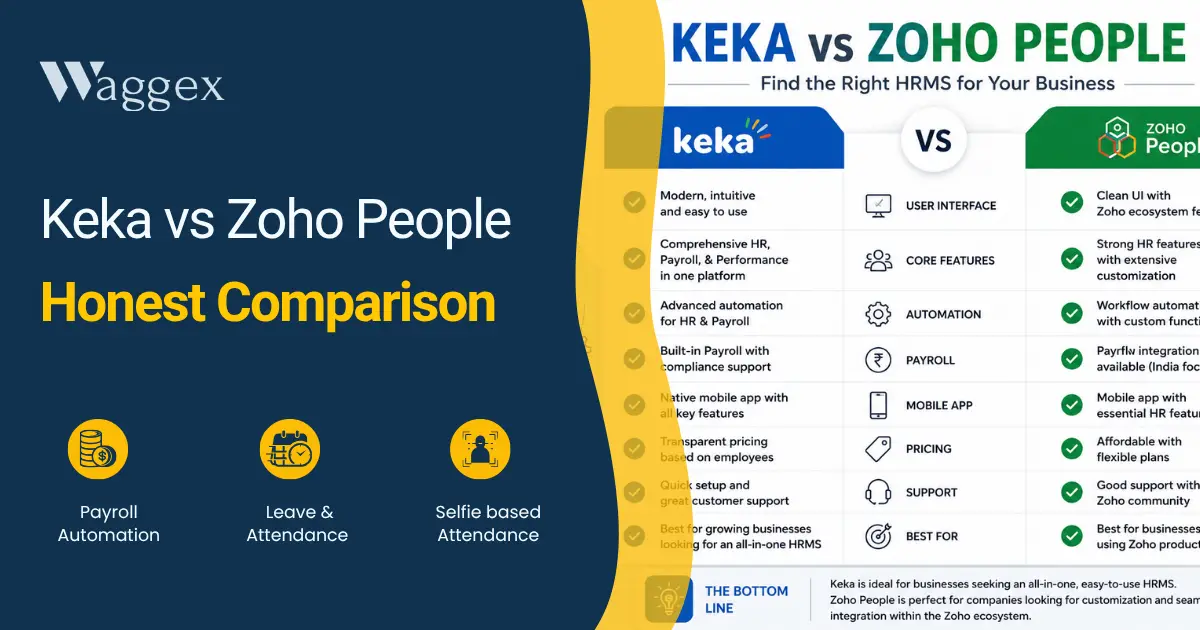
Both are good products. That’s the honest starting point. The real question isn’t which one is better overall it’s which one fits your company size, existing tools, and what you actually need from your HR system.
In this comparison, we’ll break down pricing, key features, industry-specific use cases, and where each one struggles
Keka vs Zoho People: Which HR Software Should You Choose?
Choose Keka if: your team is 50–500 people, performance management and OKRs matter to you, you want payroll included without buying a separate module, and you’re okay paying a flat monthly fee.
Choose Zoho People if: you’re already using Zoho CRM, Zoho Books, or other Zoho products, your team is under 100 people and you want to start cheap and scale, or your HR needs are more basic and per-user pricing makes more sense than a flat fee.
Neither might be right if: you’re under 50 employees, budget is a real concern, and you need attendance + payroll + compliance without paying ₹7,000/month minimum. We’ll get to that at the end.
Keka vs Zoho People Pricing in India: Real Costs Compared
Keka’s pricing model is a flat monthly fee regardless of headcount up to 100 employees. Foundation starts at ₹6,999/month, Strength at ₹9,999, Growth at ₹13,999. Above 100 employees, you move to per-employee pricing at roughly ₹50–80/employee/month depending on negotiation.
Zoho People charges per user. Essential HR starts at ₹48/user/month, Professional at ₹96/user/month, billed annually. But here’s the catch Zoho People doesn’t include payroll. You need to add Zoho Payroll separately. Once you factor that in, the total cost is closer to ₹85–180 per employee per month, which makes Zoho more expensive than it looks at the entry tier.
The hidden cost for both is implementation. Keka usually charges ₹25,000–₹75,000 for setup and data migration. Both platforms also start charging from the first day, so a 200-person company could pay for 2–3 months before the system is even live.
| Keka | Zoho People | Waggex | |
|---|---|---|---|
| Entry plan | ₹6,999/month flat (up to 100 emp) | ₹48/user/month (Essential HR) | Free up to 10 emp · ₹699/month (Small Team) |
| Mid plan | ₹9,999/month | ₹96/user/month (Professional) | ₹1,499/month (25 emp) |
| Upper plan | ₹13,999/month | ₹450/user/month (People Plus) | ₹2,499/month (50 emp) · ₹3,999/month (100 emp) |
| Payroll included? | Yes native | No needs Zoho Payroll add-on | Yes fully included |
| Indian compliance | Strong | Strong (with Zoho Payroll) | Full PF, ESI, TDS, PT auto |
| Setup / onboarding fee | ₹25,000–₹75,000 one-time | ₹5,000–₹20,000 typical | ₹0 dedicated manager included |
| Billing starts | Day 1 of subscription | Day 1 of subscription | After go-live |
| Best for headcount | 100–1,000 employees | 10–500 employees | 5–100 employees |
Keka Vs Zoho Feature Comparison
| Feature | Keka | Zoho People | Notes |
|---|---|---|---|
| Payroll (native) | ✓ Yes | ✗ Add-on | Zoho Payroll is a separate product. Works well but adds cost. |
| Indian statutory compliance | ✓ Strong | ✓ With Zoho Payroll | Both handle PF, ESI, TDS Keka does it natively. |
| Attendance (GPS / Face) | ✓ Yes | Partial | Keka integrates with biometric and GPS. Zoho needs third-party. |
| Leave management | ✓ Strong | ✓ Strong | Both handle this well. |
| Performance & OKRs | ✓ Best in class | Basic | Keka’s standout feature. Zoho People’s performance tools are lightweight. |
| Employee self-service app | ✓ Very good | ✓ Good | Both have solid apps. Keka’s is more polished. |
| Recruitment (ATS) | ✓ Yes (Keka Recruit) | ✓ Yes (Zoho Recruit) | Both have separate recruiting modules. |
| Zoho ecosystem integration | ✗ Limited | ✓ Native | If you use Zoho CRM, Books, or Projects Zoho People wins this. |
| Multi-entity / multi-state | ✓ Yes | ✓ Yes | Both handle multi-location Indian compliance. |
| Setup complexity | Medium | Lower | Keka takes longer to configure. Zoho People is faster to get started. |
| Support quality | Good | Mixed reviews | Keka support rated higher by Indian SME users on G2 and Glassdoor. |
Where Each One Actually Wins
Keka Payroll and Performance Together
Keka is known for two things: reliable payroll and strong performance management. Its OKRs, 360-degree feedback, and review tools are well-designed, making it popular with Indian product companies and SaaS startups.
Keka also connects attendance with payroll. Attendance data automatically feeds into LOP, shift allowances, and overtime calculations, reducing manual work. If you want one platform to manage the entire employee lifecycle instead of using multiple tools, Keka does this well.
Where it struggles: The flat-fee pricing can be expensive for small teams. A 30-person company paying ₹6,999/month spends about ₹233 per employee, much more than Zoho People at the same size. The setup cost is also an extra expense you need to budget for upfront.
Zoho People Ecosystem
Zoho People’s biggest advantage is its wider Zoho ecosystem. Zoho offers 45+ business apps for CRM, accounting, project management, helpdesk, and more. If your an Indian company already uses Zoho One, adding People is a natural and cost-effective choice, with data flowing between apps without extra integration work.
But if you’re not already using Zoho, the costs can add up. You may need Zoho People, Zoho Payroll, and possibly Zoho Recruit. Zoho People alone isn’t a complete HR solution for India you’ll need Zoho Payroll separately for payroll and statutory compliance.
Where it struggles: On paper the pricing can look cheap at first, but costs increase as you add the features you actually need. Support is also mixed among Indian SME users, while Keka generally gets better support ratings in this market.
Who Should Use Which By Industry
IT and Product Companies (50–300 people)
Keka. Performance management is the key factor here. Engineering teams that use OKRs and quarterly reviews need strong tools for goal-setting, peer feedback, and manager reviews. Keka handles these better than Zoho People.
Native payroll is another advantage. Most IT companies have employees across multiple states, so they need payroll that correctly manages PT, TDS, and PF for each employee.
Startups and Small Businesses (10–50 people)
Depends on the Zoho question. Already using Zoho? Zoho People makes sense and is cost-effective. Not using Zoho? The entry cost of Keka is difficult to justify at 20 people. This is where a lot of growing companies are genuinely underserved by both platforms. The need is real, but the pricing doesn’t fit.
Manufacturing and Field-Heavy Operations
Keka, with caveats. Keka’s attendance integrates with biometric hardware, which matters for factories and manufacturing units. But if your primary need is GPS-based field attendance for a team of delivery staff or field sales executives, both Keka and Zoho People need third-party tools to handle it well. Neither was built primarily for this use case.
Retail and Hospitality (Shift-Based Teams)
Neither is ideal. Shift management, daily wages, split shifts, and overtime tracking for large hourly workforces isn’t a core strength of either platform. Both handle it but not as naturally as tools built specifically around shift-based attendance.
Professional Services and Consulting
Zoho People, if already in the Zoho ecosystem, timesheet integration with Zoho Projects and billing with Zoho Books is genuinely useful for professional services firms billing clients by hours. Keka if not.
The Cost Gap Nobody Talks About For Teams Under 50
The honest gap in this comparison is that both Keka and Zoho People are built more for mid-sized companies. A 20-person company paying ₹6,999/month for Keka is spending about ₹350 per employee.
With Zoho People + Zoho Payroll, the cost can be around ₹130–180 per employee after adding the required modules. Both offer a lot for the price, but they may be more than a 20-person company actually needs.
For smaller companies that mainly need attendance, payroll, shift management, leave tracking, and compliance, there are more cost-effective options worth considering.
Waggex combines GPS attendance, face verification, shift management, leave management, payroll, and statutory compliance (PF, ESI, TDS, and PT) in one platform.
Pricing starts at ₹699/month for up to 10 employees, ₹1,499 for 25, ₹2,499 for 50, and ₹3,999 for 100 employees. There’s no setup fee or separate payroll module.
For new companies, a dedicated account manager also helps with the first month’s payroll setup and processing, so you can get comfortable with the system without handling everything on your own.
It’s not a replacement for Keka if you need enterprise performance management, or for Zoho People if deep Zoho ecosystem integration is the goal. But for a company under 50 people that needs everything connected and working without spending ₹7,000/month before the first payslip it’s worth a look. Try it free for up to 10 employees.
The Honest Summary
Keka is the better choice for Indian companies that need payroll, compliance, and performance management in one system. Its flat pricing makes more sense once you have 100+ employees. Below that, you may end up paying for features you don’t need yet.
Zoho People makes the most sense if your company already uses other Zoho products. If you don’t, the pricing can become complicated as you add the tools you actually need.
Both start charging before your system goes live, so you should budget for implementation. Neither is completely plug-and-play, especially for the needs of Indian mid-sized companies.