
Here’s a story that plays out in almost every other company more often than HR teams would like to admit. Someone joins in March. Everything seems fine. Six months later they put in their papers and claim the notice period is one month, not two because there was nothing in writing specifying two. The company checks the offer letter. The offer letter says ‘notice period as per company policy.’ The company policy document exists, but the employee never signed it. And now you’re arguing about a month of someone’s time with no paper trail to stand on.
That’s not a hypothetical. It’s what happens when hiring moves fast and paperwork gets treated as something to sort out later. The documents that matter in a dispute are the ones nobody prioritised when there was an open role to fill and a candidate ready to join.
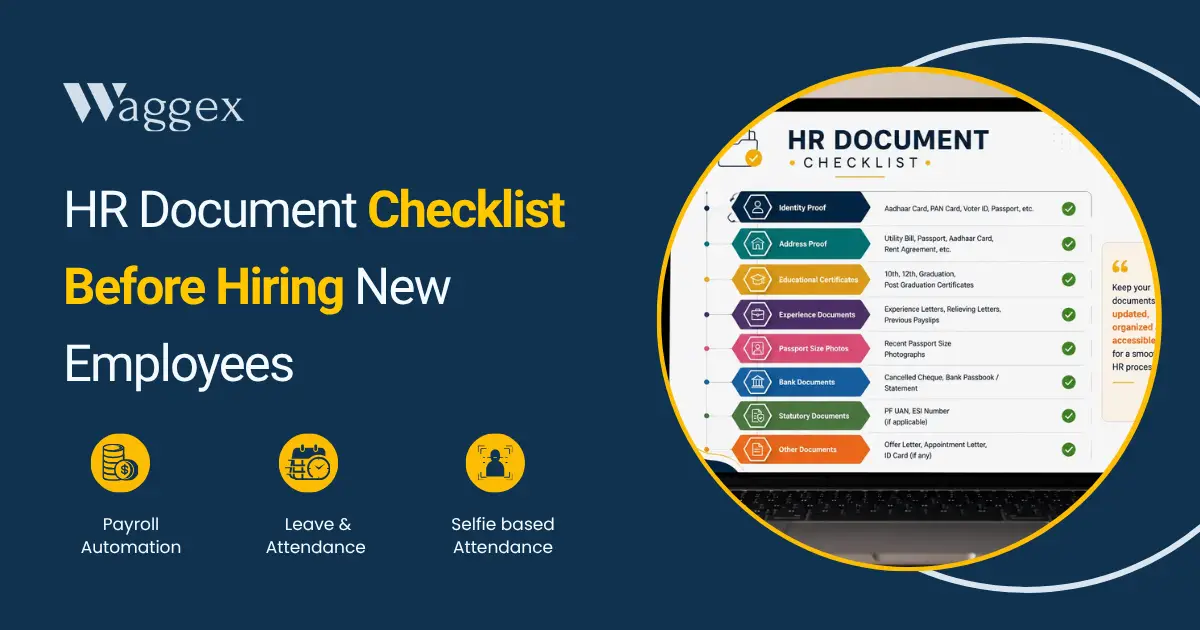
This checklist covers what you need before the offer, at joining, in the first week, and before the first salary. Every item has a note on what goes wrong if you skip it. Two recent changes make this checklist more relevant than a year ago: the Labour Codes (effective November 2025) now require written appointment letters for every employee, no exceptions. And the DPDP Act 2023 requires explicit consent before you collect anyone’s Aadhaar, PAN, or personal data. Both are routinely missed.
Priority Key
🔴 Must legal exposure if this is missing. Labour inspection, EPFO notice, TDS penalty, or an employment relationship you can’t enforce.
🟡 Should won’t always trigger a fine, but when something goes wrong you’ll wish this existed. Usually more time-consuming to fix later than to set up now.
🟢 Good to have best practice. Matters more as the team grows.
The Full Checklist
| Document / Action | Priority | What Happens If You Skip It |
|---|---|---|
| BEFORE OFFER IS SENT | ||
| Salary structure drafted 50% basic rule verified | 🔴 Must | Labour Code violation. PF calculated on wrong base. Audit liability. |
| Role and reporting line defined in writing | 🔴 Must | Disputes about scope, designation, and responsibilities later. |
| Background verification initiated | 🟡 Should | Fraud, credential inflation, undisclosed exits discovered after hiring. |
| Non-compete check previous employer’s clauses | 🟡 Should | Poaching claims, injunctions, new employee dragged into litigation. |
| OFFER LETTER (Before Joining) | ||
| Offer letter issued and signed by both parties | 🔴 Must | Offer letter = binding contract. Verbal offers aren’t enforceable. |
| CTC breakup shown all components itemised | 🔴 Must | Employee disputes ‘what was promised’ at joining. Happens constantly. |
| Probation period and confirmation criteria stated | 🟡 Should | No legal basis to extend probation or terminate probationer cleanly. |
| Notice period (both sides) written into offer | 🔴 Must | No enforceable notice period. Employee walks out without serving. |
| Joining date confirmed in writing | 🟡 Should | Date disputes for salary start, PF enrollment, gratuity calculation. |
| DOCUMENTS TO COLLECT ON DAY 1 OR BEFORE | ||
| Aadhaar Card (original + self-attested copy) | 🔴 Must | Cannot complete EPFO e-KYC. PF account creation delayed or blocked. |
| PAN Card (original + self-attested copy) | 🔴 Must | Cannot deduct or deposit TDS. Default TDS at 20% without PAN. |
| Bank account details + cancelled cheque | 🔴 Must | No way to transfer salary. Can’t set up direct credit. |
| Educational certificates (highest qualification) | 🟡 Should | No verification baseline if credential dispute arises later. |
| Previous employment documents (offer/relieving letter) | 🟡 Should | Cannot verify experience claims or check for background gaps. |
| Last payslips (3–6 months) | 🟢 Good to have | Useful for salary negotiation verification but not legally required. |
| Passport-size photographs (2 copies minimum) | 🟡 Should | Required for physical ID cards, PF form, ESI card. |
| Current address proof (Aadhaar / utility bill) | 🟡 Should | EPFO and ESIC registration needs address on record. |
| STATUTORY REGISTRATIONS DAY 1 OR SAME WEEK | ||
| PF Form 11 (EPF declaration for new member) | 🔴 Must | PF account not created. Contributions deposited without account = mess. |
| PF Form 2 (Nomination form who gets PF if employee dies) | 🔴 Must | No nominee on record. Family has no legal claim if something happens. |
| UAN activation / linkage to Aadhaar | 🔴 Must | PF deposits go in but employee cannot access or transfer the account. |
| ESI Form 1 (if gross ≤ ₹21,000/month) | 🔴 Must | Employee not covered. ESI benefits hospital, maternity, sick pay inaccessible. |
| ESI Pehchan card or IP number assigned | 🟡 Should | Employee can’t use ESIC dispensaries without an IP number on record. |
| Professional Tax enrollment (applicable states) | 🟡 Should | PT not deducted = compliance gap. Inspector can assess back liability. |
| APPOINTMENT LETTER & EMPLOYMENT CONTRACT | ||
| Appointment letter issued on joining day | 🔴 Must | Labour Code 2025 mandates written appointment for all employees. No exceptions. |
| Confidentiality / NDA clause included | 🟡 Should | No legal basis to enforce confidentiality of client data, trade secrets. |
| IP assignment clause work product belongs to company | 🟡 Should | Developer’s code, designer’s work ownership legally unclear without this. |
| Termination clause grounds and procedure | 🔴 Must | Cannot terminate cleanly without proper grounds documented from day 1. |
| Governing law and jurisdiction specified | 🟡 Should | Dispute filed in employee’s home state court, not yours, if not specified. |
| PAYROLL SETUP | ||
| Employee added to payroll system with correct DOJ | 🔴 Must | Prorated salary for joining month calculated incorrectly. |
| Salary structure configured basic, HRA, LTA, allowances | 🔴 Must | PF, ESI, TDS all calculate from salary structure. Wrong structure = wrong deductions. |
| TDS regime declared new or old regime (Form 12BB if old) | 🔴 Must | Default TDS at new regime rates. Old regime employees underpay TDS all year. |
| Investment declarations collected (old regime employees) | 🟡 Should | Without 12BB, TDS on old regime is estimated without declared deductions. |
| Bank account verified for salary transfer | 🔴 Must | Wrong account = failed salary transfer. More common than you’d think. |
| COMPANY POLICIES TO BE SHARED AND ACKNOWLEDGED | ||
| Employee handbook / HR policy document signed acknowledgement | 🔴 Must | Cannot enforce leave policy, attendance rules, or disciplinary process later. |
| Leave policy (earned, casual, sick, maternity) communicated | 🔴 Must | Leave disputes are the most common HR issue. Written policy = clean resolution. |
| Code of conduct signed | 🟡 Should | Misconduct cases weak without documented policy the employee accepted. |
| IT and device usage policy (if devices issued) | 🟡 Should | No legal basis for monitoring company devices. No data security obligation on employee. |
| POSH (Prevention of Sexual Harassment) policy acknowledged | 🔴 Must | Mandatory for all establishments with 10+ employees. ICC must be constituted. |
| Grievance redressal process communicated | 🟡 Should | Employees don’t know where to go with complaints. Escalations happen publicly. |
| DATA PROTECTION DPDP ACT 2023 | ||
| Consent obtained for collecting and processing personal data | 🔴 Must | DPDP Act 2023 requires explicit consent for data collection. No consent = violation. |
| Purpose of data collection explained to employee | 🔴 Must | Employees must know what data is collected, why, and how long it’s kept. |
| Data access controls set sensitive documents role-restricted | 🟡 Should | Aadhaar, PAN, bank details visible to everyone = data breach liability. |
Sources: Labour Codes 2025, Code on Wages 2019, EPF Act 1952, ESI Act 1948, Maternity Benefit Act 1961, POSH Act 2013, DPDP Act 2023. Verify applicability for your specific industry and state with a labour law advisor.
The Offer Letter What Most People Get Wrong
Most offer letters in India say three things: CTC, designation, joining date. That’s it. No probation criteria. No notice period. No conditions around background verification. Sometimes not even a breakdown of the CTC.
Then the employee joins. Three months in, performance isn’t working out. HR wants to let them go during probation except the offer letter never said what probation means or how long it lasts. No criteria. ‘Subject to satisfactory performance’ doesn’t hold up when the employee contests it and there’s no benchmark on paper. So the company either pays a month’s salary to make them leave quietly or deals with an ugly exit.
The legal part that surprises a lot of founders: once both parties sign an offer letter, it’s a binding contract under the Indian Contract Act 1872. If a candidate resigns from their current job because you sent them an offer, and then you withdraw it, Indian High Courts have awarded damages. The offer letter isn’t a formality it’s a contract from the moment it’s signed.
So what should actually be in it:
- CTC with every component written out. ‘CTC ₹8,40,000 per annum’ is a number, not a breakup. Write out basic, HRA, LTA, special allowance, employer PF, and gratuity provision separately. Candidates who feel misled about take-home vs CTC are almost always pointing to a gap between what the letter said and what the payslip showed.
- Probation duration and what ‘confirmation’ actually means. ’90-day probation, confirmation subject to performance review by reporting manager’ is something you can act on. ‘Probation as applicable’ is not.
- Notice period both directions, both numbers. Company-to-employee notice doesn’t have to match employee-to-company notice. But both need to be written down. If it’s not in the offer letter, it doesn’t exist legally.
- Conditions. ‘This offer is contingent on satisfactory background verification and submission of original documents.’ Without this language, you can’t cleanly withdraw if BGV flags something.
- Jurisdiction. Which state’s courts govern disputes. Without it, the employee gets to choose the court that’s convenient for them.
Offer letter vs appointment letter they’re not the same thing
People conflate these. The offer letter goes out before joining it’s conditional. The appointment letter is issued on the joining date it formalises everything: the employment relationship, HR policies, IP clause, code of conduct, POSH acknowledgement, the works. The Labour Code 2025 makes the appointment letter mandatory for every employee without exception. Daily wage workers, contract staff, part-time all of them.
One thing worth setting up if you haven’t: a standard appointment letter template stored in your HRMS, issued automatically on the joining date. When this lives in the same system as attendance and payroll setup, the joining day becomes a single workflow rather than three separate HR tasks happening across different people and folders. That’s roughly how the onboarding flow works in Waggex adding an employee triggers attendance enrollment, leave balance activation, and payroll configuration in one step, so nothing waits until someone remembers to do it.
| The single most skipped step in Indian SME hiring: Appointment letter. Not the offer that usually gets done. The formal appointment letter with policy acknowledgements and IP clause gets ‘we’ll sort this later’ and then sits in a pending folder until something goes wrong. When that happens a disciplinary issue, a trade secret dispute, an IP claim there’s no signed document establishing the ground rules. Draft one template. Issue it on every joining date. That’s the fix. |
PF and ESI Registration Do It This Week, Not This Month
There’s a pattern in startups especially: HR collects all the KYC documents, fully intends to complete the PF registration, and then two and a half weeks go by because there were other things. Meanwhile contributions have been calculated but there’s no UAN linked, so EPFO has no idea where to put the money.
PF Form 11 is the EPF declaration tells EPFO if the new employee already has a UAN from a previous employer. PF Form 2 is the nomination who receives the PF balance and EDLI insurance if the employee dies. Both take five minutes. Both should happen the same week as joining.
On the nomination: it’s easy to frame this as morbid and therefore defer it. Don’t. If a new employee dies in the first month and Form 2 wasn’t submitted, the family has no legal claim on record. The claim process becomes a mess. The form is five minutes. There’s no argument for deferring it.
ESI Form 1 is only for employees whose gross wages are ₹21,000/month or below. Check per employee, not per role someone who gets an increment above that threshold stops being ESI-eligible from the next contribution period. Worth knowing: ESI isn’t just a deduction. It covers ESIC hospital treatment, 50% sickness cash benefit for 91 days per year, 26-week maternity benefit for covered women, and dependants’ benefit on work-related death. These are actual benefits that lower-wage employees use. Enrolling them on time matters for them, not just for compliance.
The ESI threshold check is one of those things that’s easy to forget during busy hiring months. In Waggex’s payroll module, ESI eligibility is checked automatically each month against the employee’s current gross it switches on when someone’s salary comes below the threshold and off when it crosses ₹21,000. No manual check needed before every payroll run.
Three 2025–2026 Changes That Affect Every New Hire
If your standard hiring process was designed before 2025, it may be missing these:
- Fixed-term employees now get gratuity after one year, not five. The Industrial Relations Code (effective November 2025) changed this for fixed-term contract workers. They’re now entitled to proportionate gratuity after completing one year of service. Companies hiring on 12-month contracts who haven’t updated their cost modelling or their appointment letter language are now unintentionally under-provisioning. If you use fixed-term contracts, budget gratuity into the CTC from day one and check how this changes your salary structure.
- Explicit consent is now required before collecting personal data. Under the DPDP Act 2023, collecting Aadhaar, PAN, bank details, and family information without a consent notice is a violation. The notice needs to say what data you’re collecting, what you’ll use it for, who you’re sharing it with, and how long you’re keeping it. Add a one-page data consent form to your joining kit. Done once, used for every hire.
- The 50% basic rule applies to new hires from the offer stage. Under the Code on Wages (November 2025), basic salary has to be at least 50% of total CTC. If your salary template puts basic at 35% to reduce PF liability, you’re non-compliant from day one and PF is being calculated on an understated base. Audit the structure before the offer goes out, not after the employee has joined and the first payroll has run.
Getting Payroll Right Before the First Salary
Documents and statutory registrations are one side of joining. The other side the one that affects the employee’s bank account on month one is the payroll setup. A new joiner with perfect KYC documents who isn’t in the payroll system before the month cutoff either gets a manual calculation (usually wrong) or gets paid the next month (not great for a new hire’s first impression).
- Date of joining must be exact. Pro-rata salary is calculated from the DOJ. Someone who joined on 20 July gets 12 days of salary, not a month. Wrong DOJ means wrong first salary.
- Salary structure before anything else. PF, ESI, and TDS all calculate from the salary structure. If you configure this after the first payroll has already run, you’re looking at corrections. Not fun.
- Tax regime declared. New regime is the default under Income Tax Act 2025. If the employee wants old regime, they need to submit Form 12BB with their investment declarations. Without it, TDS runs on new regime regardless of what the employee intended to declare.
- Attendance linked from day one. If your team uses app-based or GPS attendance, the employee needs to be enrolled before their first working day otherwise LOP calculations for the joining month are guesswork. For remote employees this matters more, not less. Setting up GPS and selfie attendance from the first check-in avoids the classic ‘I was working from home but the system didn’t record it’ conversation.
- Payslip before or on salary date. The Code on Wages requires it. Issue it the same day the transfer goes out.
For teams using Waggex, the payroll-side of onboarding is largely self-enforcing. Adding a new employee in the system sets up attendance tracking, activates leave balance from the exact joining date, and links to payroll configuration all in one step. PF, ESI, TDS, and Professional Tax calculate automatically from the salary structure you configure once. If something is missing PAN not linked, salary structure not approved, DOJ not confirmed the system flags it before the payroll run rather than after. The compliance reminders in Reminder Management also flag upcoming deposit deadlines (7th for TDS, 15th for PF and ESI) so nothing falls through between onboarding and the first salary cycle.
POSH Probably the Most Ignored Item Here
This is the section that gets a polite nod in most HR checklists and then quietly doesn’t get done. The Prevention of Sexual Harassment Act applies to all establishments with 10 or more employees. Not optional. First offence: fine up to ₹50,000. Repeat: licence cancellation.
What compliance actually means beyond ‘having a policy’:
- The Internal Complaints Committee must be properly constituted. Not just named in a policy document. The ICC needs a presiding officer who is a senior woman employee, at least two employee members, and one external member from an NGO or someone with relevant experience. The appointment letters for ICC members have to be issued and documented.
- The policy has to be displayed, not just in the handbook. Posted at the workplace. Physically. Both things are required.
- Annual report to the District Officer. Every calendar year, the number of complaints received and disposed. Routinely missed because there’s usually nothing to report which is exactly when people forget it’s required regardless.
- Every new employee gets informed and signs an acknowledgement. Not ‘it’s in the handbook.’ A specific signed acknowledgement that they received the POSH policy and know who the ICC members are.
If you’re maintaining physical files for these acknowledgements, the risk is they get scattered. A simpler approach: store signed policy documents against each employee’s digital record in your HRMS. When a labour inspector or an ICC proceeding requires proof that a specific employee received the POSH policy on their joining date, it’s one search, not a folder hunt.
A Note on Tracking All of This
Forty items on a checklist is manageable when you’re hiring one person. When three people join the same week which happens someone forgets to submit PF Form 2, or the salary structure gets configured with last month’s template by mistake, or a PAN number gets transposed in the payroll system and TDS runs wrong for the first three months.
Manual tracking depends on one person doing the right thing at the right time, every time, even when things are busy. That’s where it breaks.
When attendance, leave, and payroll are in the same system, the payroll-related items on this checklist largely enforce themselves. Miss the DOJ and payroll can’t calculate correctly. PAN not linked, the system flags it before the first salary run. Leave balance activates from the joining date automatically no one has to remember to configure it separately two weeks after joining. Geo-location and selfie attendance are set up the same day the employee is added, so their first check-in is recorded correctly rather than being reconstructed from a WhatsApp message at month end.
The compliance side works the same way. Tax and Forms Management handles PF ECR files, ESI challans, and quarterly Form 138 TDS returns generated from the same payroll data, not manually compiled. And Reminder Management sends alerts before the 7th (TDS) and 15th (PF, ESI) every month, so nothing falls through in the weeks after a new hire joins. For companies between 10 and 100 employees, this is the specific problem Waggex is built for. Free plan for up to 10 employees no card required.
To Close
Good hiring documents are invisible. They sit in a file for years and nobody ever needs to open them. That’s the goal.
The ones that weren’t done right show up later. Notice period dispute at resignation. PF nomination missing when a family is trying to claim. Code of conduct unsigned when someone’s behaviour needs to be addressed formally. These aren’t unusual situations. They’re what happens when onboarding was treated as an afterthought.
The checklist above covers most industries. Factories have additional requirements under the Factories Act, construction sites have BOCW obligations, and establishments with 300+ workers need certified Standing Orders. For the statutory picture that wraps around payroll, the Payroll Compliance in India: Complete Guide is the most complete single reference. And if you’re drafting leave entitlements into the appointment letter and want to know which ones are legally mandatory vs optional, the All Types of Leaves in Corporate India guide covers the full list.