

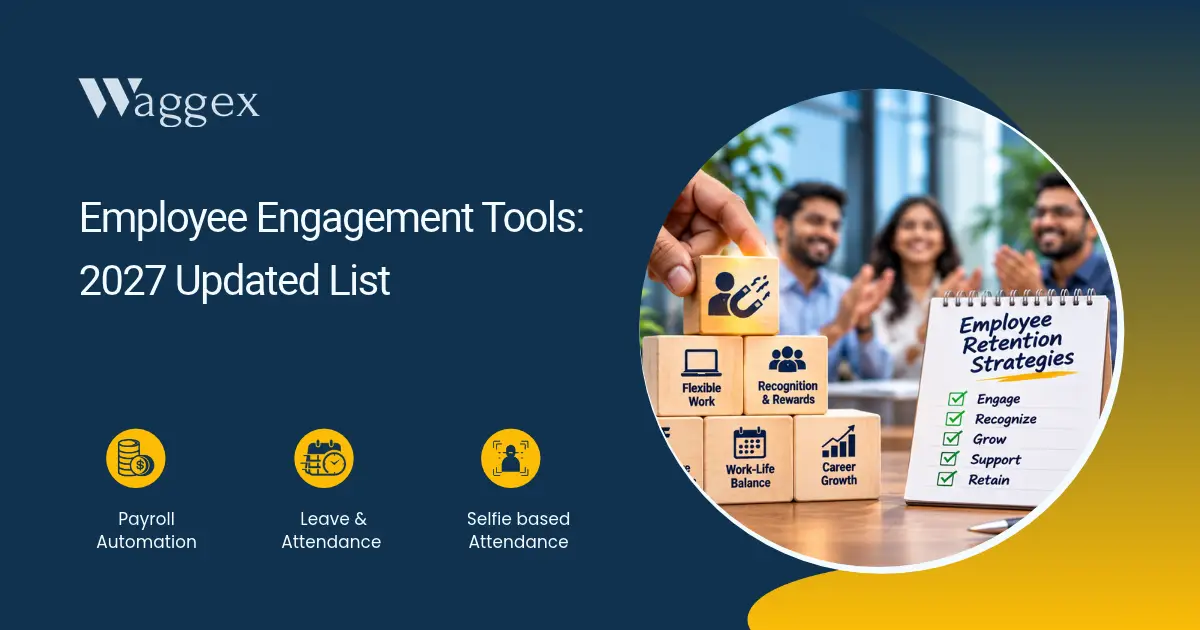
India’s voluntary attrition rate has remained above 20% in sectors like IT, BFSI, and professional services for several years. This means that nearly one in five employees leaves their job every year. As a result, companies constantly spend on recruitment, employee onboarding, and training while also dealing with the loss of valuable experience and institutional knowledge.
Many employee retention strategies fail not because the ideas are wrong, but because they target the wrong problems or are introduced too late. For example, introducing flexible work policies after several employees have already left or conducting employee engagement surveys only after losing top performers means companies are reacting to attrition instead of preventing it.
This article explores practical employee retention strategies that deliver measurable results for Indian businesses. It covers the key reasons employees leave their jobs in India, the factors that influence employee satisfaction, and the changes companies can make to improve retention and build a more stable workforce.
What Actually Drives Attrition in Indian Companies
Exit surveys in India consistently show compensation as the top stated reason for leaving. But compensation is almost always a proxy for something else dissatisfaction with growth, recognition, or the working environment expressed in the language that’s easiest to give when you’re walking out the door.
In our experience, the real drivers break into three categories: economic (genuinely underpaid relative to market), relational (manager relationship broke down, or the employee felt invisible), and structural (no visible path forward, staying meant stagnating).
The distinction matters because the intervention is different for each. You can’t fix a manager problem with a salary increment. Most companies apply generic retention tactics a bonus, a title change, a team outing regardless of what’s actually driving their attrition. That’s why the numbers don’t move.
| The cost of replacing one mid-level employee in India typically runs 50–75% of their annual CTC when you account for recruiter fees or referral payouts, onboarding time, the productivity ramp of the replacement, and the output lost during the gap. For senior roles, it can exceed 100% of CTC. Retention is almost always cheaper than replacement but that calculation rarely reaches the decision-makers who control compensation budgets. |
The Five Most Common Attrition Drivers and What Fixes Them
| Attrition Driver | What Employees Say | What Actually Fixes It |
| Below-market compensation | ‘I got a better offer elsewhere.’ | Annual pay benchmarking against market data; structured increment cycles tied to performance, not just CPI. |
| No visible growth path | ‘I don’t see where this role goes in two years.’ | Documented role ladders; internal job postings; lateral moves treated as growth, not lateral-ness. |
| Manager relationship | ‘My manager doesn’t recognise what I do.’ | Manager effectiveness tracking in performance cycles; skip-level conversations twice a year. |
| Overwork without acknowledgement | ‘I’m always stretched and it’s never noticed.’ | Workload visibility in project tracking; overtime monitoring in HRMS; recognition tied to specific contributions. |
| Payroll and process friction | ‘My salary was wrong again. My leave request took two weeks.’ | Accurate, on-time payroll; self-service portal for leave, payslips, and claims; same-day response SLA on HR queries. |
The payroll and process friction row in this table is underweighted in most retention conversations. In our experience, it matters more than most HR teams recognise. An employee who gets a wrong salary, waits two weeks for a leave approval, or can’t find their Form 130 at tax filing time has a daily experience of disorganisation. That experience colours everything else including how they feel about the company when a recruiter calls.
Salary Benchmarking: A Key Strategy for Employee Retention
One of the most common compensation mistakes companies make is not paying below-market salaries at the time of hiring, but failing to review salaries as market rates change. An employee hired at the market rate in 2023 could be earning 15–20% below the current market rate by 2026 if salary increments are based only on internal budgets rather than industry trends.
Companies should compare salaries with current market data based on job roles, salary levels, city, and industry at least once a year. Firms like Mercer, Aon, and Korn Ferry publish India-specific salary surveys that help businesses understand industry pay trends. However, many companies overlook this data and identify salary gaps only when an employee resigns after receiving a better offer from another company.
A structured annual salary review can help prevent this problem. Companies should regularly compare employee salaries against market benchmarks, identify pay gaps, and make adjustments where needed. This doesn’t mean giving everyone a large salary increase. It means understanding whether employees are being paid fairly and addressing salary gaps before competitors use them to attract valuable talent.
Career Growth Visibility: Why Indian Employees Leave When They Can’t See a Path
India’s workforce skews young. The median age of employees in IT and professional services is under 30, and career progression matters disproportionately at this stage more than perks, more than work-from-home flexibility, often more than a modest salary premium.
The problem isn’t that companies don’t offer growth most do. The problem is that employees can’t see it. When a company has no documented role ladder, when promotions happen without clear criteria, when lateral moves are treated as consolation prizes rather than capability-building steps, employees default to assuming that growth requires changing employers.
What works: publish role ladders that show the criteria for moving from one level to the next. Share internal job openings before going external. Treat a move from engineering to product, or from individual contributor to team lead, as a planned development step rather than an exception. In our experience, companies that make career paths visible retain junior employees at significantly higher rates than those that don’t even when the actual growth opportunities are similar.
Manager Effectiveness: The Retention Variable Most Companies Avoid Measuring
The research on manager impact is consistent: the single strongest predictor of whether an employee stays or leaves is their relationship with their direct manager. Gallup’s global data puts this at 70% of team engagement variance explained by the manager, not the company.
Most Indian companies don’t measure manager effectiveness systematically. Performance reviews assess the employee; they rarely assess the manager’s impact on the team. When a high-performer leaves while overall attrition is stable, the manager is almost always the variable but without data, the conversation rarely goes there.
What to track: attrition rate by team and by manager, not just organisation-wide. Voluntary exit interview themes by team. If one manager has 40% voluntary attrition and the company average is 18%, that’s a retention problem with a known address. Fixing it through coaching, a role change, or in some cases a management change will do more for retention in that team than any company-wide programme.
How HR Systems Affect Retention More Than Most Organisations Expect
Employee retention strategies usually focus on visible factors such as salary, promotions, workplace culture, and flexible working arrangements. However, everyday HR process issues also affect employee satisfaction. Poor HR processes may not seem like a major retention problem, but they can create frustration over time and negatively impact the employee experience.
Payroll errors can quickly reduce employee trust. Even if a salary mistake is corrected promptly, it can leave employees questioning how efficiently the company operates. Repeated payroll errors or delayed salary payments create an impression that the organisation cannot manage basic employee requirements properly. In a competitive job market, this can influence an employee’s decision to stay or look for another opportunity.
An HRMS that processes accurate and timely payroll while giving employees access to their payslips, leave balances, and tax documents through self-service can eliminate many everyday frustrations. While it cannot replace important retention strategies such as salary reviews, career development, and effective management, it helps create a smoother employee experience by reducing administrative issues.
Waggex’s employee self-service portal and built-in compliance tracking help businesses manage routine HR activities more efficiently, ensuring employees can access important information without depending on HR teams for every request.