
Priya gets her salary in the first week of every month and she found that it’s ₹3,300 short. She checked the payslip and there it was. LOP: 3 days. She had no idea she had 3 days of LOP. As far as she knew, she’d taken leave that her manager approved.
This kind of confusion happens every month in companies across India. Not because the rule is unfair, but because most people don’t know how their leave balance connects to their salary until they see less salary is credit in their account.
LOP stands for Loss of Pay. It’s not a fine. It’s not HR being difficult. It simply means: you were absent on days when you had no paid leave left to cover you, so you weren’t paid for those days. The formula is boring. We will try to make this article as simple as we can.
Your Leave Balance Is What Actually Controls This
Think of your paid leave like a prepaid wallet. You get a certain number of days credited at the start of the year there are casual leave, sick leave, earned leave. Every approved absence draws from that wallet. The day it hits zero, the next absence doesn’t get covered. That day becomes LOP.
So when Priya took 3 days off in November, the problem wasn’t that she took leave. It was that her casual leave balance had already run out in October she just didn’t notice. Her manager approved the leave request. But approval doesn’t create balance. There is no balance of leave in the system.
Other situations where LOP ends up on a payslip:
- Absent without applying. Didn’t show up, didn’t put in a leave request. Payroll sees it as an unapproved absence. LOP applied automatically.
- Probation period. Many companies don’t give paid leave during the first 3–6 months. Any time off in that window is usually LOP unless your offer letter says something different.
- The sandwich rule. Took Friday and Monday off? In a lot of Indian companies, Saturday and Sunday sitting between those days also get counted as leave days. If you didn’t have 4 days of balance, 4 days become LOP not 2.
The Calculation Straightforward, Except for One Thing
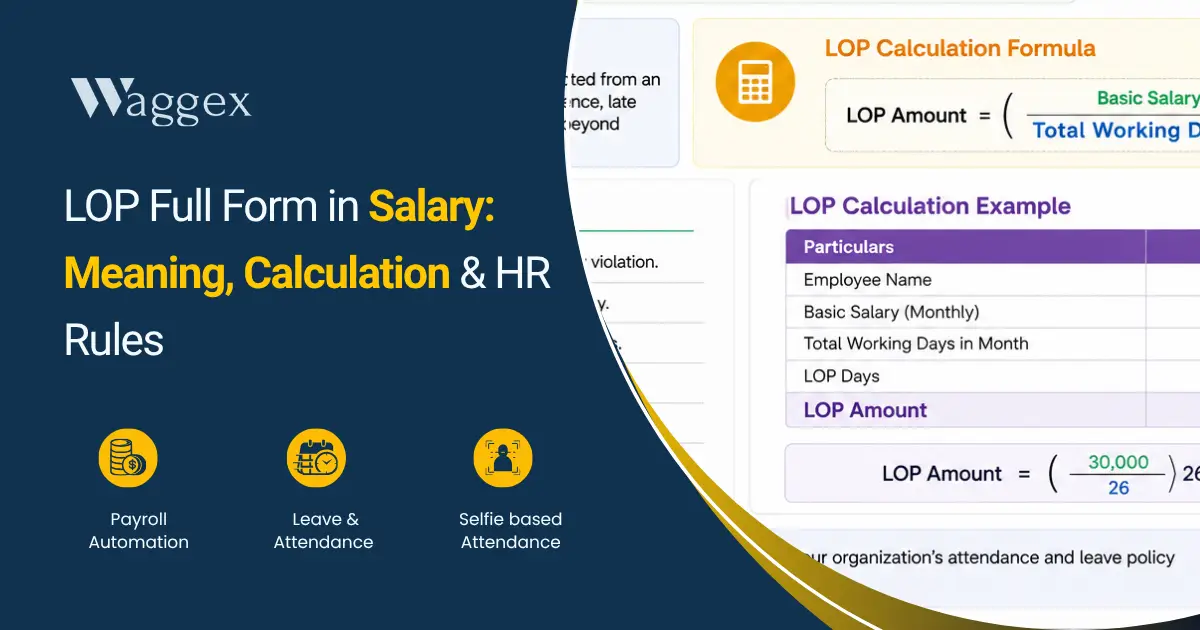
(Monthly gross salary ÷ working days in the formula) × LOP days = Amount deducted
The formula is simple. The argument is always about the divisor of that middle number. Companies use 26, 30, or the actual working days in that specific month. It’s not standardized. Indian labour law doesn’t mandate one number.
Here’s why it matters more than people think:
| Monthly salary | ₹36,000 |
| Divisor (company uses 26) | ÷ 26 = ₹1,384/day |
| LOP days | 3 days |
| Amount cut from salary | ₹1,384 × 3 = ₹4,153 |
| What hits the bank | ₹36,000 − ₹4,153 = ₹31,847 |
Same salary, same 3 LOP days but with divisor 30: ₹36,000 ÷ 30 × 3 = ₹3,600. That’s ₹553 less cut from your salary, just from the divisor being different. Check your offer letter or HR policy. It should say which one your company uses.
| LOP vs LWPhis quick difference: LWP (Leave Without Pay) is when you plan ahead and formally ask for unpaid leave, sabbatical, extended personal time, whatever. You know going in that it’s unpaid. LOP is usually a surprise you ran out of balance, or didn’t apply, and the deduction shows up after. Same calculation, different story behind it. |
Does LOP Affect PF, ESI, and TDS?
Yes and no. It depends which one you’re asking about.
| Deduction | What Actually Happens |
|---|---|
| PF | Barely affected. PF sits on basic salary, not gross. Unless LOP is huge, your PF stays the same. |
| ESI | Watch this one. If LOP pulls your gross below ₹21,000 that month, you become ESI-eligible for that one month even if you’re normally above the limit. Most payroll sheets miss it. |
| TDS | No change that month. TDS is calculated on projected annual income. One LOP month gets absorbed and corrected at year-end. |
| Gratuity | Long-term, almost nothing. Gratuity uses your last drawn salary occasional LOP doesn’t shift that much. |
The ESI one is worth remembering if you’re in HR. An employee normally earning ₹23,000 is above the ESI threshold is not covered. Three days of LOP in a bad month could push their gross to ₹19,800. ESI now applies for that month. Most payroll teams running Excel sheets don’t catch this. It recalculates automatically in a connected payroll system.
When LOP Gets Reversed
LOP reversal is when the deduction gets cancelled and the amount comes back in the next month’s salary.
It happens more than people realise. Medical certificate submitted late. Leave was verbally approved but never entered in the HRMS before payroll closed. Attendance was marked wrong because the employee logged in after the system’s attendance window. All of these lead to LOP that shouldn’t have happened and all of them can be corrected.
Process: employee raises a reversal request, attaches proof (certificate, approval email, whatever applies), HR and manager review it, payroll credits the amount in the following month. It doesn’t correct the previous payslip the reversal appears as a separate credit line on the next one.
What Goes on the Paysliphis and What HR Can’t Do
LOP has to show up as its own named line item under deductions. ‘LOPhis 3 dayshis ₹4,153.’ Not buried in ‘other deductions.’ Not unlabelled. The Code on Wages 2019 requires every deduction to be itemised on the wage slip. If an employee gets a lower salary and can’t find what caused it, something’s wrong on the payslip side.
The thing HR can’t do: mark a day as LOP when leave was approved and balance existed. If the manager clicked approve, the employee had the days, and they were absent that’s a paid leave. Calling it LOP anyway is an error the employee can dispute with the approval record as proof. This sounds obvious but it happens especially in companies where the leave system and payroll aren’t connected and someone manually enters the data.
One more: notice period with LOP. Most employment contracts say the notice period must be served in full. If an employee takes 3 LOP days during notice, many companies extend the exit date by 3 days rather than just deducting the salary. Whether this applies depends entirely on what’s written in the contract. Worth including explicitly when drafting or reviewing offer letterships without it, every exit with absence becomes a separate conversation.
How to Not Get Surprised by LOP
Most LOP surprises have the same root cause: the employee didn’t know their balance was low until the payslip arrived.
- Check your balance before booking anything. Sounds obvious. Very few people do it. Every HRMS has a leave balance page. Open it before you put in the leave request, not after.
- Apply in the system, not just on WhatsApp. A message to your manager isn’t a leave record. If it isn’t logged in the system, payroll doesn’t see an approval it sees an absence.
- Use comp-offs first. Working on a Sunday? A public holiday? That comp-off is a free day that doesn’t touch your leave balance. Use those before dipping into paid leave.
- Understand your company’s sandwich rule. If Friday and Monday are off, find out whether your company counts the weekend as leave days too. Know this before booking, not after.
LOP is one of those payroll terms that sounds technical but really comes down to one thing: you weren’t paid for days you didn’t work and couldn’t be covered with paid leave. The formula is simple. The disputes happen because leave records, attendance systems, and payroll often don’t talk to each other so what the employee thought happened and what payroll processed aren’t the same.
For companies where that mismatch is a recurring problem is leave approvals not syncing to attendance, LOP applied to days that should’ve been covered. Waggex connects leave and attendance and payroll in one place. When leave is approved, attendance updates. When balance hits zero, the next request gets flagged before payroll day. Free for up to 10 employees try it here.