

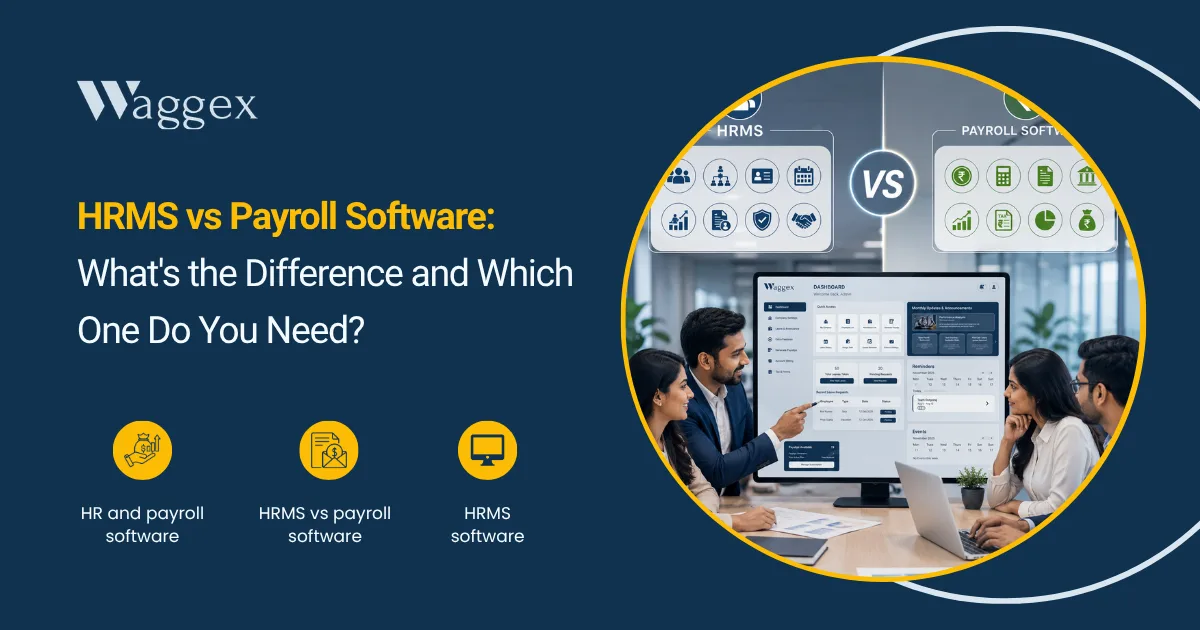
If you run a business in India and manage even 10 employees, at some point you’ve asked this question: do we need payroll software or an HRMS? Both handle salaries. Both claim to save time. Both come with a demo call and a pricing page.
The honest answer is they’re not the same thing and choosing the wrong one creates problems and you won’t even see problems coming until you’re already dealing with a wrong salary, a missed PF deadline, or an HR manager who spends 4-5 days every month just on work that should take three hours.
We’re working with hundreds of Indian businesses at Waggex. Here’s how we explain this difference in simple terms.
Start Here: What Does Each One Actually Doing?
What Is A Payroll Software?
Payroll software does one thing: it processes salaries. You give it the working days, salary structure, and statutory details for each employee it calculates the net pay, deducts PF, ESI, and TDS, generates payslips, and creates a bank transfer file. Some tools also handle Form 16 and ECR generation for EPFO.
That’s genuinely useful. But notice what’s missing: payroll software doesn’t know whether an employee came to work. It doesn’t track leaves. It doesn’t route approvals. It doesn’t store offer letters or performance records. It just processes the salary once you feed it the right inputs and getting those inputs still depends on you.
What Is A HRMS Software?
An HRMS Human Resource Management System includes payroll, but it also manages the work that produces payroll data. Attendance is tracked inside the same system. Leave requests are approved inside the same system. When payroll runs, it’s pulling from data that’s already been verified, not from a spreadsheet someone assembled the previous day.
Beyond payroll, an HRMS also handles onboarding, performance reviews, employee self-service, HR reporting, and workforce management. It’s the difference between software that processes your HR output and software that manages your HR operation.
| The simplest way to put it: Payroll software is a calculator. HRMS is the system that does the work, then runs the calculation. |
Where Standalone Payroll Software Runs Into Trouble
Payroll software works fine when HR is simple. The problems start as soon as anything becomes non-standard which, for most Indian businesses, happens faster than expected.
Someone Has to Feed It Data Every Month
Payroll software doesn’t know who was present, who took leave, who worked overtime, or who resigned mid-month. That information lives somewhere else: a biometric device, an Excel sheet, an attendance register. Someone has to compile it, verify it, and manually enter it before payroll can run.
For a 30-person team that takes 3–4 hours. For a 100-person team it takes days. And every manual step is a place where an error can enter the wrong file version, a leave that wasn’t updated, an overtime calculation that missed a shift. Research consistently shows that nearly 40% of small businesses face payroll errors every year, most of which originate at exactly this data-entry step.
Indian Compliance Doesn’t Stay Still
PF, ESI, and TDS rules change. In June 2024, EPFO revised its penalty structure the old tiered damages of 5% to 25% per annum were replaced with a flat 1% per month on arrears. That’s cleaner to calculate, but it still means PF deposited even a few days late after the 15th of each month attracts interest under Section 7Q plus damages. A Delhi trading company received a ₹3.8 lakh EPFO demand notice not for wrong calculations, but for consistently depositing contributions 3–8 days late. The law makes no distinction between intentional default and an administrative slip.
Payroll software calculates correctly but it doesn’t ensure you file on time, alert you when deadlines are approaching, or generate the right filing documents automatically. Those steps still require manual attention.
Field Teams Are Invisible to Payroll Software
A large portion of India’s workforce isn’t sitting at a desk. Delivery staff, field sales executives, technicians, housekeeping, construction site workers for these employees, attendance can’t be captured by a biometric device at one office. Payroll software has no mechanism for this at all. With Waggex, field employees mark attendance through the Selfie Attendance app or GPS-verified Geo-Location check-in from their phone. That data flows straight into payroll without anyone transferring it.
Multi-State Operations Get Complicated Fast
Professional Tax is state-administered, which means the slab rates, due dates, and filing requirements differ between Maharashtra, Karnataka, West Bengal, Gujarat, and Tamil Nadu. If your business operates in two states, payroll software often handles one correctly and the other manually. An HRMS configured for your locations handles each state’s rules independently. The Employees’ State Insurance Act also has applicability thresholds that vary by establishment type, another calculation that needs to be right by default, not by memory.
HRMS vs Payroll Software: Feature Comparison
Here’s a direct comparison of what each actually covers.
| Payroll Software | HRMS (Waggex) | |
|---|---|---|
| Main purpose | Calculate & disburse salaries | Manage full HR payroll included |
| Attendance feed | Manual import every month | Automatic same system |
| Leave → payroll link | You calculate & enter manually | Calculated automatically |
| PF / ESI / TDS | Calculates; you file manually | Calculates + reminders + ECR files |
| Employee self-service | Rarely included | Built in payslips, leaves, docs |
| Recruitment & onboarding | Not included | Included |
| Performance management | Not included | Included |
| Field / mobile attendance | Not supported | GPS, selfie, face recognition |
| Multi-state PT support | Basic or manual | Configured per state |
| HR reports & dashboards | Payroll-only reports | Full workforce visibility |
| Who operates it | Accountant / finance | HR team, managers, employees |
| Pricing (Waggex) | — | From ₹2 per employee / month |
Note: Some payroll tools have added HR modules over time. Before assuming integration, test the actual data flow ask the vendor whether attendance updates payroll automatically or whether it still requires a manual export/import step.
The Real Cost of Running Two Separate Tools
The most common setup we see in growing Indian businesses: payroll software for salaries, a separate attendance app or biometric device, WhatsApp for leave requests, email for HR records. It feels like a manageable system. Over time, the coordination cost adds up in ways that don’t show up on any invoice.
- Reentry time. Exporting from attendance and importing into payroll takes 2–4 hours per payroll cycle for a 30-person team. Over a year, that’s up to 48 hours spent on a data transfer that a connected system would eliminate entirely.
- Error cost. Each manual transfer is an opportunity for the wrong file version, a missed LOP entry, or a transposition error. One incorrect salary requires investigation, a corrected payslip, and a recovery or additional payment all of which takes longer than the original error.
- Compliance exposure. When attendance, leave, and payroll are in separate tools, generating a clean compliance trail for a PF or labour audit requires manually pulling records from multiple sources. What should be a report becomes a multi-day reconstruction exercise.
- Subscription stacking. Separate attendance app + payroll software + document storage adds up. Waggex covers attendance, payroll, leave, compliance, self-service, and HR records starting at ₹2 per employee per month often less than the combined cost of disconnected tools.
| A quick calculation worth doing: If your HR team spends 3 days on payroll prep per month compiling attendance, verifying leaves, entering data and your HR executive costs ₹30,000/month, that’s ₹3,000 of salary per month spent on data transfer. Waggex for 50 employees costs ₹100/month. See Waggex pricing. |
When Payroll Software Is Enough
We want to be straightforward about this: not every business needs a full HRMS immediately.
If you have fewer than 15–20 employees, all working from one office, with fixed salary structures and no field team standalone payroll software can handle your needs for now. The manual coordination overhead is manageable at that scale. The compliance risk is lower. The cost of separate tools is proportionate.
The signal that payroll-only software has outgrown your business isn’t a headcount number it’s whether you’re manually bridging the gap between attendance, leave, and payroll every single month. The moment that bridge exists, the errors and time loss have already begun.
Which One Do You Need? Use This to Decide
Run through your current situation against the table below.
| Situation | Payroll only? | Need HRMS? |
|---|---|---|
| < 20 employees, fixed salaries, office-based | Usually yes | Not urgent |
| Attendance data manually entered before payroll | Stop here | Yes now |
| Field staff or work-from-home employees | No | Yes |
| Leave data calculated outside payroll | No | Yes |
| Two or more states, different PT slabs | Risky | Yes |
| PF / ESI notice or penalty received | No | Yes urgently |
| HR team spending 3+ days per month on payroll prep | No | Yes |
| Employees asking HR for payslips on WhatsApp | No | Yes |
| Scaling past 50 employees | Difficult | Yes |
If you have more than two or three “Yes need HRMS” entries in that table, the coordination overhead you’re managing manually is already larger than the cost of a connected system.
Why Integration Matters More Than Individual Features
There’s a specific reason we built Waggex as a connected platform rather than a payroll tool with add-ons: the most expensive HR problems in Indian businesses aren’t caused by bad software features. They’re caused by data moving between systems incorrectly or not moving at all.
When an employee takes 2 days leave without pay, that should show up automatically in their month’s salary. When a field executive marks attendance via GPS at a client location, that should feed directly into shift management and payroll. When a salary revision is approved in the system, the next payroll should reflect it without someone updating a separate spreadsheet. These aren’t advanced features they’re what a connected system does by default.
On the compliance side: PF contributions must be deposited by the 15th of each month under the Employees’ Provident Funds Act. ESI contributions follow the same cycle under the Employees’ State Insurance Act. TDS is governed by the Income Tax Act with quarterly return deadlines. A connected HRMS generates reminders, correct calculations, and filing-ready documents for all of these as part of the standard payroll cycle not as a separate compliance task.
For employees, the difference is visible too. With Waggex’s Employee Self-Service app, staff can check their leave balance, download their payslip, view attendance records, and apply for leave from their phone. That removes a whole category of HR queries that currently land on someone’s WhatsApp at inconvenient hours.
The Short Answer
Payroll software processes a salary. HRMS manages the people and data that produce one.
For a small, stable, office-based team payroll software works and there’s no reason to over-invest. For any business where attendance tracking, leave management, field teams, compliance, or employee experience are part of daily HR work the multi-tool approach adds coordination costs that compound over time.
Waggex is used by businesses from 10 employees to several hundred across India manufacturing units, retail chains, IT services firms, logistics companies, and everything in between. We’re priced at ₹2 per employee per month because we think HRMS should be accessible from the early stages of a business, not just after the problems have become expensive. Start a free trial at waggex.com no credit card, setup in under a day.