

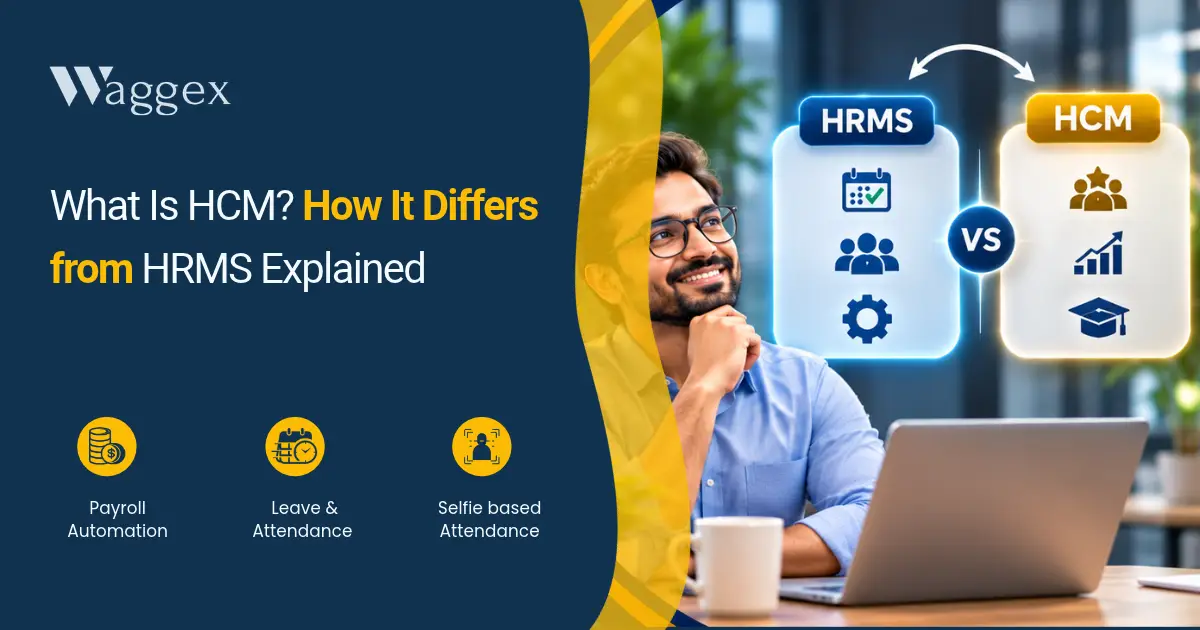
HCM and HRMS are terms that many software vendors use interchangeably. Sometimes they describe the same product, while other times they are used to highlight differences between two solutions. Although the two concepts have several overlapping features, they serve different purposes. Understanding this difference is important when choosing HR software, as it helps businesses select a system that matches their actual requirements.
Most Indian companies searching for HCM software are primarily looking for essential HRMS features such as accurate payroll processing, statutory compliance tracking, leave management, attendance, and employee records. Advanced HCM capabilities, such as workforce analytics, succession planning, talent management, and strategic workforce planning, are more relevant to companies with complex HR structures and long-term workforce planning needs.
Understanding whether your business needs an HRMS to manage daily HR operations or a broader HCM platform for strategic workforce management makes it easier to choose the right software without paying for features you may not need.
What Human Capital Management (HCM) Actually Means
Human Capital Management (HCM) is a way of managing employees as valuable business assets. It focuses on developing employee skills, improving performance, and making better workforce decisions to support business growth.
HCM software goes beyond basic HR tasks. It manages the entire employee lifecycle, including workforce planning, recruitment, onboarding, performance management, training, compensation, succession planning, and exit management. It also uses employee data to help businesses make better workforce decisions.
Popular HCM software providers include SAP SuccessFactors, Oracle HCM Cloud, and Workday. These platforms are mainly designed for large organisations with thousands of employees and complex HR requirements. For most Indian companies, they can be more advanced and expensive than necessary.
What HRMS Is and Why Most Indian Companies Need It First
HRMS Human Resource Management System is the operational layer of HR software. It covers the processes HR teams run every day: calculating payroll, processing PF and ESIC contributions, managing leave balances, tracking attendance, maintaining employee records, generating payslips, and filing statutory returns.
The distinction from HCM is scope and intent. HRMS is built to make HR operations accurate and efficient. HCM is built to make HR strategy data-driven. An HRMS tells you what your payroll cost was this month and whether PF was filed on time. An HCM platform tells you which departments are at retention risk next quarter and which employees are pipeline-ready for leadership roles.
For the vast majority of Indian companies particularly in the 20 to 500 employee range the immediate problem is operational. Payroll runs late, statutory filings get missed, attendance data doesn’t flow cleanly into salary calculations, and HR spends its time on manual reconciliation rather than anything strategic. HRMS solves these problems. HCM capabilities built on top of an unstable operations foundation don’t deliver what they promise.
| A useful test: if your team is still manually preparing bank files, tracking PF deadlines in a spreadsheet, or calculating LOP deductions outside your payroll system, HRMS is the right priority. HCM analytics are only as good as the operational data feeding them and manual processes produce data too inconsistent to run analytics on meaningfully. |
HRMS vs HCM: Key Differences Side by Side
| Dimension | HRMS | HCM |
| Primary focus | Managing HR operations: payroll, attendance, leave, statutory compliance, employee records | Managing human capital as a strategic resource: workforce planning, talent development, performance, analytics |
| Core functions | Payroll processing, PF/ESIC/TDS compliance, leave and attendance, onboarding workflows, payslip generation | Succession planning, competency mapping, learning management, workforce analytics, compensation benchmarking |
| Who uses it daily | HR operations team, payroll team, finance for compliance and cost data | HR leadership, business heads, L&D teams, talent acquisition at a strategic level |
| Output | Accurate payroll runs, clean statutory filings, documented employee records | Workforce insights, talent pipeline health, leadership readiness, retention risk data |
| Right for | Companies that need payroll accuracy and compliance as the immediate priority | Enterprises with mature HR operations looking to optimise talent and workforce strategy |
The boundary isn’t rigid. Modern HRMS platforms increasingly include HCM-adjacent features performance modules, basic workforce analytics, employee development tracking. And enterprise HCM platforms include the HRMS layer underneath. The question isn’t which category is better; it’s which capabilities your organisation is actually ready to use.
Core HCM Functions and Which Companies Actually Need Them
Workforce planning: Forecasting headcount needs 6 to 18 months out, based on growth projections, attrition rates, and skill gaps. Valuable for companies scaling rapidly or managing seasonal demand shifts. Requires reliable historical headcount and attrition data which comes from a functioning HRMS.
Succession planning and talent pipeline: Identifying which roles are at retention or vacancy risk and who in the organisation is development-ready for those roles. Most relevant for companies with 200+ employees where institutional knowledge loss is a real business risk. Below that headcount, this level of planning is rarely operationally necessary.
Learning management (LMS): Structured training delivery, completion tracking, competency development tied to role requirements. Large IT services firms, BFSI companies, and regulated industries find this most valuable. The LMS function is often purchased separately rather than as part of an HCM suite.
Compensation benchmarking: Comparing your pay structures against market data by role, band, and geography. Useful for retention strategy and offer competitiveness. Most Indian companies access this through standalone surveys (Mercer, Aon) rather than integrated HCM tools.
People analytics: Aggregating data from payroll, attendance, performance, and recruitment into dashboards that surface attrition patterns, productivity trends, and hiring effectiveness. The Deloitte India 2026 people analytics study found only 8% of Indian organisations have reached the level of analytics maturity where this data actually drives decisions the other 92% are still building the data foundation it requires.
HRIS, HRMS, and HCM: Clearing Up the Terminology
Three terms, significant overlap, no universal standard:
HRIS (Human Resource Information System): The record-keeping layer employee data, job history, contracts, documents. The database that other HR processes draw from. Some vendors use HRIS and HRMS interchangeably.
HRMS (Human Resource Management System): HRIS plus operational workflows payroll, attendance, leave, compliance. The full working system for running day-to-day HR in an Indian company context.
HCM (Human Capital Management): HRMS plus strategic capabilities workforce planning, talent management, advanced analytics. What large enterprises mean when they talk about their ‘people platform’.
Vendors often label their HRMS as HCM for positioning reasons. The practical check: does the platform handle Indian payroll compliance PF, ESIC, TDS, PT, Labour Codes 2025 correctly out of the box? If not, the strategic features don’t matter yet.
What Most Indian Companies Should Actually Be Looking For
For most Indian companies, the right starting point is payroll and HR software that manages payroll, statutory compliance, leave, attendance, and employee self-service while maintaining accurate employee records for basic workforce reporting.
Waggex offers an HRMS designed for Indian compliance requirements, covering PF, ESIC, TDS, Professional Tax (PT), gratuity, and Full and Final (F&F) settlements through a single compliance module integrated with payroll. This helps businesses keep their HR operations organised, manage statutory requirements, and maintain audit-ready records before moving towards more advanced workforce analytics.