

Ask any HR manager at a company that’s crossed 30–40 employees what their biggest time drain is. Nine out of ten will say the same thing: they spend most of their week doing things that shouldn’t require a human at all. Chasing managers for attendance sheets. Recalculating payroll because someone’s leave wasn’t updated. Answering the same questions
“What’s my PF deduction?” “Can I see last month’s payslip?” “How many leaves do I have left?” five times a day on WhatsApp.
That’s not an HR problem. That’s what happens when you try to manage a 2025 workforce with a 2005 toolkit. Spreadsheets, paper registers, and email threads were never designed for this.
HRMS software Human Resource Management System was built to fix exactly this. Not to add another layer of complexity, but to remove the ones that shouldn’t be there. This article breaks down what an HRMS actually does, who it helps, and whether your business genuinely needs one or whether you can get away without it for now.
(Spoiler: the answer changes faster than most businesses expect.)
What Is HRMS Software?
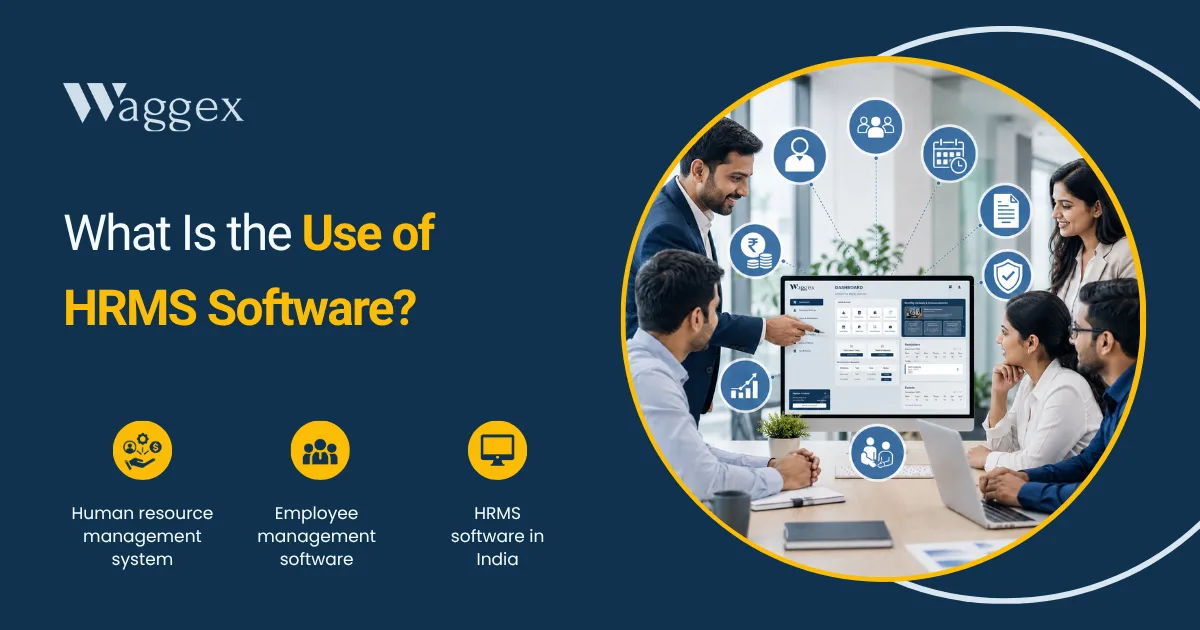
HRMS stands for Human Resource Management System. The long version: it’s a software platform that manages the full employee lifecycle from the day someone accepts your offer letter to the day they leave. Hiring, onboarding, attendance, payroll, performance reviews, compliance filing, and exit formalities all in one place, all connected to the same employee record.
The short version: it replaces the pile of spreadsheets, paper forms, WhatsApp groups, and disconnected tools that most HR teams rely on today.
Here’s why that matters more than it sounds. When your attendance data lives in one spreadsheet, your salary calculations in another, and your leave records in someone’s inbox, errors are inevitable. An employee takes 2 days of casual leave in the middle of the month. The attendance sheet gets updated. But the person doing payroll pulls last week’s version by mistake. The employee gets an incorrect salary. They raise a complaint. HR investigates. Three people spend 45 minutes resolving something that, with integrated software, wouldn’t have happened at all.
Multiply that by 50 employees and 12 months, and you start to see why Waggex users report saving over 72% of their HR administration time after switching to an integrated HRMS.
HRMS, HRIS, HCM What’s the Actual Difference?
You’ll see these three terms everywhere when researching HR software, often used as if they mean the same thing. They don’t. Here’s a plain-language breakdown:
HRIS (Human Resource Information System) is essentially a database. It stores employee records, contracts, and basic HR information. Think of it as a well-organised digital filing cabinet. Useful, but it doesn’t actually process anything: no payroll, no attendance calculations, no compliance filings.
HRMS (Human Resource Management System) goes further. It includes everything HRIS does, then adds operational tools: payroll processing, attendance and leave management, recruitment workflows, performance reviews, compliance automation, and employee self-service. It doesn’t just store data, it acts on it.
HCM (Human Capital Management) takes the strategic layer on top. Workforce planning, succession management, advanced analytics, learning and development platforms. It’s built for large enterprises with dedicated HR strategy teams. For most Indian SMEs, it’s more than needed and priced accordingly.
| Feature / Capability | HRIS | HRMS ✓ | HCM |
|---|---|---|---|
| Employee Records & Docs | Yes | Yes | Yes |
| Payroll Processing | No | Yes | Yes |
| Attendance & Leave | Basic | Full | Full |
| Statutory Compliance | No | Yes (PF/ESI/TDS) | Yes |
| Performance Reviews | No | Yes | Advanced |
| Recruitment & Onboarding | No | Yes | Yes |
| Employee Self-Service App | No | Yes | Yes |
| Strategic Workforce Analytics | No | Partial | Advanced |
| Ideal For | Record-keeping | SMEs to Enterprise | Large Enterprises |
For the majority of Indian businesses, startups, SMEs, growing mid-size companies HRMS is the right layer. Comprehensive enough to handle real operational complexity, without the enterprise price tag of full HCM platforms.
What Is HRMS Software Actually Used For?
This is what most people searching this topic want to understand not the definition, but what it does in practice, day to day. Here’s an honest breakdown.
- Keeping Every Employee Record in One Place
Before HRMS, employee information is scattered. The offer letter is in someone’s Google Drive. The PAN card copy is in a physical file. The current salary is known only to the founder and the HR manager. The promotion history lives in someone’s memory.
An HRMS creates a single, searchable employee profile that holds everything: personal details, emergency contacts, documents (Aadhaar, PAN, bank details), job history, compensation changes, department transfers, and performance records. The moment you need to verify employment for a bank loan, run a salary revision, or pull someone’s joining date for gratuity calculation it’s there in seconds.
More practically: when an employee leaves and a new HR manager joins, they don’t have to rebuild institutional memory from scratch. Everything is documented, timestamped, and accessible.
- Running Payroll Without the Monthly Panic
For most HR teams, payroll day is the most stressful day of the month. Especially in Indian businesses where the calculation isn’t just basic salary it involves PF employer and employee contributions, ESI (for applicable employees), TDS based on income tax declarations, professional tax (which varies by state), LOP deductions, overtime additions, and any reimbursements. Getting this right manually, every month, for a team of 30+ employees, is genuinely hard.
HRMS payroll modules pull attendance and leave data that’s already in the system with no re-entry, no cross-referencing between tabs and calculate each employee’s net salary automatically. The same calculation that took 2-3 days of manual work runs in under an hour. Payslips are generated and sent directly to employees’ apps.
| Why this matters for Indian businesses specifically: PF, ESI, TDS, and Professional Tax rules change. Salary slabs, contribution rates, state-specific PT slabs and HRMS updates these automatically rather than requiring your HR team to manually recalculate every time a rule changes. |
- Tracking Attendance for Teams That Don’t All Sit in One Office
Five years ago, attendance meant signing a register at the front desk. Today, attendance means something completely different: a sales team that’s mostly in the field, customer service staff working from home three days a week, delivery executives spread across a city, and office staff on rotating shifts.
A good HRMS handles all of this. Office teams can use web-based check-in or biometric integration. Field teams and remote workers can mark attendance via mobile with GPS verification to confirm location, or selfie-based attendance to prevent proxy marking. Shift scheduling, late marks, overtime tracking, and weekly off rules all calculate automatically and flow directly into payroll.
Waggex’s Geo-Location Attendance and Live Location Tracking features were specifically built for India’s distributed workforce, where field operations are the norm rather than the exception.
- Hiring and Onboarding Without the Paperwork Backlog
Recruitment creates a lot of administrative work that often gets dumped onto HR tracking where each candidate is in the process, collecting documents, generating offer letters, coordinating joining formalities. Without a system, this happens across email threads and shared drives that quickly become impossible to manage.
HRMS recruitment modules centralise the pipeline: job postings, application tracking, interview scheduling, offer letter generation from templates, and digital document collection. When a candidate accepts and becomes an employee, their profile moves straight from recruitment into the HR system no duplicate data entry.
For the new employee, digital onboarding means they can complete their documents, review company policies, and set up their profile before Day 1. They start work feeling organised rather than spending their first two days filling out forms.
- Performance Reviews That Actually Get Done
Performance appraisals have a reputation for being the thing everyone dreads and nobody does consistently. Part of the reason is the process itself manually creating review forms, distributing them, chasing managers to complete them, aggregating responses, and then trying to make fair pay decisions based on inconsistent data.
HRMS performance modules structure this end to end. Managers set goals for employees at the start of a review period. Progress can be updated through the cycle rather than just at the end. When appraisal time comes, the review form is pre-populated with attendance data, goal progress, and previous feedback. Managers complete reviews in the system. Employees can see their ratings and comment. The whole process from goal-setting to increment decision stays in one place, with a complete audit trail.
The result is appraisals that actually happen on schedule, and increment decisions that managers can actually defend with data.
- Staying Compliant Without Hiring a Compliance Specialist
Indian labour law compliance is one of those things that looks manageable until you’re actually responsible for it. PF (Provident Fund) contributions on both employer and employee sides, ESI for employees earning below the threshold, TDS calculations based on each employee’s tax declarations, Professional Tax slab rates that differ across states, Gratuity eligibility after 5 years of service, statutory bonus requirements. Each of these has its own calculation method, payment deadlines, and filing format.
HRMS software handles these calculations automatically not because it replaces expert advice, but because the rules are built into the engine. Every payroll run produces the correct deductions. ECR files for PF are generated in the right format. TDS computations follow the Income Tax Act. Deadlines trigger automatic reminders.
For a business without a dedicated compliance team which describes most Indian SMEs this is the difference between staying compliant and accidentally accumulating penalties they didn’t even know about. Waggex’s Tax & Forms Management module keeps all statutory documentation organised and audit-ready.
- Giving Employees the Self-Service They Already Expect
This one is underrated. A significant portion of HR’s daily workload isn’t strategic work, it’s answering the same employee questions repeatedly. Payslip requests. Leave balance queries. Attendance dispute corrections. Document requests for bank loans or visa applications.
An Employee Self-Service portal handles all of this without HR involvement. Employees open their app, apply for leave, see the balance update in real time, check their payslip, download their experience letter. Managers approve leave requests from the same app. HR gets notified of anything that needs their input rather than every single transaction.
| The time saving adds up quickly. If an HR executive handles 15–20 routine employee queries per day each taking 5–10 minutes that’s nearly 2 hours of non-recoverable time. Every day. An ESS portal reclaims most of that without reducing service quality. |
Who Actually Uses an HRMS?
Three groups interact with the system in completely different ways, and each gets something different out of it.
HR Teams
For HR professionals, this is the biggest shift. The hours previously spent on data entry, payroll reconciliation, leave tracking, and answering employee queries move into the background. HR has time to focus on the things that actually need human judgment retention, hiring quality, culture, career development, and difficult conversations. The system handles the predictable; people handle the important.
Managers and Team Leads
Managers don’t have to go through HR for everything. Leave approvals land in their app. They can see who on their team is in or out today. Task management tools let them assign work and track progress. Performance review prompts appear when it’s time, pre-filled with data. Shift scheduling for their team is visible in one place. The dependency loop between managers and HR which creates delays on both sides shortens considerably.
Employees
From an employee’s perspective, a well-implemented HRMS is invisible in the best possible way. Their salary arrives correctly and on time. They can access their payslip from their phone. Leave requests go through without having to track down their manager in person. Their documents are available when they need them. These aren’t glamorous benefits but their absence is something people notice immediately.
What Indian Businesses Actually Gain
Skipping the generic bullet-point list here the real benefits are specific and worth being precise about.
- Time back for HR. Waggex users report saving over 72% of HR admin time. That’s not a marketing figure, it’s the result of eliminating manual payroll processing, removing repetitive employee queries from the HR inbox, and automating the compliance calculations that previously required cross-checking multiple documents.
- Payroll accuracy. Integrating attendance data directly with payroll eliminates the manual transfer step where most payroll errors originate. Businesses report up to 40% fewer payroll discrepancies after switching to integrated HRMS software.
- Compliance without constant monitoring. PF, ESI, TDS, and PT calculations run correctly inside every payroll cycle. Filing formats are generated automatically. The risk of unintentional non-compliance which carries financial penalties and sometimes personal liability for directors decreases sharply.
- Works for every team structure. Office-based, remote, field, hybrid the same platform handles all of them. Mobile apps for employees, web dashboard for HR, manager approvals from anywhere.
- Scales without proportional HR headcount growth. Going from 20 to 80 employees doesn’t require doubling your HR team when the system handles the operational load. The platform scales; your HR team focuses on judgment, not processing.
- Audit readiness. Every action payroll run, leave approval, attendance edit, salary revision is timestamped and logged. Labour inspections and internal audits that used to require days of document preparation become manageable.
“We’re Too Small for HRMS Software” Are You, Though?
This is the most common reason businesses delay adoption, and it’s usually wrong. The calculation people make is: we only have 20 employees, this software is for big companies.
Here’s the actual calculation: how many hours per month does your team spend on payroll and HR admin? For a 20-person business, it’s typically 15–25 hours across the people involved the HR executive, the accountant, the manager chasing attendance confirmations. Multiply that by 12, then by the blended hourly cost of those people’s time. The number is larger than the annual cost of an HRMS subscription at ₹2 per employee per month.
Beyond cost, there’s risk. A 15-person company that misfiles PF for 6 months and then gets audited faces the same penalty structure as a 500-person company. The risk doesn’t scale with headcount the regulations apply equally.
The businesses that benefit most from early HRMS adoption are the ones where HR is worn by someone for whom it’s a secondary function the operations manager who also handles payroll, the founder who approves leaves over WhatsApp. Getting that off their plate, at ₹2 per employee, is not a luxury. It’s an obvious decision.
| Waggex starts at ₹2 per employee per month. No setup fee. No minimum headcount. Free trial available. For a 20-person team, that’s ₹40/month less than one cup of decent filter coffee. |
How to Choose the Right HRMS Five Questions Worth Asking
The HRMS market in India has grown quickly, and not every platform is built for the same use case. Before committing to a trial or a conversation with a sales team, these five questions will filter out the wrong options quickly.
- Does it actually support Indian statutory compliance? Not just payroll but PF ECR file generation, ESI challan formats, TDS computation with Form 16 output, state-wise Professional Tax slabs, and Gratuity calculations. Ask specifically. Many platforms support payroll but outsource compliance or leave it to manual entry.
- Is the mobile app usable by your field team? A mobile app that requires a high-end smartphone and stable 4G to function won’t work for delivery staff, field sales executives, or site supervisors. Test it on a mid-range Android device on a standard data connection.
- Does attendance flow directly into payroll? This is the integration that saves the most time. If you have to export attendance data and import it into a separate payroll module, you haven’t eliminated the manual step you’ve just changed what it looks like.
- What does support look like after you sign up? Payroll issues happen mid-cycle, not during business hours on weekdays. Check whether support is available when you actually need it, and in a language your team is comfortable with.
- Is there a free trial with real features? A demo environment pre-loaded with sample data is not the same as running a real payroll cycle for your own team. Ask for a trial that lets you process an actual payroll run before committing.
Waggex offers a free trial with no credit card required full access to attendance, payroll, and compliance features from day one. Worth 20 minutes to see if it fits your team structure.
Final Thoughts
The goal of HRMS software isn’t to add technology in your company. It’s to fix a specific, persistent problem: that managing people manually is slow, error-prone, and takes your HR team’s time away from the work that actually requires people.
Payroll should run without a three-day reconciliation. Compliance should not require a specialist to be correct. Employees should be able to check their leave balance without pinging HR on a Sunday. Managers should be able to approve leave from their phone in 30 seconds.
None of this is complicated to want. It just requires the right tools.
| If you manage a team in India and want attendance, payroll, and compliance working together without the manual overhead explore Waggex HRMS. Start your free trial at waggex.com · No credit card required · Setup in under 30 minutes |