

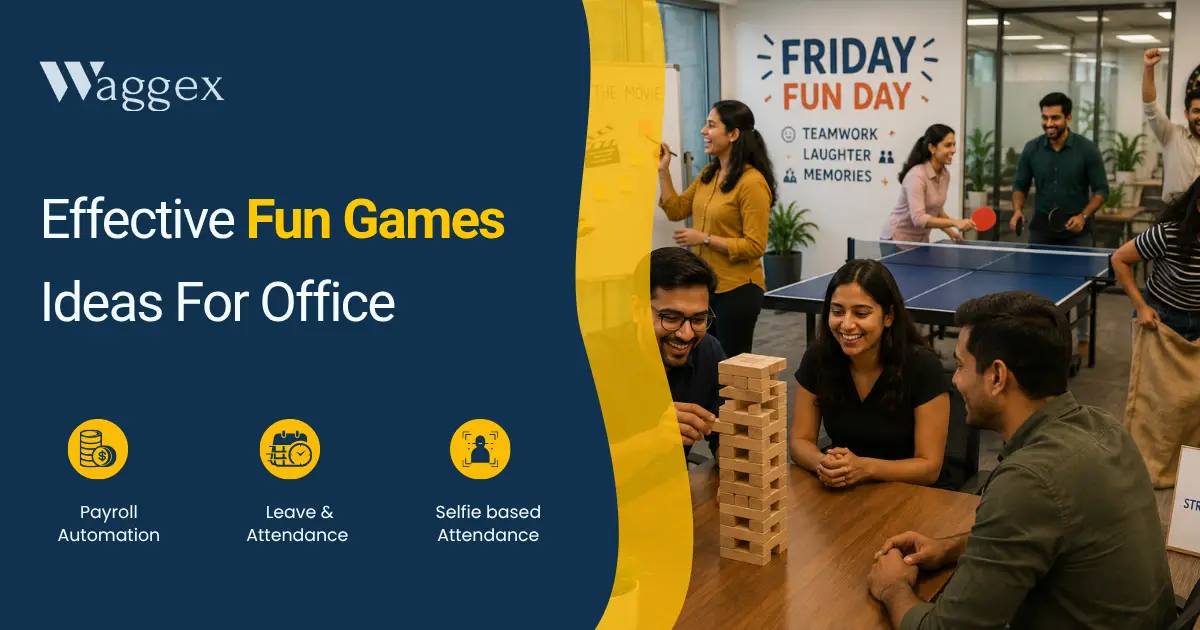
We all know what Fridays are like. By the afternoon, productivity is usually at an all-time low, and half the office is quietly checking the clock and waiting to punch out. And honestly, that’s okay.
Instead of pretending everyone is going to suddenly become super productive for the last couple of hours, why not use that time to have some fun? A few simple games can get people out of their seats, talking to each other, laughing, and actually enjoying those last couple of hours before the weekend starts.
So, if you’re looking for something fun to do at the office this Friday, here are 15 games that are easy to organise, don’t need much preparation, and won’t make everyone feel like they’ve been dragged into another corporate team-building session.
Quick Reference All 15 Games
| Game | Team Size | Time Needed | What You Need |
|---|---|---|---|
| Two Truths and a Lie | 5–30 | 15–20 min | Nothing |
| Office Bingo | Any | 30 min | Printed bingo cards |
| Dumb Charades Bollywood Edition | 8–30 | 30–45 min | Chits of film names |
| Antakshari | Any | 30–60 min | Nothing |
| The Paper Tower Challenge | Teams of 4–6 | 20 min | A4 paper + tape |
| GK Quiz with a Twist | Any | 30 min | Printed questions |
| Tambola / Housie | Any | 45–60 min | Housie tickets + number caller |
| Scavenger Hunt (Office Edition) | Teams of 3–5 | 30–45 min | A clue list |
| Rapid Fire Questions | Any | 15–20 min | A question list |
| Just a Minute (JAM) | Any | 30 min | A topic chit |
| Dumb Talent Show | Any | 30–45 min | Nothing |
| The Great Office Chef | Teams of 3–5 | 1–2 hrs | Ingredients, kitchen access |
| Pictionary Relay | Teams of 4–6 | 30 min | Whiteboard or chart paper |
| Tongue Twister Battle | Any | 15 min | A list of tongue twisters |
| Office Awards Night | Any | 30 min | Pre-made award categories |
- Two Truths and a Lie
Players: 5–30 | Time: 15–20 min | Cost: ₹0
The oldest icebreaker in the book and somehow still the best one for offices where half the team doesn’t really know each other outside their immediate pod.
How it works: everyone writes down three statements about themselves. Two are true, one is a lie. The group votes on which one they think is the lie. Simple. But the quality of the game depends on how creative people get with the lie and how surprising their truths turn out to be.
Tip: encourage people to make the lie believable and one truth completely unbelievable. That’s where it gets interesting. The quietest person in the office once claiming they were a national-level chess champion makes for a better reveal than someone lying about their favourite colour.
- Office Bingo
Players: Any | Time: 30 min | Cost: ₹50–₹200 to print
This one works best as a week-long game that culminates in Friday but you can run it in an afternoon too. The bingo grid is filled with things that actually happen at your office: ‘someone says synergy,’ ‘meeting goes 10 minutes over,’ ‘laptop charger borrowed and not returned,’ ‘someone reheats fish in the microwave.’
Each person marks their card as they spot the event happening during the day. First one to complete a row shouts Bingo and wins. The game runs passively in the background while people work and the shared recognition of office clichés is what makes it funny.
Customise the grid for your office specifically. The more inside jokes in there, the better.
- Dumb Charades Bollywood Edition
Players: 8–30 | Time: 30–45 min | Cost: ₹0
Everyone knows the rules. The Bollywood edition just makes it more interesting because the film titles are more dramatic and the acting more committed. Split into two teams, rotate who’s acting, give 2 minutes per turn.
The best variant for offices: add a category round where all the films are from one decade, or all from one actor’s filmography. Watching someone silently act out Kuch Kuch Hota Hai for a colleague who grew up in the 2010s is a specific kind of chaos that bonds people.
Include a few Telugu, Tamil, and Marathi films in the mix if your office has people from across the country. It levels the playing field and gets interesting.
- Antakshari
Players: Any | Time: 30–60 min | Cost: ₹0
Still undefeated. One team sings a line from a Bollywood song. The next team has to start with the last letter of the previous song’s first word. No repetition, no long pauses, no humming without lyrics.
The reason it works in offices: it’s completely inclusive. Doesn’t matter if you’re from Chennai, Kanpur, or Bengaluru almost everyone has enough Bollywood exposure to participate. And the competitive instinct that kicks in when your team is stuck is genuinely hilarious to watch.
Add a rule: no songs from before 2010. This either makes it harder or reveals who’s been secretly memorising older songs. Either outcome is entertaining.
- The Paper Tower Challenge
Players: Teams of 4–6 | Time: 20 min | Cost: ₹30 (A4 paper + tape)
Give each team 20 sheets of A4 paper and one roll of tape. Fifteen minutes to build the tallest freestanding tower that can support a coin on top. No other materials allowed.
This one looks simple but gets competitive very quickly. The engineering instinct kicks in someone immediately wants to roll the paper into cylinders, someone else wants to fold it into a lattice and the internal team disagreement on approach is usually funnier than the actual game.
Bonus round: no talking allowed during construction. Communication only through hand signals. Turns a 15-minute game into a 20-minute chaos.
- GK Quiz With a Twist
Players: Any | Time: 30 min | Cost: ₹0
Standard GK quiz with one rule: every question has four answer options, and the wrong answers are absurd. ‘What is the capital of France? (a) Paris (b) Mumbai (c) The Eiffel Tower (d) Bread.’ The wrong answers are where the fun is.
Run it in teams. One question per team, 30 seconds to confer and answer. Wrong answer means another team can steal. Include a few questions about your own company founding year, first client, the most embarrassing product name and suddenly it’s also a culture quiz.
Mix in a round of questions about team members themselves. ‘What city did Rohan grow up in?’ ‘What did Priya study in college?’ Suddenly everyone’s paying attention to find out if their colleagues know anything about them.
- Tambola / Housie
Players: 10+ | Time: 45–60 min | Cost: ₹100–₹300 for tickets
The most reliably exciting game in any Indian gathering. Print or buy housie tickets different combinations for everyone and have someone call numbers. First to complete a row (early five), all corners, or full house wins.
The reason it works even for people who aren’t competitive: anyone can win. The intern has the same odds as the team lead. That randomness is oddly satisfying in a workplace context.
Replace cash prizes with something low-stakes: an extra half-day off, choice of Friday lunch spot, first dibs on parking for a week. The prize matters less than the ceremony of claiming it.
- Scavenger Hunt Office Edition
Players: Teams of 3–5 | Time: 30–45 min | Cost: ₹0
Set up 8–10 clues that send teams to different parts of the office the printer room, the back of the pantry, the fire exit sign. Each clue leads to the next one. Last clue reveals a small prize or just the satisfaction of finishing first.
The office-specific variant: make clues reference real things ‘Find the place where forgotten umbrellas go to die’ (the lost and found), ‘What’s behind the notice board?’ Two teams crashing into each other at the same clue location is invariably the highlight.
Prep time is about 45 minutes but the game itself runs tight and gets genuinely competitive. Worth the setup.
- Rapid Fire Questions
Players: Any | Time: 15–20 min | Cost: ₹0
One person sits in the ‘hot seat.’ The rest of the group fires questions one at a time 30 seconds to answer as many as possible. The answers have to be first instinct, no thinking. ‘Chai or coffee?’ ‘One food you’d eat forever?’ ‘What app is open on your phone right now?’
What makes it engaging: the pressure creates answers people wouldn’t normally give. Someone who is professionally very composed will say something completely unexpected when they have three seconds to respond. That’s the version of a colleague people remember.
Include a few work-related ones mixed in: ‘Zoom or in-person?’ ‘Monday morning or Friday afternoon?’ ‘Email or call?’ The answers are always funnier than expected.
- Just a Minute (JAM)
Players: Any | Time: 30 min | Cost: ₹0
One player picks a chit with a random topic ‘Things that always go wrong on Monday,’ ‘Why noodles are better than rice,’ ‘A defence of the reply-all email.’ They have to speak for exactly one minute without pausing, repeating themselves, or deviating from the topic.
Other players can buzz in and challenge if they spot a repetition or pause. If the challenge is correct, they take over. Whoever is speaking when the minute ends wins the point.
Works best with slightly absurd topics. ‘A defence of the open-plan office’ from someone who hates open-plan offices is comedy gold.
- Dumb Talent Show
Players: Any | Time: 30–45 min | Cost: ₹0
Everyone performs a ‘talent’ air guitar, impressions of colleagues, speed-folding a paper aeroplane, the world’s fastest arrangement of a deck of cards by colour. The more absurd the talent, the better.
The rule: actual talent is optional. Commitment is mandatory. This game works because the willingness to be ridiculous in front of colleagues builds something that a team-building workshop can’t genuine unselfconsciousness.
Audience votes for their favourite using slips of paper. Anonymous voting means honest results. Give the winner a completely made-up award: ‘Most Likely to Feature on a Talent Show They Would Definitely Lose.’
- The Great Office Chef Challenge
Players: Teams of 3–5 | Time: 1–2 hrs | Cost: ₹300–₹500
Each team gets the same set of basic ingredients from the pantry or a small budget to buy from a nearby store. 45 minutes to make a dish. Could be a sandwich, a salad, a chaat whatever the ingredients allow. A panel of judges (other teams, the office manager) decides the winner on taste, presentation, and creativity.
This one requires more setup than the others but generates better stories. ‘The time the entire engineering team made a chaat that somehow had too much lemon and not enough anything else’ is the kind of thing that gets mentioned at every team lunch for the next six months.
Have a vegetarian rule that applies to every team makes the judging fairer and avoids dietary complexity.
- Pictionary Relay
Players: Teams of 4–6 | Time: 30 min | Cost: ₹0 (need a whiteboard or chart paper)
First player from each team draws a word. Their team guesses. Correct guess next player runs up and draws the next word. Fastest team to get through 10 words wins.
The relay format is what makes it different from regular Pictionary the energy of physically running to the whiteboard, the urgency of the timer, the chaos of teammates shouting wrong answers before the right one lands. The game is loud. That’s the point.
Mix easy words with very hard ones: ‘umbrella’ followed by ‘bureaucracy’ followed by ‘nostalgia.’ The spike in difficulty mid-relay is genuinely funny.
- Tongue Twister Battle
Players: Any | Time: 15 min | Cost: ₹0
Two players face off. They’re given the same tongue twister and have to say it five times fast. The one who gets through it cleaner wins. Losers go again tournament bracket style.
Include Hindi and regional language tongue twisters alongside English ones. ‘Kaccha papita pakka papita’ said by someone who grew up speaking English at home will make the entire office stop what they’re doing.
Run it as a speed round: one point for each correct repetition in 30 seconds. Highest score advances. Takes 15 minutes, zero preparation, and produces exactly the kind of shared moment that makes people feel like they’re part of a team rather than just colleagues.
- Office Awards Night
Players: Any | Time: 30 min | Cost: ₹0–₹200 for printed certificates
HR or a small committee prepares made-up award categories in advance ‘Most Likely to Have Six Browser Tabs Open,’ ‘The Person Who Replies to Every Email Within 90 Seconds,’ ‘Best Reason for Being Late to a Meeting That Has Ever Been Heard.’ Categories specific to your office, specific people, specific running jokes.
Each person gets at least one award. The ceremony has a host. Winners give a 30-second acceptance speech. The whole thing takes 25 minutes and somehow feels like an actual event.
The awards that land best are hyper-specific. ‘The Award for Most Creative Use of a Shared Calendar Invite’ for the person who always schedules meetings during lunch. People remember being seen accurately and laughed at kindly for a long time after.
A Few Things That Make These Games Work
Keep it voluntary, not mandatory.
Not everyone wants to play, and that’s completely fine. Someone who’s been dragged into a game they don’t want to play is probably going to enjoy it less than someone who chose to sit it out. Keep it genuinely optional and let people join when they feel like it.
Keep it short.
A fun 20-minute game is much better than a 90-minute activity where half the room is checking their phones. If everyone’s still having a good time when it ends, you can always play another round or move on to a second game.
The game is the excuse, not the point.
The real goal is to get people talking to colleagues they don’t normally interact with. Mixed teams work especially well for this. Instead of accounting competing against marketing for the third time, mix everyone up and give people a chance to meet and chat with someone outside their usual work circle.
Have one person run the game.
Even simple games can get messy when nobody is in charge. Have one person keep track of time, explain the rules, settle any arguments, and keep things moving. They don’t need to be a manager or an official “event host.” They just need to be willing to take charge for 20–30 minutes.
| A note for HR: Employee engagement isn’t just about sending out surveys and asking people how happy they are. You can often see it in the numbers too attendance, retention, and even how quickly new employees settle into the team. Small things like a Friday game can help create a workplace where people actually enjoy spending time with their colleagues. It costs very little, takes hardly any planning, and can make the office feel a lot more social. And if you’re already tracking attendance, look at the patterns over time. Waggex’s Leave Management module can help HR spot trends in employee leave and attendance, including patterns around Fridays. These patterns can give you another useful signal when you’re trying to understand how your teams are doing. |